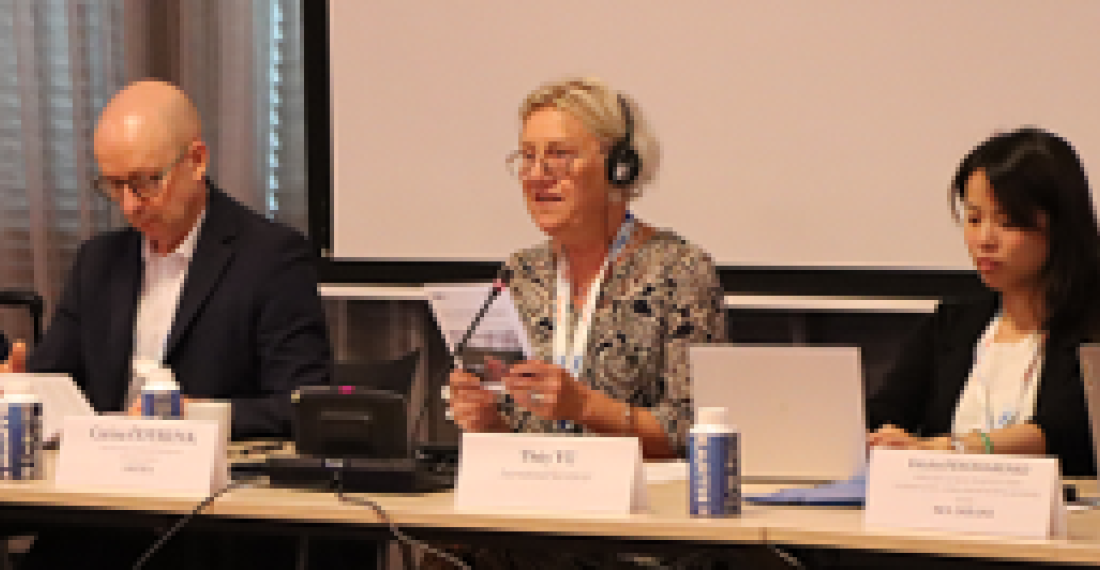
The OSCE Parliamentary Assembly held a high‑level side event today on the abductions, forcible transfers and deportations of Ukrainian children, a practice repeatedly condemned by the Assembly as a grave violation of international law. Hosted and moderated by Carina Ödebrink, OSCE PA Special Envoy for the return of Ukrainian children, the event took place during the Assembly’s Annual Session in The Hague.
The side event featured the first public presentation of the Special Envoy’s 2026 report, which reviews progress on the 2025 recommendations and introduced new proposals for 2026–2027.
Since Russia’s full‑scale invasion of Ukraine in February 2022, the report notes, thousands of Ukrainian children have been unlawfully displaced to the Russian Federation or temporarily occupied territories, raising serious concerns under international humanitarian and human rights law as well as the Genocide Convention. The OSCE PA has consistently addressed these violations in its declarations since 2022, calling for accountability and the immediate, safe return of all impacted children.
Special Envoy Ödebrink’s 2026 report reveals that, despite increased international engagement, the situation of deported and forcibly transferred Ukrainian children has not improved and returns remained very limited. It documents ongoing forced adoptions, identity changes, indoctrination and Russification, stressing that children have been “deprived of their right to identity, language, culture and heritage.” It also notes that more than one and a half million children in Russian‑occupied territories continued to face daily propaganda, militarization and severe restrictions on their rights.
The report identifies major obstacles to return, including Russia’s refusal to share information and the alteration of children’s personal data, making identification extremely difficult. It warned that prolonged separation weakened children’s connection to Ukraine and called for long‑term, trauma‑informed reintegration support. It highlights international rehabilitation initiatives — such as centers in Lithuania and Estonia — as effective examples of co-ordinated assistance.
Today’s event featured remarks by Special Envoy Ödebrink, Dmytro Ponomarenko, Ambassador‑at‑Large of Ukraine for the release of POWs, civilians, and missing persons, and Hugh Adsett, Ambassador of Canada to the Netherlands. Special Envoy Ödebrink presented her 2026 Report, followed by interventions from UN Under‑Secretary‑General Vanessa Frazier, Yasemin Cag of the European Court of Human Rights, Marie‑Jeanne Sardachti of the International Criminal Court, and Nataliia Pipa, Member of the Verkhovna Rada of Ukraine. A moderated discussion and Q&A allowed participants to identify concrete avenues for strengthened co-operation.
The OSCE has played a central role in documenting violations against Ukrainian children. Two OSCE Moscow Mechanism missions, invoked in 2023 and 2026, concluded that the forcible transfer and deportation of Ukrainian children may constitute war crimes and potentially crimes against humanity. Their findings remained authoritative reference points for accountability efforts.
This event also built on the Special Envoy’s recent engagement at the Council of Europe in Strasbourg, where on 2 July she participated in a tripartite exchange of views alongside Thórdís Kolbrún Reykfjord Gylfadóttir, Special Envoy of the Secretary General of the Council of Europe on the situation of children of Ukraine, and UN Under‑Secretary‑General Vanessa Frazier. The discussions, held during the 10th Plenary meeting of the Council of Europe’s Consultation Group on the Children of Ukraine (CGU), focused on strengthening co-ordinated responses to the challenges faced by war‑affected Ukrainian children, including accountability, protection, and long‑term support. Her participation underscored the OSCE PA’s sustained engagement across institutions and its commitment to advancing practical, co-ordinated action.
By presenting the 2026 Special Envoy Report and convening key institutional partners, the OSCE PA reaffirmed its commitment to protecting children affected by war, upholding international law, and advancing co-ordinated international efforts to secure the safe return of every Ukrainian child unlawfully displaced.
To read the full version of Special Envoy Ödebrink’s 2026 report, please click here.
source: Commonspace.eu with OSCE PA (Copenhagen)