


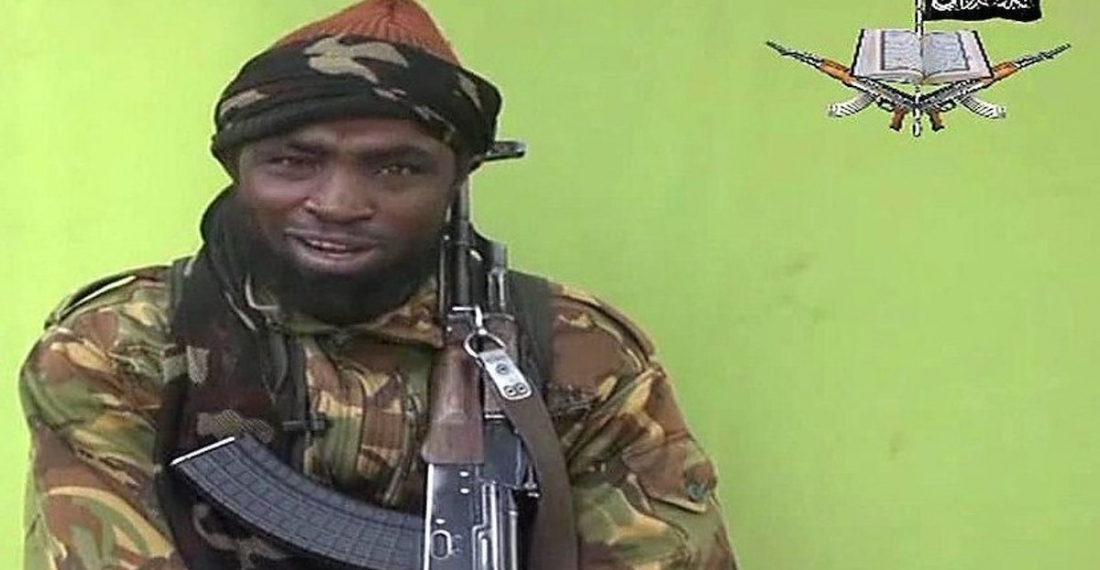
Nigeria’s Boko Haram leader is dead, says rival jihadist group ISWAP

Abubakar Shekau, the leader of the Nigerian militant group, Boko Haram, has committed suicide fighting against the rival jihadist group, the Islamic State's West Africa Province (ISWAP), the latter's leader reported in an audio recording released two weeks after initial reports of his death.

He was reportedly killed around 18 May after setting off a suicide explosive when pursued by ISWAP fighters following fighting. 

"Shekau preferred humiliation in the afterlife to humiliation on Earth," declares a voice appearing to be that of ISWAP leader, Abu Musab Al-Barnawi, in this recording given to Agence-France Presse (AFP) by a source that commonly relays the group's messages.

In the recording, ISWAP describes how its troops, sent to the Boko Haram-controlled enclave in Sambisa Forest, discovered Shekau sitting in his house and started fighting. The voice in the recording claims Shekau retreated and escaped, wandering through the bush for five days whilst being hunted down by ISWAP fighters.

After flushing him out in the bush, ISWAP’s fighters reportedly called on him and his followers to repent, but Shekau refused and killed himself, the speaker continued. "We are so happy," said the voice, adding that Shekau is "someone who has been guilty of unimaginable terrorism and atrocities."

Neither Boko Haram nor the Nigerian army have confirmed this death. Nor has the United States, which had offered $7 million for his capture. The Nigerian army says it is investigating.

Boko Haram is a jihadist terrorist organisation that gained international attention after abducting more than 270 schoolgirls from Nigeria’s Chibok town in 2014. ISWAP was previously a part of Boko Haram but split in 2016 and pledged its allegiance to the Islamic State. After gaining strength, it is now the dominant jihadist group in north-eastern Nigeria.
 

source: commonspace.eu with agencies
photo: Abubakar Shekau in a video screenshot; YouTube

Related articles

Editor's choice
News
Russian attacks on Kyiv and other Ukrainian cities highlights need of strengthening European resolve

Russian attacks on Kyiv and other Ukrainian cities highlights need of strengthening European resolve

Ukrainian President Volodymyr Zelensky condemned the attack, writing on X that it proved that US and European sanctions against Russia should not be weakened. Russia launched more than 700 drones and missiles at Ukraine in multiple waves overnight from Wednesday to Thursday, killing at least 18 people in what local officials said was the deadliest attack in months. Ukraine's air force said on Thursday morning that Russia had launched 659 drones and 44 cruise and ballistic missiles in the prior 24 hours. It said that 636 drones and 31 missiles had been shot down - but there had been direct hits in 26 locations. (click picture to read more)

Popular

Editor's choice
Interview
Thursday Interview: Murad Muradov

Thursday Interview: Murad Muradov

Today, commonspace.eu starts a new regular weekly series. THURSDAY INTERVIEW, conducted by Lauri Nikulainen, will host  persons who are thinkers, opinion shapers, and implementors in their countries and spheres. We start the series with an interview with Murad Muradov, a leading person in Azerbaijan's think tank community. He is also the first co-chair of the Action Committee for a new Armenian-Azerbaijani Dialogue. Last September he made history by being the first Azerbaijani civil society activist to visit Armenia after the 44 day war, and the start of the peace process. Speaking about this visit Murad Muradov said: "My experience was largely positive. My negative expectations luckily didn’t play out. The discussions were respectful, the panel format bringing together experts from Armenia, Azerbaijan, and Turkey was particularly valuable during the NATO Rose-Roth Seminar in Yerevan, and media coverage, while varied in tone, remained largely constructive. Some media outlets though attempted to represent me as more of a government mouthpiece than an independent expert, which was totally misleading.  Overall, I see these initiatives as important steps in rebuilding trust and normalising professional engagement. The fact that soon a larger Azerbaijani civil society visits to Armenia followed, reinforces the sense that this process is moving in the right direction." (click the image to read the interview in full)

