Mali suspended from regional organisations, ECOWAS and the African Union, over coup

Last week’s coup in Mali led by Colonel Assimi Goïta – since named transitional president of the country – has been met with severe backlash from both the regional and international communities. Whilst the European Union and France have threatened to impose sanctions on the country, the Economic Community of Western African States (ECOWAS) and the African Union (AU) have both now suspended Mali’s memberships. 

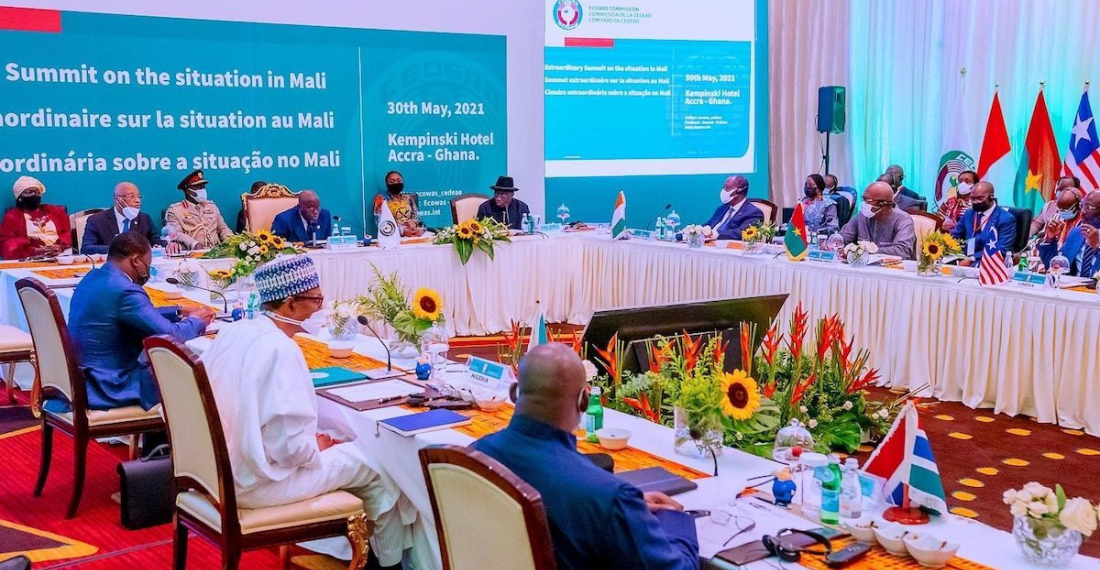
ECOWAS was the first to take the decision on Sunday (May 30). "After long discussions, the heads of state and government have decided to suspend Mali from the institutions of the Community of West African States (ECOWAS)", a press release by the ten heads of state present during an extraordinary summit in Accra stated.

The heads of state called for strict adherence to the transition timetable, that had been adopted last September after the coup of 18 August, and for a civilian prime minister to be appointed with an inclusive government to continue the transition program. However, no economic sanctions have been taken and Colonel Assimi Goïta remains in his post.

Suspension from ECOWAS means that Mali, until further notice, will no longer be able to attend sessions of heads of state, councils of ministers or sessions of the parliament of the sub-regional institution. 

Two days after Mali’s ECOWAS suspension, the AU followed suit and threatened Mali with sanctions were power not returned to the civilian transitional government. Moreover, according to a decision by the AU's Peace and Security Council, laid out in a statement published on Tuesday (1 June) evening, Mali is immediately barred from participating in African Union activities. 

In this statement, the Union said that it was "deeply concerned about the evolving situation in Mali and its negative impact on the gains made thus far in the transition process in the country." It also called for a return to the transition process, the release of all political stakeholders – including the Bah Ndaw and Moctar Ouane, the leaders of the transitional government formed last year, who are under house arrest – and for authorities to respect the 18-month transition period original stipulated in the agreement. 

Furthermore, the AU "strongly urges the Malian military to urgently and unconditionally return to the barracks, and to refrain from further interference in the political processes in Mali." Like much of the international community and civil society groups, the AU urges Mali to give the power back to the civilians to lead the transition. 
 

Source: commonspace.eu with agencies
Photo: ECOWAS emergency summit, Accra, 30 May 2021; Bayo Omoboriowo (President of Nigeria/Official Photographer)

Related articles

Editor's choice
News
Georgian Patriarch buried amid scenes of nation-wide grief

Georgian Patriarch buried amid scenes of nation-wide grief

Catholicos-Patriarch of All Georgia, Ilia II, was was buried in Tbilisi on Sunday (22 March) amid expressions and scenes of nation-wide grief. Crowds filled the Holy Trinity Cathedral, and the route to the Sioni Cathedral where he will be buried, many shouting "We love you, Patriarch".  The service was led by Ecumenical Patriarch, His Holiness Bartholomew I, together with Metropolitan Shio and members of the Holy Synod of the Georgian Church. Soldiers lined the route from Trinity Cathedral to Sion Cathedral, but tens of thousands of people were also present Ilia II died on March 17. Since March 18, his body has been laying in state in the Trinity Cathedral where thousands of citizens paid tribute. During these days, the flow of people who wanted to say goodbye to the Patriarch flowed to the cathedral continuously, 24 hours a day. Citizens often had to stand in a queue for several hours to enter the cathedral.   Read the Obituary of Ilia II,  written by Dennis Sammut at  Read the Obituary of Ilia II,  written by Dennis Sammut here  Read the Obituary of Ilia II,  written by Dennis Sammut here   https://www.commonspace.eu/node/13740

Popular

Editor's choice
Interview
Thursday Interview: Murad Muradov

Thursday Interview: Murad Muradov

Today, commonspace.eu starts a new regular weekly series. THURSDAY INTERVIEW, conducted by Lauri Nikulainen, will host  persons who are thinkers, opinion shapers, and implementors in their countries and spheres. We start the series with an interview with Murad Muradov, a leading person in Azerbaijan's think tank community. He is also the first co-chair of the Action Committee for a new Armenian-Azerbaijani Dialogue. Last September he made history by being the first Azerbaijani civil society activist to visit Armenia after the 44 day war, and the start of the peace process. Speaking about this visit Murad Muradov said: "My experience was largely positive. My negative expectations luckily didn’t play out. The discussions were respectful, the panel format bringing together experts from Armenia, Azerbaijan, and Turkey was particularly valuable during the NATO Rose-Roth Seminar in Yerevan, and media coverage, while varied in tone, remained largely constructive. Some media outlets though attempted to represent me as more of a government mouthpiece than an independent expert, which was totally misleading.  Overall, I see these initiatives as important steps in rebuilding trust and normalising professional engagement. The fact that soon a larger Azerbaijani civil society visits to Armenia followed, reinforces the sense that this process is moving in the right direction." (click the image to read the interview in full)