


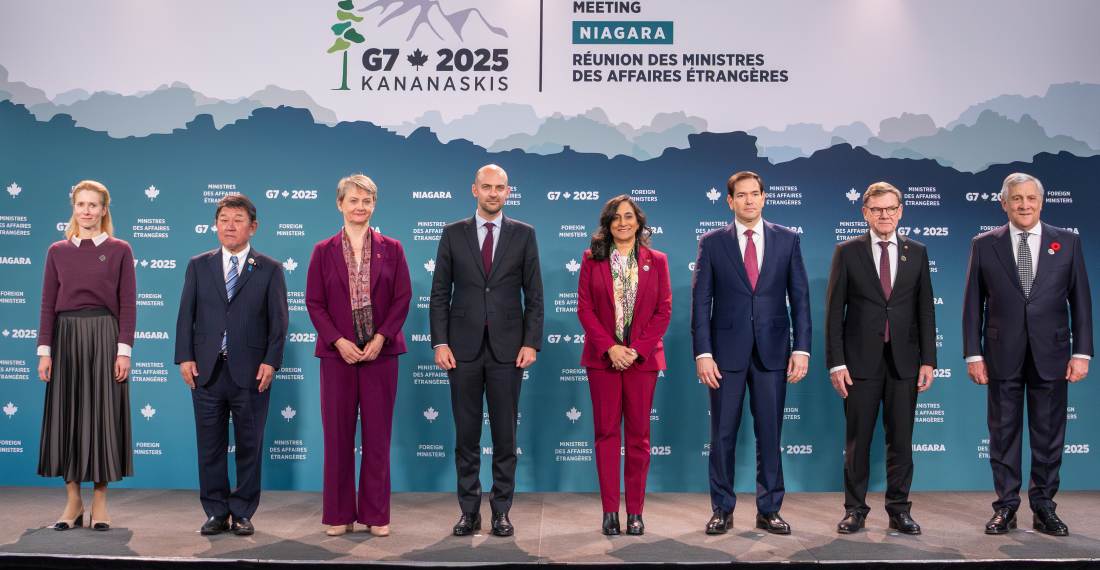
The Foreign Ministers of Canada, France, Germany, Italy, Japan, the United Kingdom, and the United States of America, and the High Representative of the European Union, met under Canada’s G7 Presidency, in Niagara, on November 11-12, 2025.
The Foreign Ministers of Brazil, India, the Kingdom of Saudi Arabia, Mexico, the Republic of Korea, South Africa, and Ukraine, also joined the meeting for discussions on maritime security and prosperity, critical minerals, economic resilience and energy security.
At the end of their meeting the G7 foreign ministers said:
Ukraine’s long-term prosperity, security and defence
We reaffirmed our unwavering support for Ukraine in defending its territorial integrity and right to exist, and its freedom, sovereignty, and independence.
We reiterated that an immediate ceasefire is urgently needed. We agreed that the current line of contact should be the starting point of negotiations. We remain committed to the principle that international borders must not be changed by force.
We are increasing the economic costs to Russia, and exploring measures against countries and entities that are helping finance Russia’s war efforts.
We condemned the provision to Russia of military assistance by DPRK and Iran, and the provision of weapons and dual-use components by China, a decisive enabler of Russia’s war.
We acknowledged the ongoing discussions on a wide range of financing options, including further leveraging immobilised Russian Sovereign Assets in our jurisdictions in a coordinated way to support Ukraine.
We strongly condemned Russia’s recent direct attacks on energy infrastructure and reaffirmed our support for Ukraine’s energy security.
Peace and stability in the Middle East
We reiterated our strong support for President Trump’s Comprehensive Plan to End the Gaza Conflict. We welcomed the ceasefire and the release of hostages. We stressed the urgency of returning the remains of deceased hostages. We also welcomed the increased flows of aid, but expressed concern about restrictions that remain in place. We called on all parties to allow for humanitarian assistance without interference at scale, through the United Nations and its agencies, and the Red Crescent, in addition to other international institutions and INGOs, as stipulated in President Trump’s plan.
It is vital that all parties continue to engage constructively on the next steps outlined in the Comprehensive Plan, in pursuit of a political horizon for peaceful and prosperous co-existence for the Israeli and Palestinian peoples that advances comprehensive Middle East peace and stability. We will also continue to maintain attention on the situation in the West Bank.
We urged Iran to fully implement its obligations both under UN Security Council resolutions and the Treaty on the Non-Proliferation of Nuclear Weapons. Iran must resume full cooperation with the International Atomic Energy Agency, including enabling inspections of all nuclear facilities and materials. We called on Iran to engage in direct talks with the United States, supported by the E3. We continue to call on all UN member states to adhere to their obligations following the legal implementation of the snapback mechanism.
Regional security and prosperity across the Indo-Pacific
We reaffirmed the importance of a free and open Indo-Pacific based on the rule of law. We reiterated our strong opposition to any unilateral attempts to change the status quo in particular by force or coercion, including in the East China Sea and the South China Sea.
We expressed serious concern over the use of dangerous maneuvers and water cannons in the South China Sea, as well as efforts to restrict freedom of navigation and overflight through militarization and coercion in the South China Sea. We reiterated that the award rendered by the Arbitral Tribunal on 12 July 2016 is a significant milestone, binding upon the parties.
We emphasized the importance of maintaining peace and stability across the Taiwan Strait, and opposed any unilateral attempts to change the status quo, particularly by force or coercion. We encouraged the peaceful resolution of cross-Strait issues through constructive dialogue. We also expressed support for Taiwan’s meaningful participation in appropriate international organizations.
We remain concerned about China’s military build-up and rapid increase of nuclear weapons arsenal and call on Beijing to demonstrate its commitment to stability through improved transparency.
We strongly condemned the DPRK’s nuclear and ballistic missile programs and reaffirmed our commitment to the complete denuclearization of the DPRK, in accordance with relevant UN Security Council Resolutions. We expressed grave concern over the DPRK’s cryptocurrency thefts. We urged DPRK to resolve the abductions issue expeditiously.
Haiti
We stressed the need for voluntary personnel and financial contributions to implement UNSC Resolution 2793. We urged the Haitian authorities to present a concrete plan and timeline toward free and fair elections. We welcomed the launch of a Regional Maritime Security Initiative to address transnational organized crime and foster greater stability and resilience in Haiti and the Caribbean through improved maritime security.
Sudan
We strongly condemned the recent escalation of violence and attacks that are often ethnically-motivated, by the Rapid Support Forces (RSF) against unarmed civilians and aid workers, particularly in El Fasher and North Kordofan. We deplore the devastating impact of this war on civilians including the famine that has led to the world’s largest humanitarian crisis. We unequivocally condemn sexual violence. We urged the Rapid Support Forces (RSF) and Sudanese Armed Forces (SAF) to respect human rights, de-escalate, commit to an immediate and permanent ceasefire, and ensure rapid and unimpeded passage of humanitarian assistance. We expressed our support for diplomatic efforts underway to restore peace and security and called upon external actors to contribute to that end.
Eastern DRC
We remain deeply concerned by ongoing violence and reports of human rights violations in eastern DRC, including conflict-related sexual violence. We called on all parties to protect civilians and facilitate humanitarian access. We urged all parties to engage in good faith in the peace process, to deliver lasting peace and security, in line with UNSC Resolution 2773. We called on parties to uphold commitments to fully implement the June 27 Peace Agreement and July 19 Declaration of Principles. We welcomed the Paris Conference on peace and stability in the Great Lakes region, held on October 30, 2025.
Migration and economic security
We noted the serious impact of conflict and instability on affected countries and regions, as well as on broader regional and international security, undermining growth and development, lessening opportunity and driving displacement and irregular migration. We committed to take up these issues at a future G7 Foreign Ministers’ Meeting.
Maritime security and prosperity
Maritime security and prosperity are fundamental to global stability, economic resilience, and the well-being of all nations. We reaffirm the principles reflected in the United Nations Convention of the Law of the Sea.
We recalled the G7 Foreign Ministers’ Declaration on Maritime Security and Prosperity, adopted in Charlevoix, Quebec on March 14, 2025. We welcomed the work carried out by the members of the G7 NB8++ Shadow Fleet Task Force.
We reiterated our commitment to strengthen G7 coordination with partners to prevent the use of unregistered or fraudulently registered, uninsured and substandard vessels engaged in sanctions evasion, risky navigation practices, arms transfers, illegal, unreported and unregulated fishing, illicit trade, and maritime crime.
We reaffirmed our shared commitment to address hybrid threats, including activity against critical undersea infrastructure, and to strengthening partnership in securing maritime ports and routes against the trafficking of illegal drugs.
Economic resilience, energy security and critical minerals
Building on the G7 Critical Minerals Action Plan, the G7 Roadmap to promote standards-based markets for critical minerals and the Production Alliance, we are pursuing partnerships that drive economic development, innovation, resilient and sustainable supply chains, and shared prosperity and security beyond the G7.
We expressed particular concern with the use of non-market policies and practices to disrupt critical minerals supply chains, as well as other forms of market distortions including overcapacity. In this regard, we welcome the results of the recent U.S. – China discussions and discourage any future policy impediments to predictable trade, including in critical minerals.
G7 members agreed to pursue concrete initiatives, jointly with partners, to address vulnerabilities by reducing our dependencies, and strengthening our collective economic resilience and security.
source: commonspace.eu



