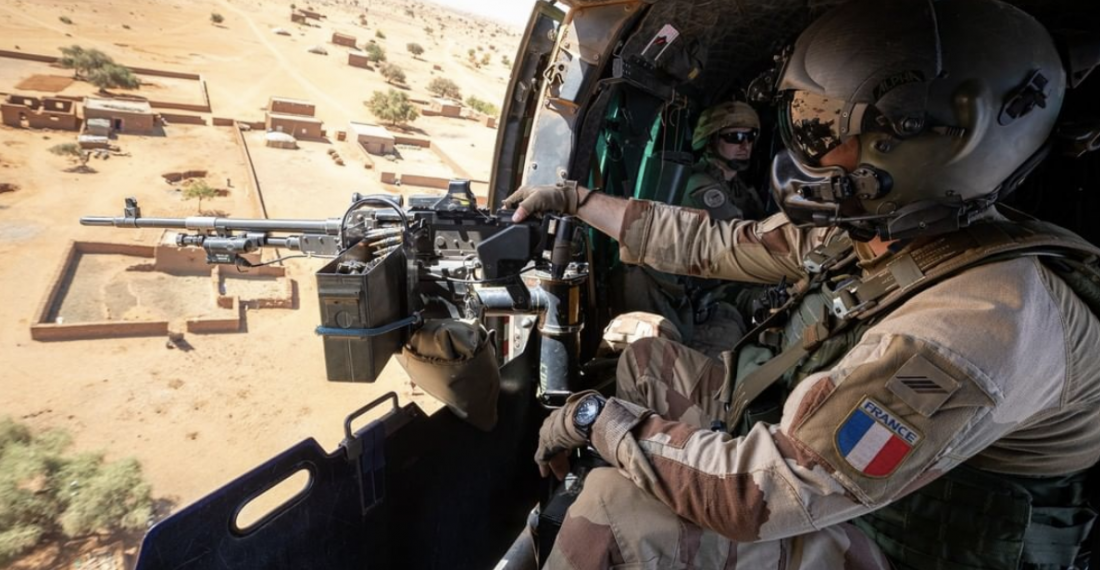
France "has decided to suspend joint military operations with Malian forces," the French Ministry of the Armed Forces announced on Thursday (3 June) after the recent coup d'état on 24 May – the second one in only nine months.
France had already threatened sanctions and the withdrawal of its troops from Mali following the coup which brought to power Colonel Assimi Goïta. The French republic has now gone from threat to action, choosing to suspend "as a precautionary and temporary measure" its bilateral military co-operation with the Sahel country. This decision leads to a sine die stop of the joint operations carried out by the soldiers of the French force, "Barkhane", with the Malian Armed Forces.
France’s president, Emmanuel Macron, had mentioned earlier in the week that the French army could not fight terrorism in the Sahel on its own and that its presence on the ground required the strengthening of stable and legitimate institutions. The head of state announced on Sunday (30 May) that he would "not stay by the side of a country where there is no longer democratic legitimacy or transition", and therefore urged the Malian military to give the power back to its civilians to lead the transition.
The decision to suspend its military co-operation with Mali also results in the halting of training activities carried out by the French with the Malian military and security forces. "These decisions will be reassessed in the coming days in the light of the answers that will be provided by the Malian authorities", the French Ministry of the Armed Forces announced on Thursday.
The Malian army is thus cut off from two of its main supporters: France and the United States. In the aftermath of the putsch, the Americans announced the suspension of their assistance to the Malian forces. Moreover, Mali’s membership from the Economic Community of Western African States (ECOWAS) and the African Union (AU) has also been suspended on 30 May and 2 June respectively.
"Requirements and red lines have been set by the ECOWAS and by the AU to clarify the framework of the political transition in Mali", underlined the ministry in the press release, adding that “It is up to the Malian authorities to respond quickly".