


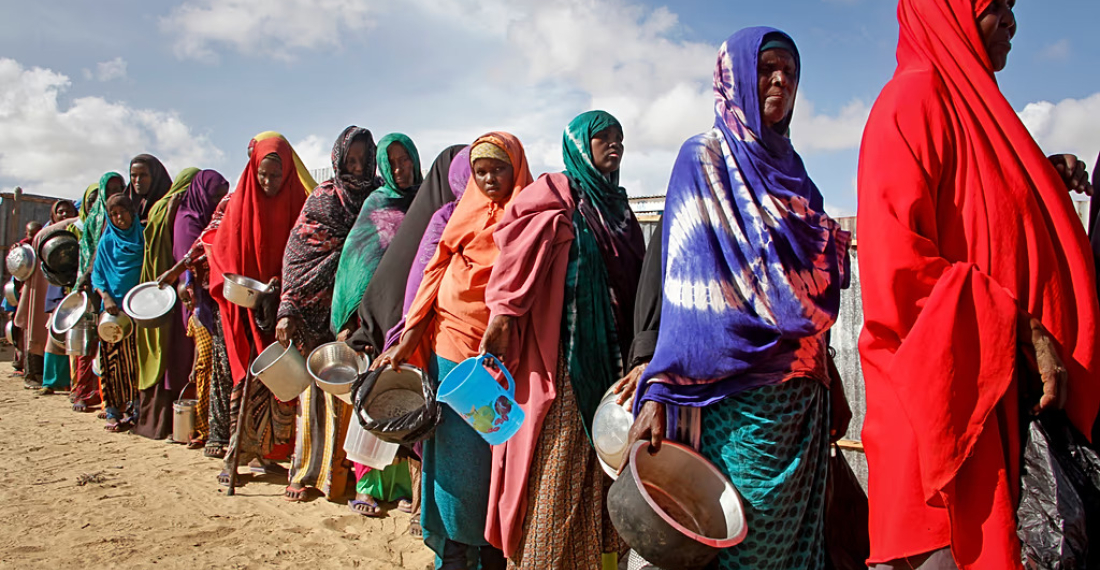
Food insecurity in Somalia has nearly doubled in the past year

Integrated Food Security Phase Classification (IPC), a United Nations-backed group that monitors hunger and malnutrition, says that the number of Somalians classified as being in a "crisis or worse… has nearly doubled between February–March 2026 to a staggering 6.5 million people since early 2025”.

"This alarming deterioration is driven by worsening drought, rising food prices, and insecurity across central, southern, and parts of northern Somalia," the report added.

"The situation is compounded by declining humanitarian assistance."

UN agencies, for example, have warned of funding shortfalls since Washington slashed aid budgets under Donald Trump’s administration. In January, the United States suspended aid to Somalia following the destruction of a US-funded WFP warehouse in the capital Mogadishu's port.

The IPC’s report suggested that a predicted near-normal rainfall from April to June will lead to modest improvements in overall food security. 

Source: commonspace.eu with Agence France-Presse

Related articles

Popular

Editor's choice
Interview
Thursday Interview: Murad Muradov

Thursday Interview: Murad Muradov

Today, commonspace.eu starts a new regular weekly series. THURSDAY INTERVIEW, conducted by Lauri Nikulainen, will host  persons who are thinkers, opinion shapers, and implementors in their countries and spheres. We start the series with an interview with Murad Muradov, a leading person in Azerbaijan's think tank community. He is also the first co-chair of the Action Committee for a new Armenian-Azerbaijani Dialogue. Last September he made history by being the first Azerbaijani civil society activist to visit Armenia after the 44 day war, and the start of the peace process. Speaking about this visit Murad Muradov said: "My experience was largely positive. My negative expectations luckily didn’t play out. The discussions were respectful, the panel format bringing together experts from Armenia, Azerbaijan, and Turkey was particularly valuable during the NATO Rose-Roth Seminar in Yerevan, and media coverage, while varied in tone, remained largely constructive. Some media outlets though attempted to represent me as more of a government mouthpiece than an independent expert, which was totally misleading.  Overall, I see these initiatives as important steps in rebuilding trust and normalising professional engagement. The fact that soon a larger Azerbaijani civil society visits to Armenia followed, reinforces the sense that this process is moving in the right direction." (click the image to read the interview in full)


