


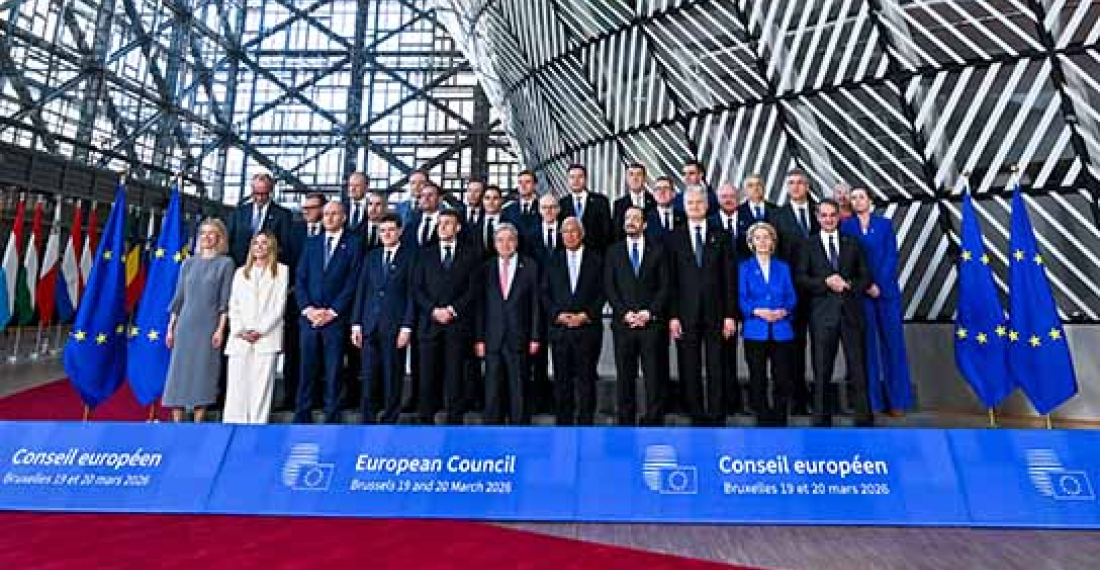
The leaders of the 27 member states of the European Union met in Brussels on Thursday, 19 March 2026, to discuss the current global situation, and, in particular, the crisis in the Gulf, and the wider Middle East.
EU leaders adopted conclusions on Ukraine, the Middle East, competitiveness and the single market, European defence and security, migration, multilateralism, strengthening Europe's democratic resilience, protecting children online, the EU's eastern regions and Dniester river.
The leaders also met UN Secretary-General António Guterres to discuss the geopolitical situation and multilateralism.
The EU leaders adopted a decision on the position of the EU in the present situation. It says,
Developments in Iran and the wider region threaten regional and global security. The European Council calls for de-escalation and maximum restraint, the protection of civilians and civilian infrastructure and full respect of international law by all parties, including the principles of the United Nations Charter and international humanitarian law. In this regard, it calls for a moratorium on strikes against energy and water facilities.
The European Council deplores the loss of civilian life and is closely monitoring the far-reaching impact of the hostilities, including on economic stability. Conclusions – 19 March 2026 EUCO 1/26 2 EN 5. The European Council strongly condemns Iran’s indiscriminate military strikes against countries in the region and expresses its solidarity with countries affected. It calls on Iran and its proxies to immediately cease these attacks and respect the sovereignty and territorial integrity of countries in the region, in line with UN Security Council Resolution (UNSCR) 2817, which should be fully implemented.
The European Council underlines the importance of concerted action to help partners strengthen counter-drone and air defence capabilities. In that context, it welcomes Ukraine’s readiness to provide support and expertise in air defence and counter-drone systems to Gulf countries.
The European Union stands firmly and unequivocally in support of Member States close to the region. It welcomes the support provided by Member States in this regard, in particular through the deployment of military assets in the Eastern Mediterranean and in support of Cyprus. The European Council acknowledges the intention of Cyprus to initiate a discussion with the UK on the UK bases in Cyprus and stands ready to provide assistance as needed.
The European Council recalls the need to safeguard regional airspace and ensure maritime security and respect for the freedom of navigation, and condemns any acts that threaten navigation or prevent vessels from entering and exiting the Strait of Hormuz.
The European Council highlights the role of the EU maritime defensive operations EUNAVFOR ASPIDES and EUNAVFOR ATALANTA, and calls for their reinforcement with more assets, in line with their respective mandates.
The European Council also welcomes the increased efforts announced by Member States, including through strengthened coordination with partners in the region, to ensure freedom of navigation in the Strait of Hormuz, once the conditions are met. Conclusions – 19 March 2026 EUCO 1/26 3 EN
The European Union will continue to protect its security and interests, working with regional and global partners to counter the impact of the ongoing hostilities. The European Union and its Member States are taking all necessary steps to ensure the safety of EU citizens in the region, including by providing conditions for their safe departure.
The European Council invites the Commission to continue to report to the Council on the potential impact of recent developments for the EU in terms of energy security and energy prices, supply chains and migration, and to propose measures as appropriate. It also calls for coordination at EU level, including on the possible impact on internal security.
While the conflict has not translated into immediate migratory flows towards the European Union, the European Council underlines the importance of maintaining a high level of vigilance and ensuring the necessary level of preparedness, based on the tools and policies that the EU developed over the past years. On the basis of the lessons learned from the 2015 migration crisis and to avoid a similar situation, the EU is ready to fully mobilise its diplomatic, legal, operational and financial tools to prevent uncontrolled migratory movements to the EU and preserve security in Europe. The security and the control of the European Union’s external borders will continue to be strengthened. The European Council stresses the importance of working with partners in the region to ensure that they receive the necessary assistance and support.
The European Union will continue to engage with partners in the region to contribute to de-escalation and regional stability. It stands ready to contribute to all diplomatic efforts to reduce tensions and to bring about a lasting solution to end the hostilities, prevent Iran from acquiring a nuclear weapon and put an end to its destabilising activities, including its ballistic missile programme. Conclusions – 19 March 2026 EUCO 1/26 4 EN
The European Council reiterates that Iran must never be allowed to acquire a nuclear weapon and that it must comply with its legally binding nuclear safeguard obligations under the Non-Proliferation Treaty. The European Council urges Iran to resume full cooperation with the International Atomic Energy Agency.
The European Council calls on the Iranian regime to cease the violence and repression against its own people. It calls for the respect of the universal human rights and fundamental freedoms of the Iranian people, including the right to choose their own future.
The European Council also discussed the deteriorating situation in Gaza and the West Bank
source: commonspace.eu with the Council of the European Union



