


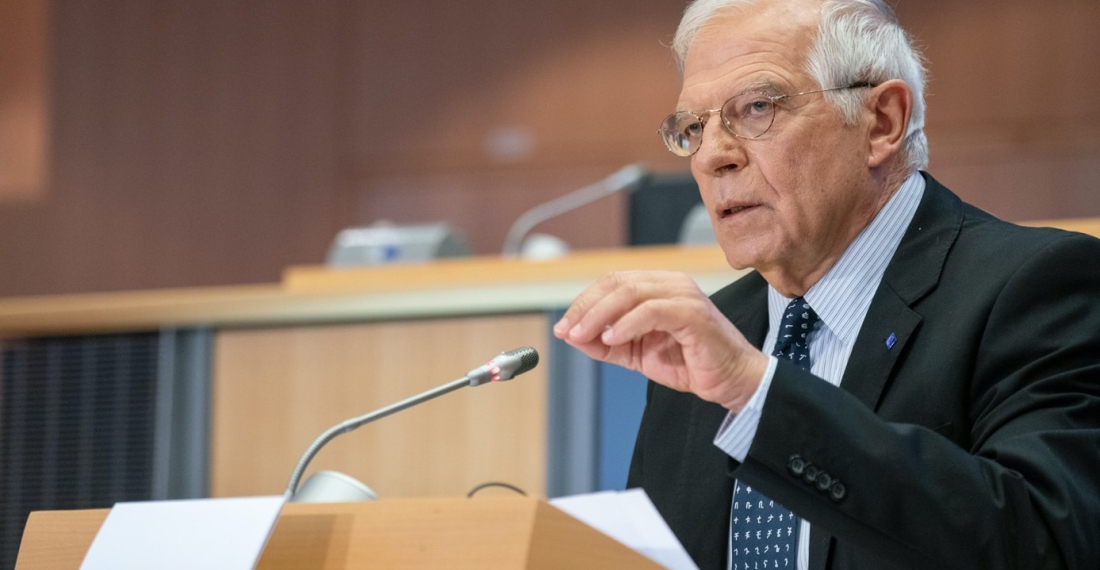
EU concerned at situation in the Balkans amid tension between Kosovo and Serbia

EU High Representative for Foreign and Security Policy, Josep Borrell, has expressed concern at recent developments in the Balkans amid increasing tensions between Kosovo and Serbia.

Borrell, who is currently on an official visit to Abu Dhabi where he is participating in the 2022 Sir Bani Yas Forum, on Saturday (5 November) spoke with Serbian president, Alexander Vucic, and Kosovar Prime Minister, Albin Kurti,

A statement issued later by the European Extern Action Service, said:

"The recent developments in the relations between Kosovo and Serbia put years of hard work and achievements reached under the EU-facilitated Dialogue between Belgrade and Pristina at risk and hamper the security situation in the region and beyond.

The European Union calls both sides to refrain from any unilateral actions, which might lead to further tensions.

The withdrawal of Kosovo Serbs from Kosovo institutions is not a solution to the current disputes. It has the potential to further escalate the tensions on the ground.

We call on Serbia and Kosovo Serb representatives to respect their Dialogue obligations and return to the Kosovo institutions to fulfil their duties, including in the Police, Judiciary and local administrations. 

At the same time, the EU again urges Kosovo authorities to respect their own obligations without delay. This means immediately extending the process of re-registration of vehicles and suspending any punitive action against KM plate holders. The licence plates issue can be resolved by the Parties under the Dialogue.

The EU also calls on Kosovo to start immediately steps to establish the Association/Community of Serb Majority Municipalities. The Kosovo Assembly has ratified the Brussels Agreement and Kosovo’s Constitutional Court ruled that the Association/Community needs to be established. Therefore, its establishment is a binding legal obligation for Kosovo. Continued failure to implement this obligation undermines the principle of Rule of Law and damages Kosovo’s reputation and credibility.

It is the responsibility of the Parties to ensure peace and stability. Any actions, such as burning of cars, or intimidating rhetoric that could lead to tensions, are unacceptable and will trigger an appropriate reaction by the international community.

In close coordination with NATO/KFOR and the Kosovo Police, the EU Rule of Law Mission (EULEX) is standing ready to ensure stability on the ground in Kosovo in its role as second security responder. EULEX and KFOR will continue supporting to maintain a safe and secure environment in line with their respective mandates.

The EU urges the Parties to choose the path of Dialogue in earnest, and refrain from any action that would lead to violence and confrontation. The EU stands ready to continue to facilitate negotiations, but both Parties need to show readiness to seek solutions in a constructive manner and respect their obligations made in the Dialogue."
source commonspace e.u with the press service of the EEAS.
photo: EU High Representative Josep Borrell

Related articles

Editor's choice
News
Russia adds pressure on Armenia ahead of key elections; recalls Ambassador in Yerevan for consultations

Russia adds pressure on Armenia ahead of key elections; recalls Ambassador in Yerevan for consultations

Ahead of key parliamentary elections,scheduled to be held in Armenia on Sunday, 7 June, Russia continues to attempt to put pressure on the Armenian Government led by prime minister Nikol Pashinyan. On 30 May, Russia recalled its Ambassador to Yerevan for consultations. A terse statement, published on the website of the Russian Foreign Ministry, said, "The Ambassador of the Russian Federation to the Republic of Armenia , S.P. Kopyrkin, has been summoned to Moscow for consultations in connection with the steps taken by the Armenian leadership to move closer to the European Union, which are detrimental to cooperation within the EAEU." This followed a statement issued the day before, by the leaders of the Eurasian Economic Union (EAEU) that challenges the Armenian trajectory towards approximating to the European Union. Vladimir Putin is undertood to have personally pushed the other four EAEU leaders to issue the statement, which said: "Taking into account the significant risks to the economic security of the member states of the Eurasian Economic Union (hereinafter referred to as the Union) arising in connection with the preparation of the Republic of Armenia for accession to the European Union, as well as the need to prevent the associated damage to the member states of the Union: decided that the members of the Eurasian Intergovernmental Council from the Republic of Belarus, the Republic of Kazakhstan, the Kyrgyz Republic and the Russian Federation will report at the next meeting of the Supreme Eurasian Economic Council in December 2026 on the possible consequences of the suspension of the Treaty on the Eurasian Economic Union with respect to the Republic of Armenia. We share the position on the need to hold a national referendum in the Republic of Armenia as soon as possible on joining the European Union or continuing to be part of the Eurasian Economic Union."

Popular

Editor's choice
Interview
Thursday Interview: Murad Muradov

Thursday Interview: Murad Muradov

Today, commonspace.eu starts a new regular weekly series. THURSDAY INTERVIEW, conducted by Lauri Nikulainen, will host  persons who are thinkers, opinion shapers, and implementors in their countries and spheres. We start the series with an interview with Murad Muradov, a leading person in Azerbaijan's think tank community. He is also the first co-chair of the Action Committee for a new Armenian-Azerbaijani Dialogue. Last September he made history by being the first Azerbaijani civil society activist to visit Armenia after the 44 day war, and the start of the peace process. Speaking about this visit Murad Muradov said: "My experience was largely positive. My negative expectations luckily didn’t play out. The discussions were respectful, the panel format bringing together experts from Armenia, Azerbaijan, and Turkey was particularly valuable during the NATO Rose-Roth Seminar in Yerevan, and media coverage, while varied in tone, remained largely constructive. Some media outlets though attempted to represent me as more of a government mouthpiece than an independent expert, which was totally misleading.  Overall, I see these initiatives as important steps in rebuilding trust and normalising professional engagement. The fact that soon a larger Azerbaijani civil society visits to Armenia followed, reinforces the sense that this process is moving in the right direction." (click the image to read the interview in full)

