


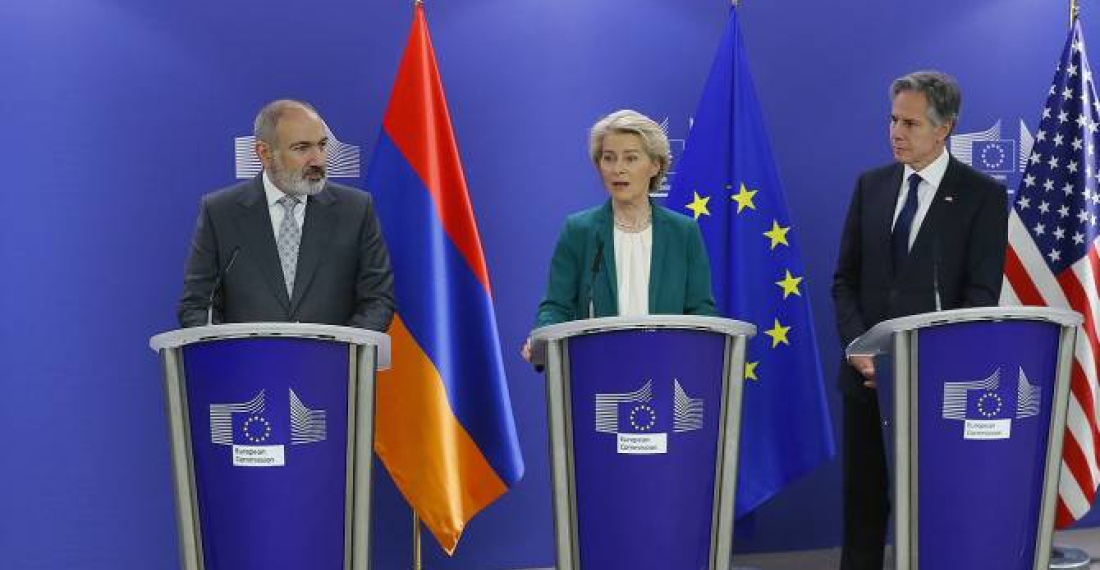
EU and US make a generous financial pledge to Armenia as they affirm their support for its sovereignty, democracy, territorial integrity, and socio-economic resilience

The European Union and the United States have made a generous financial pledge to Armenia and reaffirmed their support for its sovereignty, democracy, territorial integrity, and socio-economic resilience.

President of the European Commission, Ursula von der Leyen, EU High Representative/Vice-President, Josep Borrell, Secretary of State of the United States of America, Antony Blinken, USAID Administrator Samantha Power, and Prime Minister of the Republic of Armenia, Nikol Pashinyan, met today, April 5, 2024 in Brussels to reaffirm support for Armenia's sovereignty, democracy, territorial integrity, and socio-economic resilience.

A statement issued after the end of the meeting said:

"The European Union and the United States support a stable, peaceful, secure, democratic, and prosperous future for Armenia and the region. In this context, we aim to expand cooperation to strengthen Armenia's resilience, including in key sectors such political reforms, economic development and humanitarian support. We will look to expand our partnerships, for example, in mobility, governance, law enforcement, trade, connectivity, agriculture, energy, and technology. The European Union and the United States envisage stronger cooperation with Armenia to support these key sectors.

The European Union and the United States acknowledged the substantial progress Armenia has made since 2018 on democratic and justice reforms and the fight against corruption, and expressed a commitment to continue partnering with and supporting Armenia as it further strengthens its democracy and the rule of law, in line with our shared values and principles.

The EU will continue to support Armenia on its reform path through the implementation of the Comprehensive and Enhanced Partnership Agreement (CEPA). In order to boost reforms and enhance cooperation in all areas, the EU and Armenia will make headway on the new EU-Armenia Partnership Agenda.

The United States is committed to helping Armenia and PM Pashinyan carry out envisioned reforms. The Biden Administration, working with the U.S. Congress, plans to provide over $65 million in fiscal year 2023 development assistance to Armenia.

The European Union and the United States welcomed Armenia's commitment to improved connectivity with the outside world, including the Crossroads of Peace initiative, which would promote shared prosperity and regional economic and trade diversification.

The EU and the US intend to provide further assistance to help the country mitigate risks, diversify its trade, and strengthen its economic and institutional resilience.

To underpin the new EU-Armenia Partnership Agenda, the EU will put forward a EUR 270 million Resilience and Growth Plan for Armenia for the period 2024-2027.

The EU's Resilience and Growth Plan for Armenia will aim at building up Armenia's socio-economic resilience, while supporting trade diversification. It will contribute to the long-term needs of displaced people. It will strengthen sectoral cooperation with Armenia, while stepping up support to regulatory alignment to unlock the full potential of the CEPA. The EU will continue to support key sectors from trade diversification, infrastructure development, and energy, to aviation safety.

President Von der Leyen also referred to the benefits of the Economic and Investment Plan, launched in 2021, which already mobilized over EUR 550 million worth of investments through grants, blending and guarantees in Armenia. In line with the Economic and Investment Plan, the EU's Resilience and Growth Plan will step up support to strategic investments, in particular on connectivity infrastructure in transport, digital and energy, and invest in business development to boost jobs and economic growth. The Economic and Investment Plan has the potential to deliver economic dividends of peace including on regional connectivity, if and when conditions allow. The EU will also look at ways to support mobility.

The United States is working with Armenia in multiple sectors to enhance economic growth and reform, trade diversification and resilience. The United States will work with Armenia to attract further U.S. investment, streamline technology trade opportunities, increase cybersecurity cooperation, and expand technology infrastructure. The United States is committed to Armenia's safe, reliable, and secure energy future and is working to support energy diversification and explore the feasibility of new civil nuclear power options that prioritize the highest nuclear security, safety, and nonproliferation standards. The United States is committed to enhancing Armenia's food security as well as facilitating the flow of agricultural products across Armenia's borders.

Recognizing the continuing challenges that Armenia faces in supporting and socially including over 100,000 displaced persons and refugees, the European Union and the United States intend to continue providing support to Armenia in its efforts to provide housing, training, employment opportunities and psycho-social support to those who need it, and to ensure the dignified living conditions of displaced persons. 

The EU swiftly mobilised EUR 18 million in humanitarian support and EUR 15 million in budget support since September 2023 to respond to the emergency and socio-economic needs of refugees. This brings the total allocation of humanitarian aid to the affected population to EUR 38,4 million since 2020. The EU stands with Armenia in addressing and supporting the long-term needs of refugees. The EU's Resilience and Growth Plan will also include budget support for the long-term economic and social inclusion of displaced people.  

The United States has similarly announced more than $7 million in humanitarian support for displaced persons and refugees since September 2023.  This funding brings total U.S. humanitarian assistance to nearly $31 million since September 2020. The U.S. assistance has provided life-saving food assistance, humanitarian protection, and emergency shelter and will continue to respond to the needs of the displaced persons and refugees. The United States will support Armenia's efforts to minimize the strain on public services and infrastructure, and facilitate social cohesion and economic development.

A prosperous, sovereign, and democratic Armenia that develops its own partnerships and freely sets its own course will contribute to regional stability and prosperity.
source: commonspace.eu with the press service of the European Union
photo: President Ursula von der Leyen with US Secretary of State Blinken and Armenian Prime Minister Pashinyan at their meeting in Brussels on 5 April 2024

Related articles

Editor's choice
News
UAE says it will withdraw from Yemen, but division emerges in Yemeni presidential council

UAE says it will withdraw from Yemen, but division emerges in Yemeni presidential council

In a move seen as an attempt to de-escalate a crises with Saudi Arabia, the United Arab Emirates, on Tuesday (30th December) announced that it was heeding a call to withdraw its troops from Southern Yemen. UAE says that its presence included counter-terrorism teams that were crucial in fighting against Islamist groups. UAE sources said that parts of Yemen not controlled by the Houthis have had Al Qaeda in the Arab Peninsula (AQAP) operatives using the territory to launch attacks on Europe, the US and Middle East. UAE teams have co-ordinated with American and British special forces and intelligence. The sources added that Emirati forces and their Yemeni allies also helped reverse Houthi gains in the south. including the liberation of Aden port. The small UAE contingent has remained in place since the UAE withdrew most of its military personnel in 2019. The leading English-language newspaper in Abu Dhabi, The National, said that the main UAE force was based at Riyan Mukalla International Airport, with access to fixed-wing aircraft and helicopters, but also operated smaller contingents in the port town Balhaf and Shabwa. "It is understood it also flew a number of drones from the airbase that were able to track terrorist movements, pass information back to its allies and assisted special forces' missions." Meanwhile a division has emerged in Yemen's presidential council after four members denounced what they called the 'unilateral decisions' by the chairman. Four of Yemen’s eight Presidential Leadership Council members on Tuesday denounced an announcement by the council’s chairman accusing him of breaching the governing agreement. Tension between Yemeni leaders has been rising for weeks, underscoring the fragility of the country's already fractured political landscape and further complicating efforts to confront the Iran-backed Houthi rebels. The latest rift took an unprecedented turn on Tuesday morning, marked by a Saudi-led coalition “limited operation” striking combat vehicles Riyadh linked to the Southern Transitional Council, which has three members in the PLC. The PLC Chairman, Rashad al Alimi, on Tuesday said that he was seeking to cancel the joint defence agreement with the UAE. “What has been issued … constitutes a clear violation of the Declaration of the Transfer of Power [agreement], which explicitly stipulates that the Presidential Leadership Council is a collective body whose decisions are taken by consensus, or by majority when consensus is not possible,” the statement by the four members said. “It does not, under any circumstances, allow for unilateral decision-making on sovereign, military, or major political matters." The statement was signed by STC chief Aidarous Al Zubaidi, Faraj Al Bahsani, Tariq Saleh and Abu Zaraa al Muharrami. (click the picture to read the full article).

Popular

Editor's choice
News
UAE says it will withdraw from Yemen, but division emerges in Yemeni presidential council

UAE says it will withdraw from Yemen, but division emerges in Yemeni presidential council

In a move seen as an attempt to de-escalate a crises with Saudi Arabia, the United Arab Emirates, on Tuesday (30th December) announced that it was heeding a call to withdraw its troops from Southern Yemen. UAE says that its presence included counter-terrorism teams that were crucial in fighting against Islamist groups. UAE sources said that parts of Yemen not controlled by the Houthis have had Al Qaeda in the Arab Peninsula (AQAP) operatives using the territory to launch attacks on Europe, the US and Middle East. UAE teams have co-ordinated with American and British special forces and intelligence. The sources added that Emirati forces and their Yemeni allies also helped reverse Houthi gains in the south. including the liberation of Aden port. The small UAE contingent has remained in place since the UAE withdrew most of its military personnel in 2019. The leading English-language newspaper in Abu Dhabi, The National, said that the main UAE force was based at Riyan Mukalla International Airport, with access to fixed-wing aircraft and helicopters, but also operated smaller contingents in the port town Balhaf and Shabwa. "It is understood it also flew a number of drones from the airbase that were able to track terrorist movements, pass information back to its allies and assisted special forces' missions." Meanwhile a division has emerged in Yemen's presidential council after four members denounced what they called the 'unilateral decisions' by the chairman. Four of Yemen’s eight Presidential Leadership Council members on Tuesday denounced an announcement by the council’s chairman accusing him of breaching the governing agreement. Tension between Yemeni leaders has been rising for weeks, underscoring the fragility of the country's already fractured political landscape and further complicating efforts to confront the Iran-backed Houthi rebels. The latest rift took an unprecedented turn on Tuesday morning, marked by a Saudi-led coalition “limited operation” striking combat vehicles Riyadh linked to the Southern Transitional Council, which has three members in the PLC. The PLC Chairman, Rashad al Alimi, on Tuesday said that he was seeking to cancel the joint defence agreement with the UAE. “What has been issued … constitutes a clear violation of the Declaration of the Transfer of Power [agreement], which explicitly stipulates that the Presidential Leadership Council is a collective body whose decisions are taken by consensus, or by majority when consensus is not possible,” the statement by the four members said. “It does not, under any circumstances, allow for unilateral decision-making on sovereign, military, or major political matters." The statement was signed by STC chief Aidarous Al Zubaidi, Faraj Al Bahsani, Tariq Saleh and Abu Zaraa al Muharrami. (click the picture to read the full article).

