


Dead and missing after floods in Morocco

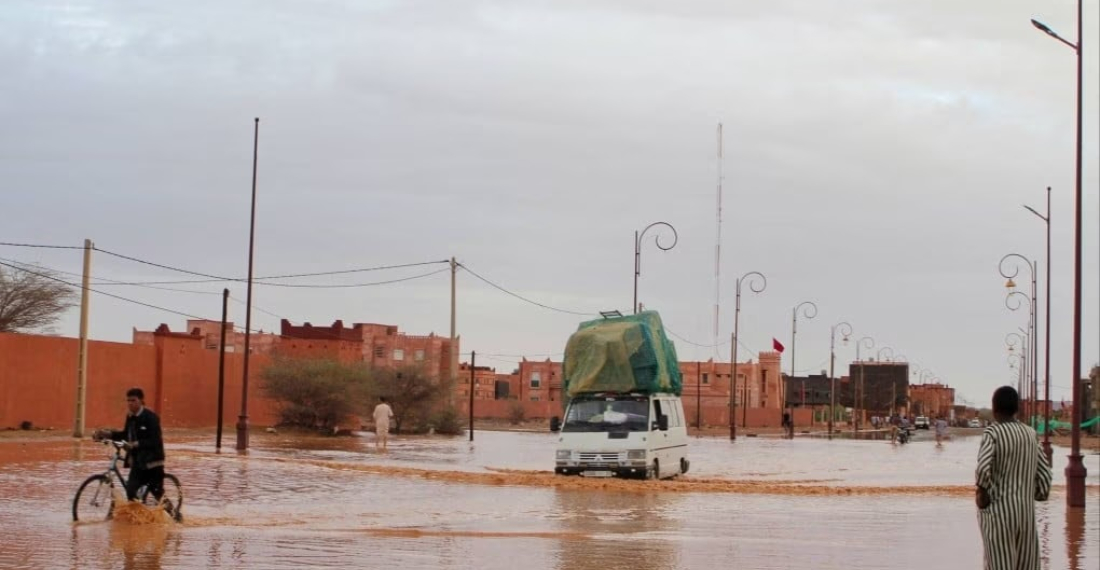
Floods in southern Morocco have killed at least 11 people and left nine missing. The Moroccan interior ministry told the French news agency AFP. One of the dead is a foreigner. It did not say who he was.

Seventeen prefectures and provinces in the south were hit by heavy thunderstorms, causing flooding. Seven people died in the province of Tata and two in the province of Errachidia.

The ministry spoke of an "exceptional" weather phenomenon in the area. "The amount of rain measured in two days is equal to the amount that normally falls in the region in a whole year," a spokesman said. In the province of Ouarzazate, 47 millimetres of rain fell in three hours. In Tagounite, near the Algerian border, 170 millimetres fell, according to the meteorological service.

The floods destroyed 40 houses and damaged 93 roads. Drinking water, electricity and telephone networks have also been affected.

Over the past few days, heavy rains have hit normally dry areas of southern Morocco and Algeria, causing flooding. The heavy rains are due to an "extremely unstable tropical air mass", the head of Morocco's meteorological institute told AFP.
Source: commonspace.eu with AFP and agencies

Related articles

Editor's choice
News
Russia puts pressure on Armenia ahead of Putin-Pashinyan meeting in Bishkek next week

Russia puts pressure on Armenia ahead of Putin-Pashinyan meeting in Bishkek next week

Russian president, Vladimir Putin, and Armenian prime minister, Nikol Pashinyan are expected to meet in Bishkek next week on the margins of the Shanghai Cooperation Organisation. Russian presidential aide Yury Ushakov confirmed this according to the Russian agency, TASS. “We will have a conversation with Armenian Prime Minister Nikol Pashinyan. Our leaders have already spoken following the elections held in Armenia, so it is fairly clear what the conversation will be about,” Ushakov said. He added that, among other issues, the leaders will discuss Yerevan’s aspiration to join the EU and its cooperation with the Eurasian Economic Union. “We continue to insist that Armenia cannot aspire to EU membership while at the same time receiving enormous benefits from its cooperation within the Eurasian Economic Union. This issue must somehow be resolved. And the President and the Prime Minister will undoubtedly discuss it,” Ushakov said. The meeting comes as Russia continues to put unprecedented pressure on Armenia. Using very undiplomatic language, Russian Foreign Ministry spokesperson, Maria Zakharova, on Friday (28 August), called on Pashinyan to stop shifting responsibility for Armenia's problems onto Russia and the CSTO. In 2022, the Armenian Prime Minister personally refused the deployment of the organization's mission, opting instead for Western mediation in Prague, where he officially recognized Karabakh as part of Azerbaijan, recalled the official representative of the Russian Ministry of Foreign Affairs. Yerevan's attempts to blame Moscow, the church, or its own citizens for the consequences of its own decisions are shameless and contradict historical facts, Zakharova emphasized. "Everyone is to blame in your view. Only you are not to blame." "Nikol Vovayevich, elections in your country have ended. You can stop hanging noodles on the ears of your people. Gather your courage and tell the truth at least once, as it actually happened," wrote Russian Foreign Ministry spokesperson Maria Zakharova, addressing Nikol Pashinyan’s statements yesterday. The five-year program of the Armenian government released this week, only speaks of releations with Russia as a "partnership" and omits the previously used term "strategic alliance". Pashinyan told the Armenian parliament this week, "The events of September 2022 took place right before your eyes. A strategic partnership should mean a strategic partnership. If we write 'strategic partnership' in the document now, you will ask why Russia and the CSTO did not fulfill their security obligations in September 2022. What else do I need to tell you?"

Popular

Editor's choice
Interview
Thursday Interview: Murad Muradov

Thursday Interview: Murad Muradov

Today, commonspace.eu starts a new regular weekly series. THURSDAY INTERVIEW, conducted by Lauri Nikulainen, will host  persons who are thinkers, opinion shapers, and implementors in their countries and spheres. We start the series with an interview with Murad Muradov, a leading person in Azerbaijan's think tank community. He is also the first co-chair of the Action Committee for a new Armenian-Azerbaijani Dialogue. Last September he made history by being the first Azerbaijani civil society activist to visit Armenia after the 44 day war, and the start of the peace process. Speaking about this visit Murad Muradov said: "My experience was largely positive. My negative expectations luckily didn’t play out. The discussions were respectful, the panel format bringing together experts from Armenia, Azerbaijan, and Turkey was particularly valuable during the NATO Rose-Roth Seminar in Yerevan, and media coverage, while varied in tone, remained largely constructive. Some media outlets though attempted to represent me as more of a government mouthpiece than an independent expert, which was totally misleading.  Overall, I see these initiatives as important steps in rebuilding trust and normalising professional engagement. The fact that soon a larger Azerbaijani civil society visits to Armenia followed, reinforces the sense that this process is moving in the right direction." (click the image to read the interview in full)

