


Armenian and Azerbaijani experts on confidence-building measures hold 5th plenary meeting in Kachreti

The Joint Armenian-Azerbaijani Liaison Group on Confidence-Building Measures in support of lasting peace in the South Caucasus (JOLIG) held its 5th plenary meeting in Kachreti, Georgia, on Thursday, 31 August 2023.

The Group welcomed the successful conclusion of the 1st South Caucasus Youth Peace Summer School which brought together ten young men and women from across the region for an intensive ten-day programme. The idea of a South Caucasus Peace Summer School was contained in the JOLIG report "The South Caucasus from war to peace: thirty measures between now and 2030", published in April 2022. The members of JOLIG congratulated LINKS Europe for holding the Summer School successfully despite the difficult regional context, and hoped that a similar event can be held in 2024.

The Joint Liaison Group discussed its future work and took appropriate decisions

"The South Caucasus: a region connecting regions"

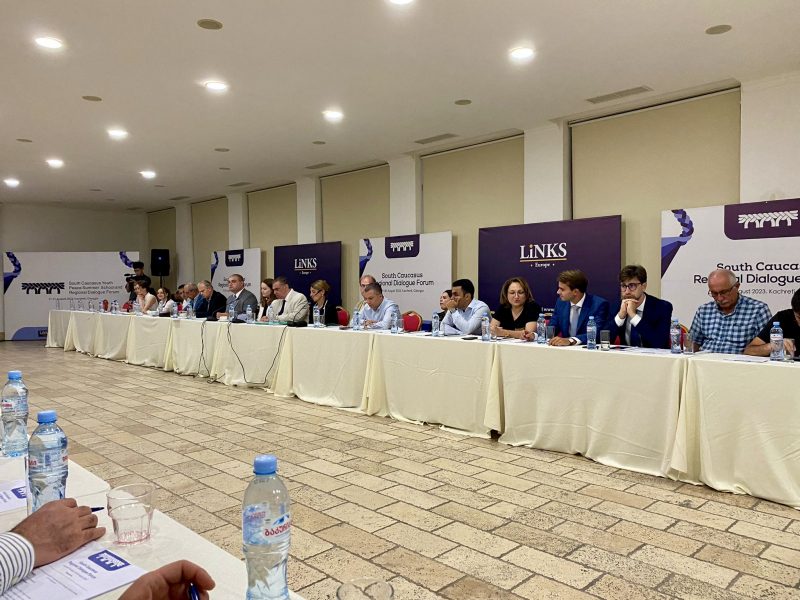
Earlier, members of the Joint Liaison Group took part in the South Caucasus Regional Dialogue Forum in Kachreti, Georgia, on 29-30 August. The Forum, organised by LINKS Europe in cooperation with the Georgian Centre for Strategy and Development was attended by diplomats, officials, experts, opinion leaders and civil society activists from Armenia, Azerbaijan and Georgia. Among the speakers at the two-day conference was Dennis Sammut, Director, LINKS Europe Foundation; Tinatin Bregvadze, Chairman, Georgian Centre for Strategy and Development; Rebecca Lie, Chargé d'affaires a.i., Embassy of the Kingdom of Norway in Tbilisi; Giorgi Khelashvili, Advisor to the Speaker of the Parliament of Georgia; Ambassador Dirk Schuebel, European Union Special Representative for the Eastern Partnership; Ambassador Pawel Herczynski, Head of the European Union Delegation to Georgia; Gottfried Hanne, Head of the Regional Office of the EU Special Representative for the South Caucasus; Markus Ritter, Head of the EU Monitoring Mission in Armenia; and Lisa Orrenius, Head of PARC (Policy, Analysis, Reporting & Communications), EU Monitoring Mission in Georgia. JOLIG members, Ahmad Alili, Benyamin Poghosyan, Shahla Ismayil, Anar Valiyev, Stepan Grigoryan, Johnny Melikian and Taron Hovhannisyan also made presentations during the forum. Other speakers, included Orkhan Baghirov (Caucasus Studies Centre, Baku; Giorgi Baguadze (Georgian Centre for Strategy and Development); Vano Abramashvili (Caucasus House, Tbilisi); Tinatin Khidasheli (Former Defence Minister of Georgia); and Shorena Lordkipanidze.

At the end of the conference, all 30 young participants of the South Caucasus Youth Peace Summer School presented participants of the Forum their ideas on future possible confidence-building measures for their consideration.
Image
First day of the South Caucasus Regional Dialogue Forum, Kachreti, Georgia
First day of the South Caucasus Regional Dialogue Forum, 29 August 2023, Kachreti, Georgia

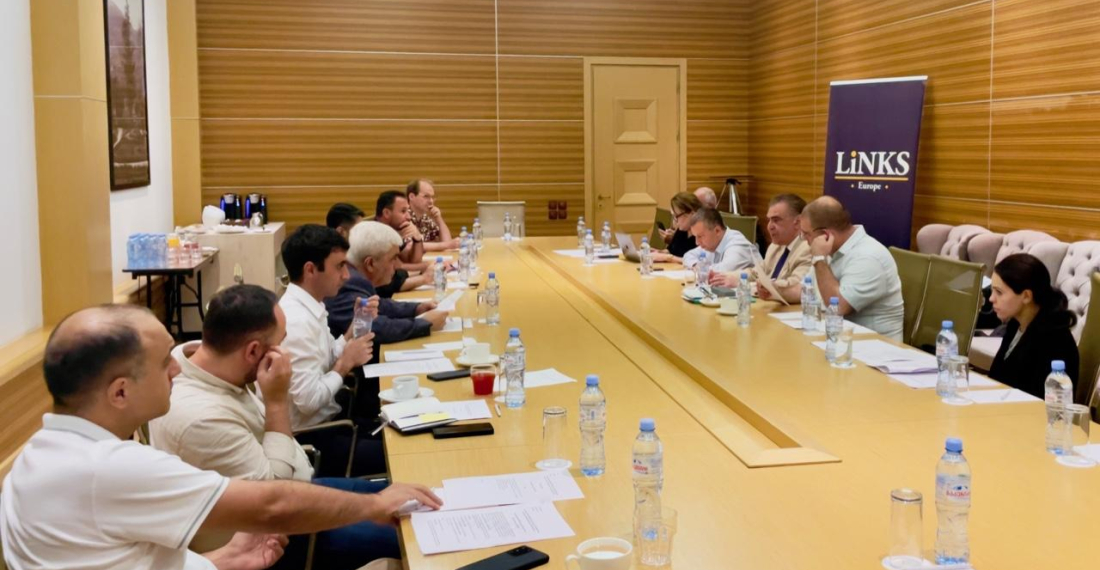
The following members of the Joint Liaison Group were present at the 5th Plenary Meeting in Kachreti: Ahmad Alili (co-rapporteur, Azerbaijan); Mehman Aliyev; Stepan Grigoryan, Tatevik Hayrapetyan, Taron Hovhanisian, Shahla Ismayil; Gulmammad Mammadov, Gevorg Melikyan, Johnny Melikyan, Benyamin Poghosyan (co-rapporteur, Armenia), and Anar Valiyev. The JOLIG meeting was chaired by Dennis Sammut (Special Adviser to the Liaison Group and Head of the Secretariat), assisted by Maximiliaan van Lange (LINKS Europe, Chief of Staff).

The Joint Armenian-Azerbaijani Liaison Group on Confidence-Building Measures in support of lasting peace in the South Caucasus (JOLIG) is an independent initiative facilitated by LINKS Europe and supported by the European Union.

More information about the Joint Liaison Group and its work is available on the website commonspace.eu here. For more information about the meeting, and the work of JOLIG please contact Maximiliaan van Lange (maximiliaan@links-europe.eu)

source: commonspace.eu
photo: Members of the Joint Armenian-Azerbaijani expert group on confidence-building measures at their 5th plenary meeting in Kachreti, Georgia on 31 August 2023 (c) commonspace.eu

Related articles

Editor's choice
News
Borrell tells the European Parliament that the situation in Afghanistan was critical, but the EU will remain engaged

Borrell tells the European Parliament that the situation in Afghanistan was critical, but the EU will remain engaged

Borrell underlined that the European Union will make every effort to support the peace process and to remain a committed partner to the Afghan people. "Of course, we will have to take into account the evolving situation, but disengagement is not an option.  We are clear on that: there is no alternative to a negotiated political settlement, through inclusive peace talks.
Editor's choice
News
Germany will soon have the largest conventional army in Europe, but there will be no conscription

Germany will soon have the largest conventional army in Europe, but there will be no conscription

The Bundeswehr currently has around 182,000 troops. The new military service model aims to increase that number by 20,000 over the next year, rising to between 255,000 and 260,000 over the next 10 years, supplemented by approximately 200,000 reservists. From next year, all 18-year-old men and women will be sent a questionnaire to assess their interest and willingness to join the armed forces. It will be mandatory for men and voluntary for women. From July 2027 all men aged 18 will also have to take a medical exam to assess their fitness for duty. If the government's targets are not met, a form of compulsory enlistment could be considered by parliament. If war were to break out, the military would be able to draw on the questionnaires and medical exams for potential recruits. Defence Minister Boris Pistorius said despite the new military service plan there was "no cause for concern... no reason for fear". "The more capable of deterrence and defence our armed forces are, through armament through training and through personnel, the less likely it is that we will become a party to a conflict at all," Pistorius said. Defence spending in Germany tumbled after the end of the Cold War, while conscription was suspended in 2011. Given its past, Germany has long been shy of showing military might, but earlier this year Friedrich Merz announced that the rule for German defence "now has to be whatever it takes", following Russia's full-scale invasion of Ukraine. Around 300,000 young men per year will be affected. The defense minister argues that this is the only way for the Bundeswehr to get an idea of who could be called up in the event of a conflict.

Popular

Editor's choice
News
Germany will soon have the largest conventional army in Europe, but there will be no conscription

Germany will soon have the largest conventional army in Europe, but there will be no conscription

The Bundeswehr currently has around 182,000 troops. The new military service model aims to increase that number by 20,000 over the next year, rising to between 255,000 and 260,000 over the next 10 years, supplemented by approximately 200,000 reservists. From next year, all 18-year-old men and women will be sent a questionnaire to assess their interest and willingness to join the armed forces. It will be mandatory for men and voluntary for women. From July 2027 all men aged 18 will also have to take a medical exam to assess their fitness for duty. If the government's targets are not met, a form of compulsory enlistment could be considered by parliament. If war were to break out, the military would be able to draw on the questionnaires and medical exams for potential recruits. Defence Minister Boris Pistorius said despite the new military service plan there was "no cause for concern... no reason for fear". "The more capable of deterrence and defence our armed forces are, through armament through training and through personnel, the less likely it is that we will become a party to a conflict at all," Pistorius said. Defence spending in Germany tumbled after the end of the Cold War, while conscription was suspended in 2011. Given its past, Germany has long been shy of showing military might, but earlier this year Friedrich Merz announced that the rule for German defence "now has to be whatever it takes", following Russia's full-scale invasion of Ukraine. Around 300,000 young men per year will be affected. The defense minister argues that this is the only way for the Bundeswehr to get an idea of who could be called up in the event of a conflict.

