


All power to Xi

It happened as was planned and expected. On Sunday (23 Ocotber) China's President Xi Jinping, was named to another term as head of the ruling Communist Party in a break with tradition that sees him becoming the paramount leader of China.

In the process Xi also promoted allies who support his vision of tighter control over society and the struggling economy.

Xi, who took power in 2012 was awarded a third five-year term as general secretary, discarding a custom under which his predecessor left after 10 years. The 69-year-old leader is expected by some to try to stay in power for life.

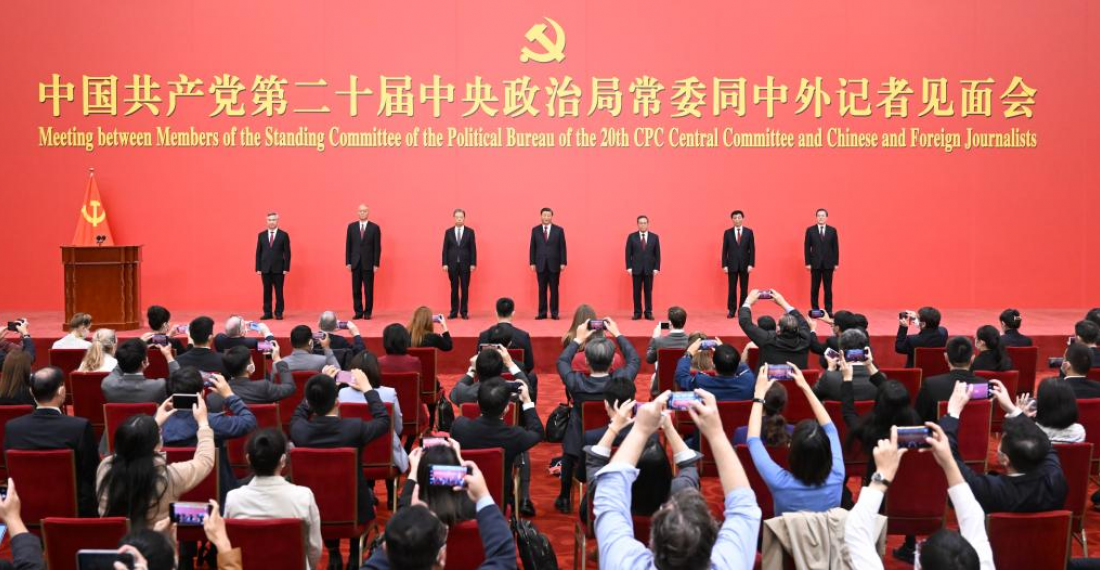
The apex of power in China is the seven member standing committee of the Politburo of the Communist Party. Xi and the other six men who form Standing Committee, appeared for the first time as a group before reporters in the Great Hall of the People, in central Beijing. The lineup appeared to reflect what some commentators called “Maximum Xi,” valuing loyalty over ability. Some new leaders lack national-level experience as vice premier or Cabinet minister that typically is seen as a requirement for the post.

related content on commonspace.eu: Monday Commentary: Comrade Xi's Party

The second person in seniority appears to be Li Qiang, the Shanghai party secretary. He is likely to emerge as the new prime minister. Zhao Leji, already a member, was promoted to No. 3, likely to head the legislature. Those posts are to be assigned when the legislature meets next year.

Li Qiang’s promotion served as apparent confirmation, as it puts him in line to be premier with no background in national government. Li Qiang is seen as close to Xi after they worked together in Zhejiang province in the southeast in the early 2000s.

Other new Standing Committee members include Cai Qi, the Beijing party secretary, and Ding Xuexiang, a career party functionary who is regarded as Xi’s “alter ego” or chief of staff. Wang Huning, a former law school dean who is chief of ideology, stayed on the committee. The No. 7 member is Li Xi, the party secretary of Guangdong province in the southeast, the center of China’s export-oriented manufacturing industry.

The Central Committee has 11 women, or 5% of the total. Its 24-member Politburo, which has had only four female members since the 1990s, has none following the departure of Vice Premier Sun Chunlan.

Party plans call for creating a prosperous society by mid-century and restoring China to its historic role as a political, economic and cultural leader.

During the congress,  Xi also called for faster military development,  “self-reliance and strength” in technology and defense of China’s interests abroad, which raises the likelihood of further conflict.

Xi, in a report to the congress last week, called for “regulating the mechanism of wealth accumulation,” suggesting entrepreneurs might face still more political pressure, but gave no details.

Xi suspended retirement rules to keep Gen. Zhang Youxia, 72, on the Central Committee. That allows Zhang, a veteran of China’s 1979 war with Vietnam, to stay as Xi’s deputy chairman on the commission that controls the party’s military wing, the People’s Liberation Army.

The party elite agreed in the 1990s to limit the general secretary to two five-year terms in hopes of avoiding a repeat of power struggles in previous decades. That leader also becomes chairman of the military commission and takes the ceremonial title of president.

Xi is on track to become the first leader in a generation to pick his own successor but has yet to indicate possible candidates. Hu Jintao and his predecessor, Jiang Zemin, both were picked in the 1980s by then-supreme leader Deng Xiaoping.

Ahead of the congress, banners criticizing Xi and “zero COVID” were hung above a major Beijing thoroughfare in a rare protest. Photos of the event were deleted from social media. The popular WeChat messaging app shut down accounts that forwarded them.

Xi’s government also faces criticism over mass detentions and other abuses against mostly Muslim ethnic groups and the jailing of government critics.
source: commonspace.eu with Associated Press and other agencies
photo: The new seven member standing committee of the Politburo of the Communist Party of China pose for photograph after their appointment was announced in the Great Hall of the People in Beijing. (picture courtesy of the Xinhua News Agency, Beijing)

Related articles

Editor's choice
News
Council of Europe launches new International Claims Commission for Ukraine

Council of Europe launches new International Claims Commission for Ukraine

Thirty-four countries and the European Union have signed a new convention establishing an International Claims Commission for Ukraine at a diplomatic conference co-hosted by the 46-nation Council of Europe and the Netherlands in the Hague. The diplomatic conference was attended by leaders and high-level representatives from over 50 states, including the President of Ukraine, Volodymyr Zelenskyy, the President of the Republic of Moldova, Maia Sandu, and the Prime Minister of the Netherlands, Dick Schoof.  “Today marks a major step forward in ensuring accountability for Ukraine. The International Claims Commission represents justice and hope for tens of thousands of victims—our determination that those who have suffered will not be forgotten. I call for quick ratifications so we can get the commission rapidly up and running for the people of Ukraine,” said Council of Europe Secretary General Alain Berset. Ukrainian President Volodymyr Zelenskyy said: “We expect that every mechanism for compensation from the Register of Damage and Claims Commission to the actual payments – will start working and receive strong and sufficient international support, so that people can truly feel that any kind of damage caused by the war can be compensated. This war, and Russia’s responsibility for it, MUST become a clear example – so that others learn not to choose aggression.” “Accountability is about creating the conditions for peace that endures. And therefore, accountability is a condition of security – today and for the future. But accountability is not only about Ukraine. And it is not only about one aggressor and one victim. Accountability is about Europe. About every country in Europe. It is about whether Europe, as a whole, is willing to defend its peace,” said Maia Sandu, President of the Republic of Moldova, which currently holds the Presidency of the Council of Europe’s Committee of Ministers. The Prime Minister of the Netherlands, Dick Schoof, said: “Every day Russia is deliberately bombarding homes, destroying businesses and damaging infrastructure in Ukraine. Russia must compensate Ukraine for the damage caused. That is why we have launched the International Claims Commission for Ukraine and we are honoured to host it.” The International Claims Commission will be the second part of a comprehensive compensation mechanism related to Russia’s war of aggression, building on the existing Register of Damage for Ukraine. The claims commission will be established within the framework of the Council of Europe and will also be open to other countries. The Register of Damage for Ukraine, created in 2023, collects and records compensation claims submitted by individuals, organisations and public bodies in Ukraine. Forty-four states and the European Union have so far joined the Register, which has already received 86,000 claims. The International Claims Commission will review, assess and decide upon claims submitted to the Register of Damage for Ukraine and determine the amount of compensation, if any, which is due in each case. The convention establishing the commission will enter into force once it has been ratified by 25 signatories, as long as sufficient funds have been secured to support its initial work.

Popular

Editor's choice
News
Council of Europe launches new International Claims Commission for Ukraine

Council of Europe launches new International Claims Commission for Ukraine

Thirty-four countries and the European Union have signed a new convention establishing an International Claims Commission for Ukraine at a diplomatic conference co-hosted by the 46-nation Council of Europe and the Netherlands in the Hague. The diplomatic conference was attended by leaders and high-level representatives from over 50 states, including the President of Ukraine, Volodymyr Zelenskyy, the President of the Republic of Moldova, Maia Sandu, and the Prime Minister of the Netherlands, Dick Schoof.  “Today marks a major step forward in ensuring accountability for Ukraine. The International Claims Commission represents justice and hope for tens of thousands of victims—our determination that those who have suffered will not be forgotten. I call for quick ratifications so we can get the commission rapidly up and running for the people of Ukraine,” said Council of Europe Secretary General Alain Berset. Ukrainian President Volodymyr Zelenskyy said: “We expect that every mechanism for compensation from the Register of Damage and Claims Commission to the actual payments – will start working and receive strong and sufficient international support, so that people can truly feel that any kind of damage caused by the war can be compensated. This war, and Russia’s responsibility for it, MUST become a clear example – so that others learn not to choose aggression.” “Accountability is about creating the conditions for peace that endures. And therefore, accountability is a condition of security – today and for the future. But accountability is not only about Ukraine. And it is not only about one aggressor and one victim. Accountability is about Europe. About every country in Europe. It is about whether Europe, as a whole, is willing to defend its peace,” said Maia Sandu, President of the Republic of Moldova, which currently holds the Presidency of the Council of Europe’s Committee of Ministers. The Prime Minister of the Netherlands, Dick Schoof, said: “Every day Russia is deliberately bombarding homes, destroying businesses and damaging infrastructure in Ukraine. Russia must compensate Ukraine for the damage caused. That is why we have launched the International Claims Commission for Ukraine and we are honoured to host it.” The International Claims Commission will be the second part of a comprehensive compensation mechanism related to Russia’s war of aggression, building on the existing Register of Damage for Ukraine. The claims commission will be established within the framework of the Council of Europe and will also be open to other countries. The Register of Damage for Ukraine, created in 2023, collects and records compensation claims submitted by individuals, organisations and public bodies in Ukraine. Forty-four states and the European Union have so far joined the Register, which has already received 86,000 claims. The International Claims Commission will review, assess and decide upon claims submitted to the Register of Damage for Ukraine and determine the amount of compensation, if any, which is due in each case. The convention establishing the commission will enter into force once it has been ratified by 25 signatories, as long as sufficient funds have been secured to support its initial work.

