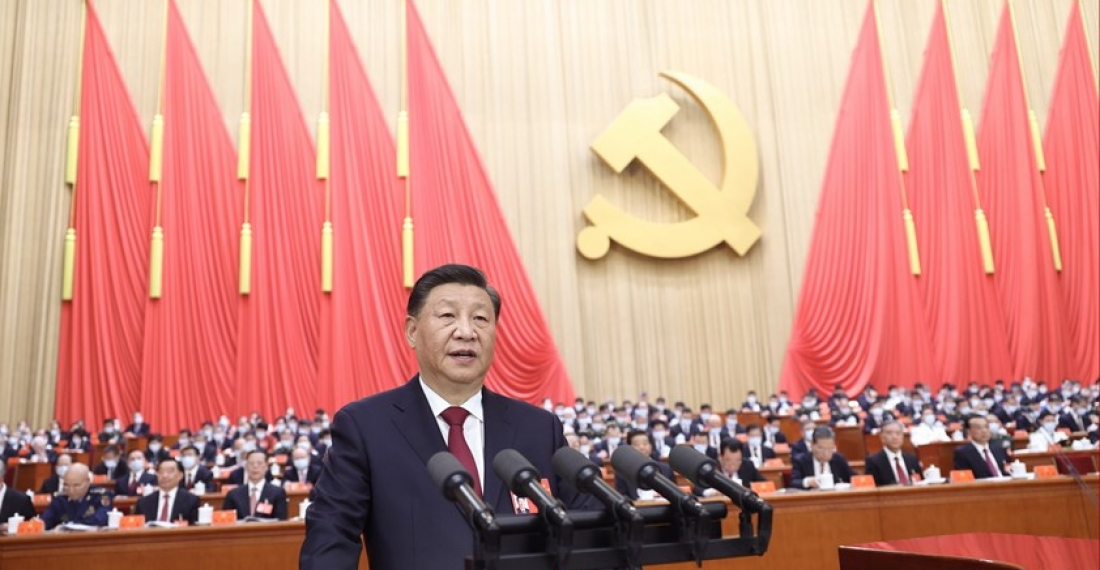
An event on the other side of the world that started on Sunday has huge global importance and will define international politics for decades to come. The 20th Congress of the Communist Party of China (CPC) is perhaps not the most important ever in terms of its impact within China itself, but when it comes to China’s role in the world it certainly is. This is not only because China is today stronger than it has ever been in modern times, but also because the congress gives the seal of approval to a Chinese global posture that is assertive, ambitious and with as yet an undefined end-game.
That end-game is being defined by Xi Jinping, who during this congress is expected to be confirmed in his post as Party leader for an unprecedented third term. President Xi has been making speeches both at the main session of the Congress and at side events. This morning he told a meeting of Communist activists on the fringe of the main event, that Chinese people should stay united as "a piece of hard steel" under the leadership of the Communist Party of China (CPC) and “pull together with one mind to power the giant ship of national rejuvenation through the wind and waves to reach its destination.”
In a more formal speech to the Congress plenum a day before Xi had given an indication of what that destination is: “Incomparable glory’ awaits China on world stage”, Xi Jinping told the party congress. By 2049, when the People’s Republic will hold centennial celebrations, China should become a leading power in all aspects, the leader stated
So no modesty or lack of ambition here. But what does this mean for the rest of the world?
I join others in expressing admiration for the way China has transformed itself over the last half a century, how it has become an economic giant; how it has increased the quality of life of most of its people, and yes, even for the restraint it has often shown in global politics, compared for example to the adventurism of Vladimir Putin’s Russia. But all this came at a cost too, and it is not clear where Xi will strike the balance between success and the cost of success, and more importantly what is the Chinese end-game.
Nationalism not Communism defines today’s China.
Firstly, it is easy to get confused by the discourse and the rhetoric. Despite the communist branding, the Communist Party of China is today essentially an instrument of Chinese nationalism. Xi has been on the vanguard of this transformation. So arguments for confronting China on an ideological basis are essentially superfluous. The question that needs to be asked is if Chinese nationalism is a threat, first to its neighbours, and more broadly to the world. There is no clear answer to this question yet, and for this reason there may still be some space for this path to be avoided. But clearly this window is closing.
The Chinese question has many dimensions: The CPC policies within China itself – for example in Tibet and Xinjiang; its approach towards the special regions such as Hong Kong; and then of course there is the issue of Taiwan. These issues, China insists, are internal issues and of no concern to outsiders. China will deal with them as it deems fit. Xi went so far on Sunday to say that the use of force was an option in ensuring Taiwan did not steer away from the “One China” direction.
Whilst the other issues are important from a moral and humanitarian point of view, Taiwan appears to be a red line for many in the United States, and a possible first cause of conflict. Relations on this issue are already strained following the visit of House Speaker Pelosi to Taiwan earlier this year. China and the US need to embark on a programme of military confidence-building measures to defuse the situation in the Taiwan straits. Neither side should see this as weakness. It is a step back towards sanity.
The second set of issues is related to China’s immediate neighbourhood, particularly in the South China Sea, and on the Himalayan border with India. In the South China Sea the Chinese are on a weak footing. International law goes against most of their claims to islands, islets and reefs that China is claiming as part of strategy to expand its maritime boundaries. China needs this expansion to secure access to the open seas. It is building an impressive new blue sea navy in case it needs to enforce its claim by force. China’s neighbours are jittery, and so far Beijing has failed to re-assure them. There is plenty of scope for misunderstandings and eventually conflict between now and 2049. A robust US message that it will support allies in the Asia Pacific region is appropriate. It does not exclude parallel diplomatic initiatives, of which there are at the moment not enough. India has its own way of dealing with China, and does not seem interested in escalating things in the Himalayas. Here too diplomacy and confidence-building measures need to play in tandem with military deterrence.
Thirdly there is the dimension of China as a global power. China’s military reach is limited. Forays, such as a military base in Djibouti, are more symbolic than substantial. But economically China is already a global power. Its Belt and Road initiative is a way of projecting power and influence to every corner of the world. But the devil is here in the detail. Chinese projects do not come with the strings of respect for human rights, as some western projects do, but their economic cost is high. African countries are quickly realising Chinese friendship is not what it first appears to be. The US and the EU are, belatedly, trying to counter the Chinese thrust onto the world, through economic programmes of their own. There will be competition, but it is possible to keep it within bounds.
The world (or to be more precise the west) is starting to learn how to deal with Chinese power. First it ignored it. Then, once it woke up to it, it panicked, leading to some belligerent statements from Washington and some European capitals. Now it is settling down to reflect more deeply how to deal with.
China has, overall, showed restrain in international affairs. This is partly due to the fact that its leadership takes a long term view of the world. Xi could speak about 2049 as it was tomorrow. Most western leaders do not even try to think beyond their next election cycle. Reconciling these two time frames is going to be one place to start in trying to manage relations with China. How ever one can see a streak of Putinism in Xi. Part of the problem is that Xi does not appear to have a restraining element within his leadership, especially now that his power is absolute. Even Mao Tse Tung had that, even at the peak of the Cultural Revolution. Chu en Lai (Zhou Enlai), Chinese prime minister between 1948 and 1976, was a loyal communist by conviction, and survived the rough and tumble of Chinese Communist Party politics, for his loyalty was appreciated. But he was also a suave articulate politician who understood the world, and made sure that China was never completely isolated from it.
Secondly, the Chinese military “threat” needs to be carefully assessed, and the response to it needs to be commensurate.
Thirdly, there is a need – a huge need – to improve dialogue. So far this process has been led by business and by China specialists. It needs to expand way beyond that.
After the thousands of delegates to the 20th Congress of the Communist Party of China go back to their cities and provinces the leadership in Beijing will feel emboldened to move forward to the next stage in its strategy. The world needs to watch carefully, but not passively. It should not over react that, but neither should it fail to act to signals coming out of China. The east may be red – well pink anyway – but for the moment engagement is the best policy to pursue.