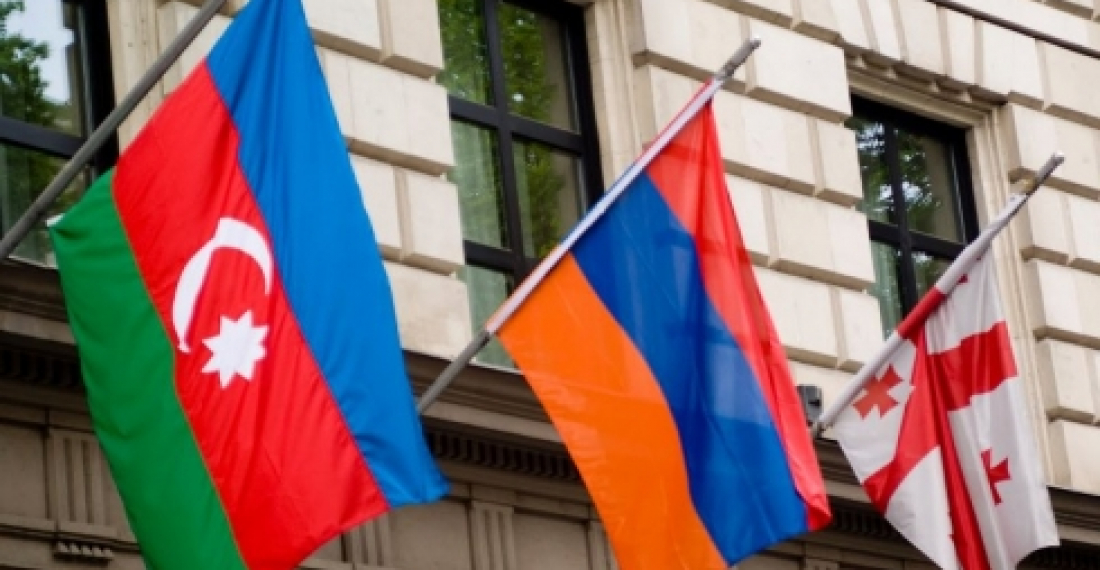
Leaders in the South Caucasus addressed their compatriots on the occasion of the new year in televised broadcasts that struck a distinctly different tone.
In Azerbaijan, President Ilham Aliev once more emphasised his country's achievements since independence 23 years ago. He said this was possible because the country had also followed an independent policy, adding that this was "based on national interests and national values. It provides for the current realities of Azerbaijan. Today, Azerbaijan is a dynamic and rapidly developing country. Azerbaijan is a country that successfully goes down the path of democracy, freedom, independence, progress and development". President Aliev said that in 2014 "Azerbaijan chaired the Committee of Ministers of the Council of Europe, making a valuable contribution to the development of democracy and protection of human rights in Europe".
President Aliev also spoke of economic achievements, and addressed directly the issue of declining oil prices which many consider will have dramatic implications for Azerbaijan. He said:
"You are well aware that due to the decline in oil prices in the world, including our region, certain tensions are being experienced. Azerbaijan is an island of stability, a model country. Our country provides and will continue to provide both political and economic stability. The Azerbaijani people will live in safety, and the well-being of our people will improve every year."
President Aliev spoke of the Nagorno-Karabaklh conflict and used strong language to describe the leadership in Armenia accusing it of not wanting peace:
"...unfortunately the Armenian-Azerbaijani conflict over Nagorno-Karabakh has not been resolved this year either. The reason for this is the criminal and bloodthirsty regime of Armenia. Armenia does not want peace. All of its efforts are aimed either at not holding the negotiations or at conducting them for the sake of imitation. This year the mediators were more active - we have to acknowledge that. The leaders of Russia, USA and France held consecutive trilateral meetings in August, September and October. I appreciate that and am grateful to these countries. However, Armenia acted insincerely at these meetings. Moreover, less than two weeks after the Paris meeting it began a large-scale military exercise on occupied territories. The exercises pursued only one goal - to provoke Azerbaijan, to commit an act of sabotage and undermine the process of negotiations. We observed the same in the summer months when Armenian sabotage groups attacked Azerbaijani positions. But the Azerbaijani army gave them a fitting rebuff, killing more than 50 occupants. Similar events took place at the end of this year. And again, the Azerbaijani army gave an adequate response to the enemy. The occupying state should know that a strong Azerbaijani army may restore the territorial integrity of our country at any time. We still hope that the negotiating process can produce a positive result, and there are many factors enhancing this hope. We have political power, economic potential and a powerful army. Next year, about $5 billion will be spent on the development of our army, twice the total budget of the impoverished Armenia.
The Armenian-Azerbaijani conflict over Nagorno-Karabakh can be resolved only on the basis of norms and principles of international law. UN Security Council resolutions must be implemented. The occupying forces must withdraw from the occupied Azerbaijani lands and the territorial integrity of our country must be restored. These are the basic principles. On the basis of these principles we are ready to sign any agreement."
In contrast to President Aliev's detailed speech Armenian President Serzh Sargsyan televised address was shorter but striking in both what he said in it, and what he did not. Whilst also referring to his country's progress in 2014, President Sargsyan said this had to be done "in a complex geopolitical situation".
The Armenian leader said
"2014 was marked by turbulent events happening in various corners of the world. Unfortunately, those storms have not calmed down yet. Just one year ago perhaps few people could imagine such a rapid escalation of events and their negative outcomes. The primary task of Armenian authorities has been to keep our people and our country away from those storms, maintain peace in Armenia and Artsakh and ensure their security and stability. Rarely have we managed to fully guard ourselves against aggravation of various negative trends because we constitute one part of the world. No matter how small we consider our country to be, we are a part of the world".
President Sargsyan made no direct reference to the Karabakh conflict, but instead invited Armenians to raise a toast to the members of the military:
"The last year was characterized by an unprecedented exacerbation of tensions on our borders. This is the reality we live in. Our army carries out all its tasks creditably and with a high level of professionalism. I have no doubt that today, upon gathering around the New Year table, we will definitely raise our glasses in a toast to our soldiers and officers, wishing them "Good service.""
President Sargsyan said that 2015 will be a symbolic year for Armenia. Referring to the centenary anniversary of the atrocities in Anatolia, sometimes characterised as the Armenian genocide, President Sargsyan said
"We are going to properly organize the events dedicated to the 100th anniversary of the Mets Eghern. Together we will do it with dignity. We will mark the victory of life over death, emphasizing the heroic and glorious path of our people. We will emphasize our people's will and effort to survive, revive and to be liberated. We will also stress the rich harvest Armenian genius has yielded for the world throughout the past centenary."
As the clock struck midnight shortly after President Sargsyan finished his speech, the Eurasian Economic Union officially came into being, with Armenia as a full member. A historic moment by any stretch of the imagination, yet President Sargsyan made no reference whatsoever to it in his address.
Georgian leaders also addressed their compatriots on the occasion of the new year.
Prime Minister Irakli Garibashvili said 2014 was historic for Georgia as it made step towards European integration, which will be further pursued. He stressed the need for unity in order for Georgia to become a strong European state. He said:
"2014 was really historic for our country. It was historic year, which took us even closer to Europe. Georgia's future is with Europe. Our great ancestors aspired towards Europe; we aspire towards Europe too and are doing everything for this purpose."
"The basis of success of the Georgian state is our resolve, unity, as well as the responsibility and commitment of each of us - the authorities and the people - towards the country." "We can do much more and today we need to stand together like never before in order to make our homeland strong European state."
Garibashvili also spoke of global and regional difficulties and their impact on Georgia saying that 2014 was a difficult year for the world, for the entire region, but that the Georgian government managed to maintain stability and peace in this difficult period."
In his address, Prime Minister Garibvashvili extended new year greetings to "our Abkhaz and Ossetian brothers." Without dwelling on the unresolved conflicts he said, "I believe that regardless of everything, we will still gain mutual confidence and take care of our common homeland, for the unification of our country".
Georgian President Giorgi Margvelashvili said in his televised New Year address to the nation that 2014 was of "great significance" for Georgia and the country will continue next year on the path of building free society. Whilst not exactly upbeat, Margvelashvili's address was optimistic in tone "2014 was of great significance for our country and even though we don't live in delight yet, we have taken very important steps this year," the President said. "We took a step forward to the dream of our ancestors - to live in a free and independent society built upon prosperity."
"We will continue to follow this path with more dignity next year and the result we achieve will be reflected on the well-being of each of us and the whole country. I believe that we have everything in our multi-century culture for achieving this goal. We are talented and skilful and if we add our efforts, Georgia will become strong, united country, where each of us will have a possibility to serve our families and homeland in dignity," the President said. In his address Margvelashvili also wished "happy New Year to our compatriots in Abkhazia and Tskhinvali Region."
Commonspace.eu political editor said in a comment:
The three South Caucasus countries start 2015 in very different positions with a different outlook about their future and their role in the world. This was reflected in the speeches of their leaders on new year's eve. These messages are still important in the societies of the three countries where people gather around the family table to meet the new year, usually with the television set on. What the leaders say and dont say in these addresses is therefore important. President Sargsyan decision to ignorte completely the fact that as he was speaking as the Eurasia Economic Union, of which Armenia is now a full member, came into existance is puzzling. It may indicate the extent to which the issue remains a divisive one in Armenian society, one therefore that president Sargsyan preferred not to mention in a new year's address that emphasised unity. Similarly the use of strong language by the President of Azerbaijan in describing the Armenian leadership and the outright blaming of Armenia as the cause for the failure in the Karabakh peace negotiations is as clear a sign as any of how bad things are in the Karabakh peace process. President Aliev's assertion that Azerbaijan in 2014 made "a valuable contribution to the development of democracy and protection of human rights in Europe" is likely to be greeted with much cynicism and derision, given the number of politically motivated arrests and prosecutions in Azerbaijan in the last year. In Georgia the Prime Minister and President avoided triumphalist statements but highlighted the new relationship between Georgia and the European Union sealed in 2014. They were both however quick to point out the hard work ahead if this opportunity is to have any meaningful results.On the whole the new year messages offer an interesting insight into where the region is heading in 2015, even if the assessments of 2014 were somewhat distorted.
source: commonspace.eu with agencies.