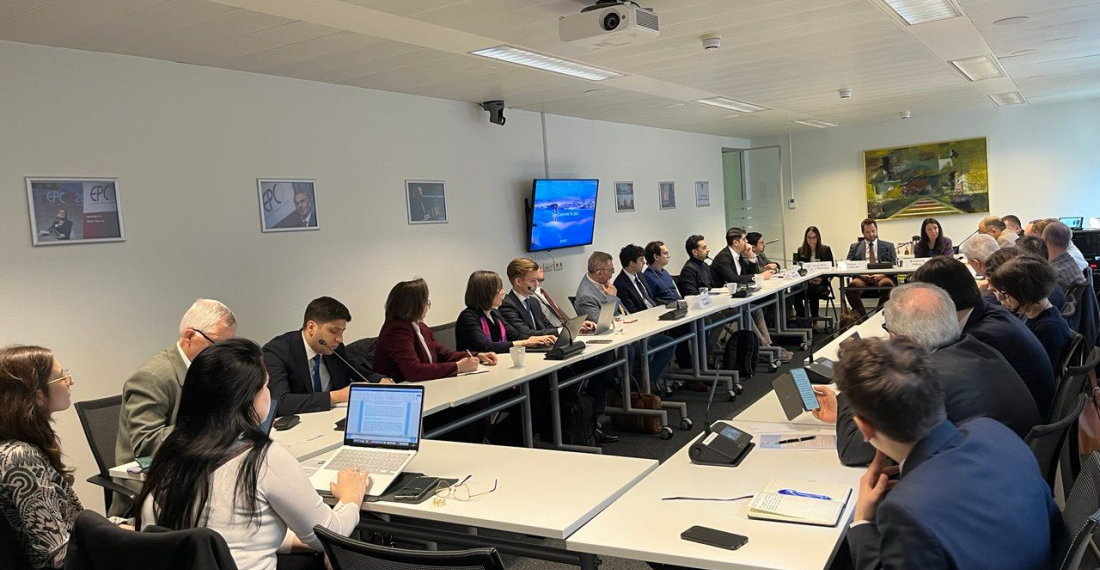
On Thursday, 26 February 2026, the LINKS Europe Foundation and the European Policy Centre (EPC) co-hosted a roundtable discussion in Brussels examining the future of the Armenia–Azerbaijan peace process. Held under the Chatham House Rule, the event brought together experts, diplomats and civil society representatives to assess what several speakers described as a paradigm shift in the South Caucasus.
In her introductory remarks, Amanda Paul, Deputy Head of the Europe in the World Programme at the EPC, noted that recent positive developments have unfolded against a global backdrop marked by the erosion of the rules-based order, the war in Ukraine and evolving US foreign policy dynamics. Despite pressures, she observed that the region has experienced an “ongoing stream of positive developments.” The continued engagement of both the European Union and the United States, for example by US Vice President JD Vance’s diplomatic engagement with the region, signals sustained international attention to the South Caucasus.
A young process
Peter Svedberg, representing the Office of the EU Special Representative for the South Caucasus, conveyed his greetings and underlined that developments over the past six months amount to a significant shift in regional dynamics. Armenia–Azerbaijan relations, he noted, are currently within a critical window of opportunity in which immediate large-scale escalation in Nagorno-Karabakh is no longer the primary risk to the overarching peace process. In March 2025, the two sides agreed on the core elements of a peace agreement, which was initialed at a White House meeting on 8 August 2025. Since then, a series of unprecedented steps toward reconciliation have followed.
Among these developments, major trade restrictions have been lifted, and the locally-led Peace Bridge Initiative has facilitated direct, government-backed civil society exchanges aimed at building trust and normalising dialogue. In parallel, discussions around the US-backed Trump Route for International Peace and Prosperity (TRIPP), a proposed transit corridor linking Azerbaijan to its exclave of Nakhchivan via southern Armenia, have reinforced momentum toward regional connectivity and stabilisation.
Mr. Svedberg cautioned that this remains a young and fragile process. The key question now is how to widen participation beyond political elites and ensure broader societal ownership. With parliamentary elections approaching in Armenia in June 2026, safeguarding the democratic environment from disinformation, especially referencing efforts linked to the Kremlin, will be essential to maintaining trust and continuity.
The first panel - Dr. Benyamin Poghosyan and Dr. Anar Valiyev, chaired by Amanda Paul
The first panel, featuring Dr. Benyamin Poghosyan and Dr. Anar Valiyev, chaired by Amanda Paul, focused on the trajectory of the peace process, its regional implications, and the role of external actors.
Two broad scenarios
Dr. Poghosyan, Senior Research Fellow at APRI Armenia, acknowledged the widening of civil society engagement and the emergence of new initiatives, but warned that momentum alone is insufficient. He outlined two possible scenarios over the next several years. In the first, progress continues without institutionalisation, leaving the peace process dependent on political will and personal decisions by leaders. Under such conditions, progress could theoretically be reversed, resulting in a situation characterised by stability without formalised peace. In this scenario, TRIPP might function as a limited transit arrangement generating only modest economic benefits for Armenia, while full normalisation, particularly with Türkiye, remains elusive due to constitutional and political preconditions.
In the second scenario, current momentum is deliberately used to institutionalise peace through formal ratification and legally binding agreements. While this would not eliminate all disputes, it would significantly reduce the likelihood of renewed conflict. Dr. Poghosyan stressed that framing TRIPP as a geopolitical instrument aimed at countering Russia or Iran could provoke backlash and undermine stability. Instead, he argued, it should be presented as a pragmatic connectivity initiative serving regional development and trade.
Amanda Paul raised the question of whether the Trump administration could leverage its relationship with President Erdoğan to influence Türkiye’s position, even if influencing Azerbaijan directly proves more complex. Dr. Poghosyan suggested that President Trump’s personal diplomacy may indeed be influential, but Armenia’s concerns rank relatively low on the broader US–Türkiye agenda, which includes defence cooperation, sanctions, and investment priorities.
Institutional gaps and the case for gradual normalisation
Dr. Valiyev, Associate Professor at ADA University, largely agreed with Dr. Poghosyan’s broader assessment but introduced nuances. He noted a significant decline in hostile media rhetoric between Armenia and Azerbaijan, with officials adopting more neutral and occasionally positive language. This rhetorical shift, he argued, is one of the most important trust-building developments of the current phase.
He cautioned against viewing a peace agreement merely as a document to be signed. In his view, confidence-building measures such as trade expansion, economic cooperation and increased societal interaction should precede formal ratification. A treaty should consolidate an already functioning reality rather than attempt to create one. He further suggested that Azerbaijan may no longer be constraining Armenia–Türkiye normalisation to the same extent as previously assumed, though the broader process remains insufficiently institutionalised.
On US involvement, Dr. Valiyev observed that engagement appears closely tied to President Trump’s personal diplomatic agenda and may fluctuate with political change in Washington. He encouraged participants to rethink TRIPP not simply as an economic corridor, but as a long-term societal project capable of fostering interdependence and shared interests, similar to major regional infrastructure projects of the 1990s that served as anchors for cooperation.
The subsequent discussion addressed whether economic interdependence can genuinely reduce the risk of renewed conflict. Dr. Poghosyan noted that in Armenia connectivity projects are often viewed less as engines of prosperity and more as mechanisms to decrease the likelihood of war. Dr. Valiyev agreed that mutual reliance can function as a stabilising force, but emphasised that clarity in legal frameworks and investor confidence will be crucial for implementation.
The second panel - Murad Muradov and Narek Minasyan, chaired by Alexandra Dumitrescu
The second panel, featuring Murad Muradov and Narek Minasyan and chaired by Alexandra Dumitrescu (Program Manager and International Coordinator, LINKS Europe), shifted the focus to the societal dimension of peace-building. Ms. Dumitrescu highlighted the need to expand civil society participation, including youth and women, and to translate existing dialogue formats into structured societal engagement.
Murad Muradov, co-founder and Deputy Director of the Topchubashov Center in Azerbaijan, reflected on recent visits conducted within the framework of the Peace Bridge Initiative, including travel to a land crossing in a newly delimited border area. These visits, supported by both governments, created space for direct and candid exchanges. Public reactions in Azerbaijan, he noted, have generally been neutral to cautiously positive. While scepticism remains, particularly among voices aligned with external narratives, the tone of debate has shifted. Even public discussion, including surveys on the potential sale of Armenian goods, signals a gradual normalisation of interaction.
Narek Minasyan, Associate Expert at the Armenian Council Research Center, traced the evolution of the Peace Bridge Initiative, which began in October and has since enabled reciprocal visits to Yerevan and Baku, including direct air connections and coordinated land crossings. What began as expert-level exchanges has developed into a broader “track 1.5” format, combining governmental backing with civil society initiatives. For societies that lived in isolation for decades, he stressed, the ability to visit one another’s capitals represents a significant psychological shift.
Both speakers agreed that while top-down diplomacy remains essential, sustainable peace requires structured societal interaction. Dialogue should become normal rather than exceptional.
Public reactions
On public perception, Mr. Muradov described a debate in Azerbaijan between sceptics and optimists. While some commentators question the viability of peace, broader reactions suggest a willingness to test new formats of engagement.
In Armenia, Mr. Minasyan characterised reactions as layered: a supportive majority viewing dialogue as a means to prevent escalation; a vocal minority rejecting engagement outright; and a cautious middle concerned about justice, sustainability, and unresolved humanitarian issues. With parliamentary elections approaching, the peace agenda has become politicised, adding further sensitivity to the process.
Both speakers acknowledged that rhetoric remains important. Content and narratives circulating in either country can still generate mistrust, underscoring the need for responsible communication.
The role of external actors
Asked about the role of organisations such as LINKS Europe and the EPC, Mr. Muradov argued that external facilitators helped create the initial space for dialogue. As direct travel and contact have now become possible, the format should gradually evolve. Rather than focusing solely on conflict resolution, future discussions could address concrete areas of cooperation, such as energy, environment, trade, and regional security, allowing experts to build shared knowledge and potentially a common political agenda.
Mr. Minasyan emphasised that peace initiatives must be inclusive and transparent, avoiding the perception of closed-door diplomacy. Projects should deliver visible dividends for ordinary citizens in both countries. He suggested that business communities could become an important driver of interdependence, with European actors serving as connectors between Armenian and Azerbaijani economic stakeholders.
Education, mobility, long-term trust
The panel also touched on the importance of educational cooperation. Peace education and the revision of divisive historical narratives were recognised as long-term priorities, though speakers cautioned that such reforms require time and careful sequencing. In the near term, more modest steps such as joint lectures or thematic discussions could gradually reduce tensions.
On the question of opening border checkpoints to reciprocal citizen travel, the speakers advised caution. While such measures represent a desirable long-term goal, the current stage of the process remains fragile. Gradual transit arrangements may be more realistic than immediate two-way open-border regimes.
Finally, regarding the future of diplomatic formats, the speakers noted that formal state-level engagement is already ongoing through foreign ministerial meetings, delimitation commissions, and high-level political contacts. A comprehensive peace treaty would provide the legal umbrella under which more structured intergovernmental cooperation could emerge.
Closing remarks from the editorial staff at commonspace.eu:
The next two years will be critical in determining whether the region achieves a durable peace or returns to a fragile status quo. As underscored by the Armenia–Azerbaijan Strategic Expert Platform meeting in Antwerp (27 February), this is a moment of historic importance for the South Caucasus, and both leaders and societies must make full use of the current momentum for the long-term peace and prosperity of the wider region.
LINKS Europe Foundation and commonspace.eu will continue to build on their long history of engagement in the South Caucasus, and remain committed to fostering informed debate, regional connectivity, and sustainable reconciliation in this new chapter for Armenia and Azerbaijan.