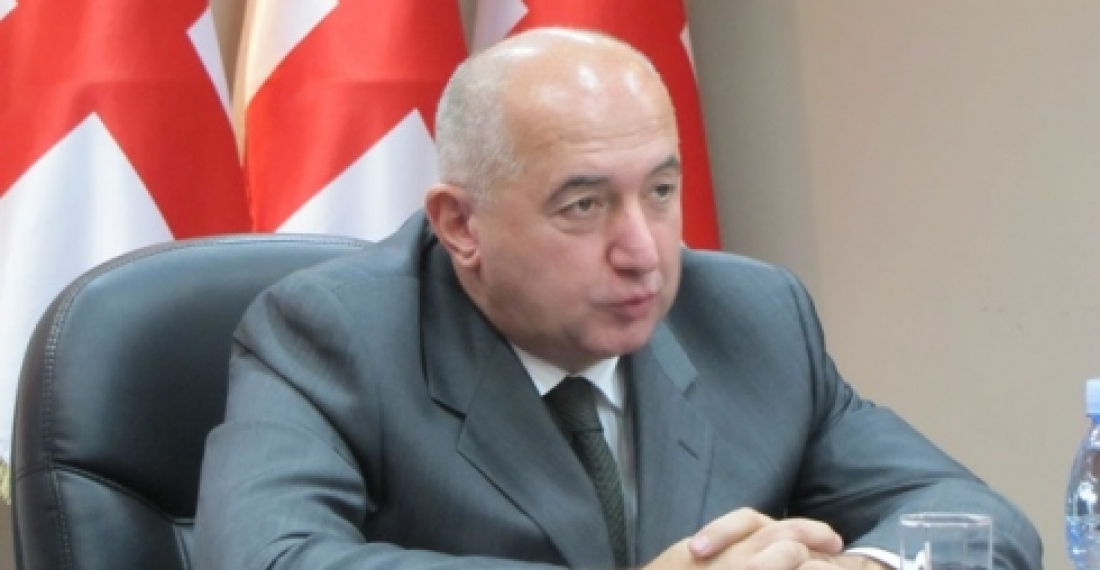
Paata Zakareishvili is an unlikely person to be thrown on the front line of high powered international diplomacy. A long time civil society activist with an impeccable record of support for human rights and initiatives for peace Zakareishvili stands out amongst the lawyers, footballers and former Komsomol boys in the cabinet of Prime Minister Bidhzina Ivanishvili. His task is however not easy, for the issues of Abkhazia and South Ossetia are no longer a localised internal problem but have since August 2008 become prominent in global diplomacy.
Speaking to Marion Kipiani in a wide ranging interview for our new quarterly publication, CommonspaceEXTRA Zakareshvili emphasizes continuity in the objectives of the Georgian government, but highlights important changes to the approach for achieving them. Zakareshvili speaks about the peaceful nature of the new Georgian government's approach, but will this be enough to take the current negotiations to a point where a breakthrough can be achieved?
The following is the interview in full:
Q: We would like to start by asking you about the conflict resolution processes with Abkhazia and South Ossetia and your approach as the new State Minister for Reintegration. How would you say your approach differs from the one of the previous government and previous State Ministers?
A: Our approach is peaceful, and we are trying to do our best to make the Abkhaz and Ossetian parties feel that the Georgian state is taking into consideration their interests. We agree with the State Strategy that was adopted by the previous Government and its context but we consider that previously its implementation was politicized. We try to stick to the actual essentials of the Strategy and to implement it. We have changed the rhetoric - conflict resolution is not part of propaganda anymore. The Abkhaz and South Ossetian parties often used the Former Georgian Government\'s aggressive rhetoric to demonstrate to the world that Georgia was a permanent source of danger for them. But we are trying not to give them reason for such arguments, so that we can start actually taking steps towards peace building.
Q: What is your assessment of the "Geneva Talks?" Are you happy with the format of the talks or do you see any need for changes?
The current format is acceptable for us, but personally I am not against discussing proposals concerning changes to the format, however we should be sure that these changes are necessary. The Abkhazian and South Ossetian participants left the last meeting [in Geneva], which was the first in which the new Georgian Government took part. They claimed the format needed to be changed. But we did not even discuss any changes so it is not clear for us why the format would need to be changed. Perhaps some results are difficult to reach because the format is not perfect. So we are ready to discuss the proposals of format change if we will see what kind of result it will lead us to. But so far we do not see what Geneva Talks participants mean by changing the format and what result they are trying to reach by this.
In fact, the Geneva talks are a format for providing conditions for resolution of the Georgian-Russian conflict. Change of the format is mainly in the interest of Abkhaz and Ossetian participants. As to Georgian-Russian relations, we think that the current format can lead to results if the sides will be constructive.
Q: Do you foresee any possibility of yourself perhaps visiting Abkhazia and South Ossetia?
Of course it is not excluded if there is a necessity for it but there are no conditions or foundation for it to be done right now. The main thing is not just to go there but the reason for going there. Actually I never faced any problem to go anywhere but it is all about the question - where will this or that activity lead us and what will the outcome be.
Q: What is your assessment of the role of the European Union, as a partner in the Geneva talks and more generally in conflict resolution?
Nowadays the European Union is the only international organisation that institutionally works on the issue of conflicts. Until 2008, the UN and OSCE were present in the conflict zones but they had to stop their activities due to the attempts of the Russian Federation. EU is the only organization that Russia didn\'t manage to prevent from activities as Russia is not its member and thus could not prevent their engagement from within. The EU as a mediator managed to convince Russia to sign the six-point plan. With the report of Independent International Fact-Finding Mission, in September 2009 the EU took an unprecedented step - it assessed the reasons for the conflict and investigated its facts. And finally, the EU represents the structure that works alongside the conflict territories as the European Union Monitoring Mission (EUMM).
Q: How do you assess the possibilities of the EUMM Incident Prevention and Response Mechanism (IPRM) restarting at the Abkhaz Administrative Boundary Line (ABL)? [The Abkhaz side has not participated in the IPRM since spring 2012 after accusing the Head of Mission of showing disrespect toward Abkhazia.]
I doubt there is a chance for a restoration of the work of the Gali Incident Prevention and Response Mechanism in the nearest future. With the new Georgian policy this problem does not hold a threat anymore, however. The Incident Prevention and Response Mechanism was created as a local crisis prevention mechanism. The new Georgian Government with its policies tries not to create any tensions along the ABL. Naturally it would be better if the Incident Prevention and Response Mechanism were working. Having said that, by this we also prove to the Abkhaz side that we are doing everything to minimise tension and by this reduce the risks created by the non-existence of Incident Prevention and Response Mechanism.
Q: Now we would like to ask you about some concrete proposals on conflict resolution which were floated during the last months. Regarding the restoration of the railway lines through Abkhazia, how do you see the potential for conflict resolution of this idea?
The restoration of the railway is just an idea; there are no negotiations ongoing so far. Our interest was actually to find out in how far the Russian Federation would be ready to discuss this idea, and now we see that there is no interest from the side of Russia. I have personally been involved in the processes of conflict resolution for a long time, and very often other parties have blamed Georgia for not taking steps they were themselves not ready to implement. I doubt that Russia would be ready to discuss the railway line because then they would have to revise their policy of recognition [of the independence of Abkhazia]. Our motivation was to propose this idea in order to move the current situation from deadlock but Russia lacks interest. There have been two meetings so far between [Russian Deputy Foreign Minister Grigory] Karasin and [the Special Representative of the Georgian Prime Minister for bilateral relations with Russia Zurab] Abashidze and this topic has never been brought up.
Q: Are there any other concrete proposals toward Abkhazia regarding the restoration of contact and confidence building?
There are certain proposals but they are currently work in progress. That is why I am not willing to speak about them, taking into account the Abkhaz side\'s wish not to publicly discuss these proposals until we can show some results.
Q: Regarding South Ossetia, a proposal was floated in January for the restoration of Ergneti market [a market where Georgians, South Ossetians and Russians traded jointly before it was closed by the then-Georgian Government in 2004]. Could you give us an idea about the status of this proposal and the Ossetian reaction to it?
What makes Ergneti market different from the proposal of restoring the railway through Abkhazia is that the reopening of the market is a discussion going on at the local level but the Georgian Government has not even suggested this as an idea yet. Some Members of Parliament and representatives of Gori municipality have raised this topics but this is not an initiative of the Government. We think that the Ergneti market was an interesting phenomenon of trading between Georgia and Russia when the road connection between Russia and Georgia was actually open, and when Russia was using this as a way to circulate goods through Russia and the Caucasus. Until this road connection is re-established there is really no point of talking about Ergneti market because the local trade between Gori and Tskhinvali is not on a level to allow a serious discussion of this topic. It is early to discuss this; some other conditions need to be satisfied before we can start talking about Ergneti market.
Q: Given your own background in working in civil society on conflict resolution, what is your view at the present moment of the involvement of Georgian civil society? Do you see specific strengths and weaknesses and would you have any recommendations to Georgian civil society organisations?
Well, I was not the only one working on this topic in Georgian civil society. There are other organisations and individuals who have a lot of experience in working in this area. When I was active in the civil sector, I saw the errors in the policies of the governments of [Eduard] Shevardnadze and [Mikheil] Saakashvili and I tried to talk to the other sides in the conflict in order to develop joint suggestions. We are ready to cooperate with the civil sector, and what makes us different from the previous government is that we are not trying to control or manage civic initiatives. We are not preventing anyone from or persecuting them for working on this topic, like I myself had been pressured. The previous governments were not involving me in any projects, I was acting independently. Now we are trying to involve the other sides to the conflict, so anyone who can find a common language with the Abkhaz and Ossetian parties is welcomed by us. And we are ready to engage and participate in these processes if there is interest in this. We will accept their proposals, just as we ourselves used to propose ideas to the previous government.
Q: As to what concerns the ongoing efforts to improve bilateral relations between Georgia and Russia, how do you evaluate the potential of improved Georgia-Russia ties as having a positive impact on conflict resolution with Abkhazia and South Ossetia?
The normalisation of relations between Georgia and Russia is absolutely necessary and will happen in one way or the other. Unfortunately, we will not reach good-neighbourly relations for quite some time to come. And as long as Russia recognises the independence of Abkhazia and South Ossetia, diplomatic relations [between Georgia and the Russian Federation] will not be restored. As long this does not happen, we will not be able to say that relations are normalised. But besides that there are a lot of other issues on which we can cooperate, such as on the questions of the North Caucasus, trade, transport, religious and cultural relations - all the other things that do not include diplomatic relations.
Marion Kipiani interviewed Paata Zakareshivili for CommonspaceEXTRA, the new quarterly publication that compliments commonspace.eu