Landmine Free South Caucasus 2026 will start in earnest on 9 November

Despite the lack of support from the international community, the campaign LANDMINE FREE SOUTH CAUCASUS 2026 has had a soft launch on 1 October, and will start in earnest on 9 November.

The regional campaign, Landmine Free South Caucasus’ (LFSC), was initiated by LINKS Europe Foundation in 2018 to address the critical issue of landmine and unexploded ordnance contamination in Armenia, Azerbaijan and Georgia. With significant landmine contamination in the region posing an ongoing threat to life and eliciting high economic costs, LFSC advocated for a regional, holistic approach to complete clearance. 

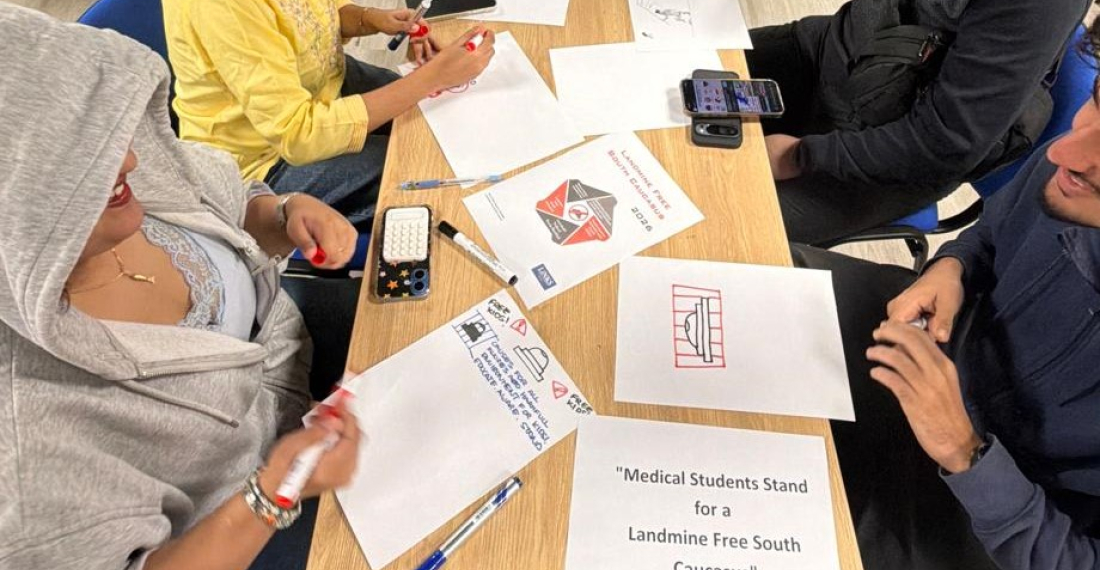
Picture shows students in Tbilisi making handmade posters for the campaign.

LINKS Europe will launch a new set of infographics which will help people to understand the scale of the problem of landmines and other unexploded landmines in the South Caucasus.

The LFSC 2026 campaign will continue until 15 December. JOIN US IN OUR EFFORT TO MAKE THE SOUTH CAUCASUS LANDMINE FREE!

source: commonspace.eu


Related articles

Editor's choice
News
Lula wins fourth term in Brazil, Vucic loses in Serbia

Lula wins fourth term in Brazil, Vucic loses in Serbia

In elections on both sides of the Atlantic, that are likely to have deep implications for their respective regions, one incumbent won, another lost. In Brazil, Latin America's biggest country, left-wing President Lula won a fourth term in office, defeating his right-wing challenger Flávio Bolsonaro. The 80-year-old, took just under 52% of the vote in a run-off on Sunday. Lula thanked cheering supporters in São Paulo and said he had defended Brazil's democracy. His opponent, Flavio Bolsonaro - who won the first round - says the result is "inexplicable" and called for it to be annulled. His father, ex-president Jair Bolsonaro, is currently serving a jail sentence under house arrest for plotting a coup after losing the last election. This election was bitterly fought - and it bucks a wider regional trend towards right-wing leaders. On the other side of the Atlantic, in Serbia, long-standing leader Aleksandar Vučić has admitted defeat to the student-led protest movement in snap parliamentary elections. "We still do not have final results... it is clear that we have lost these elections," the right-wing populist leader said as he conceded late on Sunday. Preliminary figures from Serbia's election commission indicated a record high turnout, which commentators had suggested would favour the student movement. Celebrations erupted after Vučić conceded. Vučić called the snap elections after two years of protests triggered by the collapse of a train station canopy in the city of Novi Sad, which killed 16 and was seen as emblematic of corruption and negligence. Both election results are going to have a deep impact on their respective regions.

Popular

Editor's choice
Interview
Thursday Interview: Murad Muradov

Thursday Interview: Murad Muradov

Today, commonspace.eu starts a new regular weekly series. THURSDAY INTERVIEW, conducted by Lauri Nikulainen, will host  persons who are thinkers, opinion shapers, and implementors in their countries and spheres. We start the series with an interview with Murad Muradov, a leading person in Azerbaijan's think tank community. He is also the first co-chair of the Action Committee for a new Armenian-Azerbaijani Dialogue. Last September he made history by being the first Azerbaijani civil society activist to visit Armenia after the 44 day war, and the start of the peace process. Speaking about this visit Murad Muradov said: "My experience was largely positive. My negative expectations luckily didn’t play out. The discussions were respectful, the panel format bringing together experts from Armenia, Azerbaijan, and Turkey was particularly valuable during the NATO Rose-Roth Seminar in Yerevan, and media coverage, while varied in tone, remained largely constructive. Some media outlets though attempted to represent me as more of a government mouthpiece than an independent expert, which was totally misleading.  Overall, I see these initiatives as important steps in rebuilding trust and normalising professional engagement. The fact that soon a larger Azerbaijani civil society visits to Armenia followed, reinforces the sense that this process is moving in the right direction." (click the image to read the interview in full)