


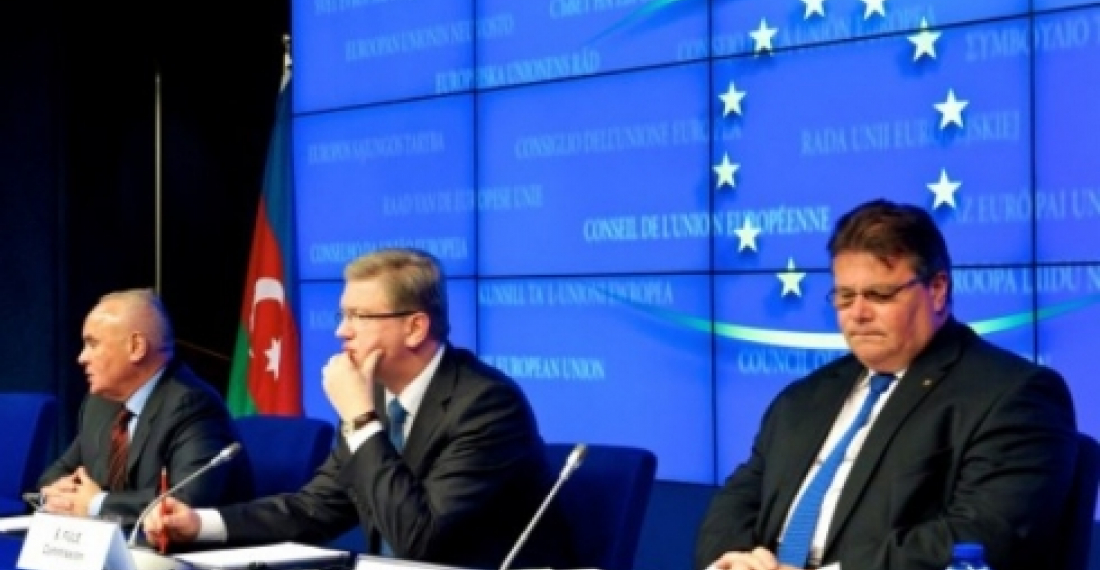
Meetings of the EU-Armenia Co-operation Council and the EU-Azerbaijan Co-operation Council were held in Brussels on Monday. The annual meetings provide an opportunity for the EU and the two Caucasus states to review progress in their bilateral relations and to plan ahead.
This is an odd moment in the state of relations and the statements that emerged from the meetings reflect the reality as all sides tried to put a brave face forward and give the impression of business as usual. In fact it hardly is.
With regards to Armenia the EU is still reeling from the last minute decision of the Armenian government not to go ahead with an Association Agreement that had been painstakingly negotiated over the last three years. Commissioner Stefan Fule told a press conference after the meeting of the EU-Armenia Co-operation Council which was also attended by the Armenian Foreign Minister, Edward Nalbandian,
"Compared to previous Cooperation Council there is definitely a difference in the content of our discussions - given the new international commitments of Armenia. But what remains the same, is our desire and resolve to continue to have a close relationship and take it forward, based on what we have achieved so far. In this light, we have reconfirmed the need to revisit the basis for our bilateral relations, as well as to update the EU-Armenia European Neighbourhood Policy Action Plan to adjust it to the extent and ambitions of our future cooperation."
Relations with Azerbaijan are also at the moment somewhat awkward. Azerbaijan has shown no enthusiasm to sign an Association Agreement with the EU, preferring instead a more general "strategic partnership". The EU has concerns about the pace and breadth of political and economic reforms in Azerbaijan. In a press conference, also attended by the Azerbaijani representative, Deputy Foreign Minister Mahmud Mamad Guliev, Commissioner Fule said
"May I start with the same sentence I used last year? Because it fits well this year: 'We are glad to see Azerbaijan and the European Union moving closer to each other. Our cooperation is bearing fruit' - just look at the results of the Eastern Partnership summit in Vilnius and the signature of the Visa Facilitation Agreement."
There was however also some thinly veiled criticism about what are perceived to be Azerbaijani shortcomings. Fule said:
"Another essential element of our relations is respect for fundamental freedoms. We call on Azerbaijan to respect its international commitments in this regard. There is still a lot to be done in areas such as freedom of the media, freedom of assembly, freedom of association.
It is equally important to bring electoral legislation in line with the recommendations of the OSCE/ ODIHR. This needs to happen soon so that Azerbaijan can deliver fair and transparent municipal elections next year and parliamentary elections in 2015. There is also important work to be done to address corruption.
In all these areas, Azerbaijan can count on the EU's support. We are committed to continue and to deepen our frank and open dialogue. We are committed to make our cooperation mutually enriching. We will be as ambitious as our partners are willing to be, and we will deliver to the extent to which our partners are able to deliver on reforms."
There was no hint of drama in either meetings. Both sides in both meetings pledged eternal friendship, and there is a wish to consolidate whatever small gains have been achieved and move forward slowly. But quite where relations between the EU and the two countries will be going over the next year and more is not at all clear. However for the moment all sides are marking time.
source: commonspace.eu
photo: The EU-Azerbaijan Co-operation Council Meeting in Brussels on 9 November, (from left to right) Azerbaijani Deputy Foreign Minister M. Mamad Guliev, the EU Commissioner for Enlargement Stefan Fule and the Lithuanian Foreign Minister (EU Presidency) Linas Linkevičius, (Picture courtesy of the Press Service of the European Union).



