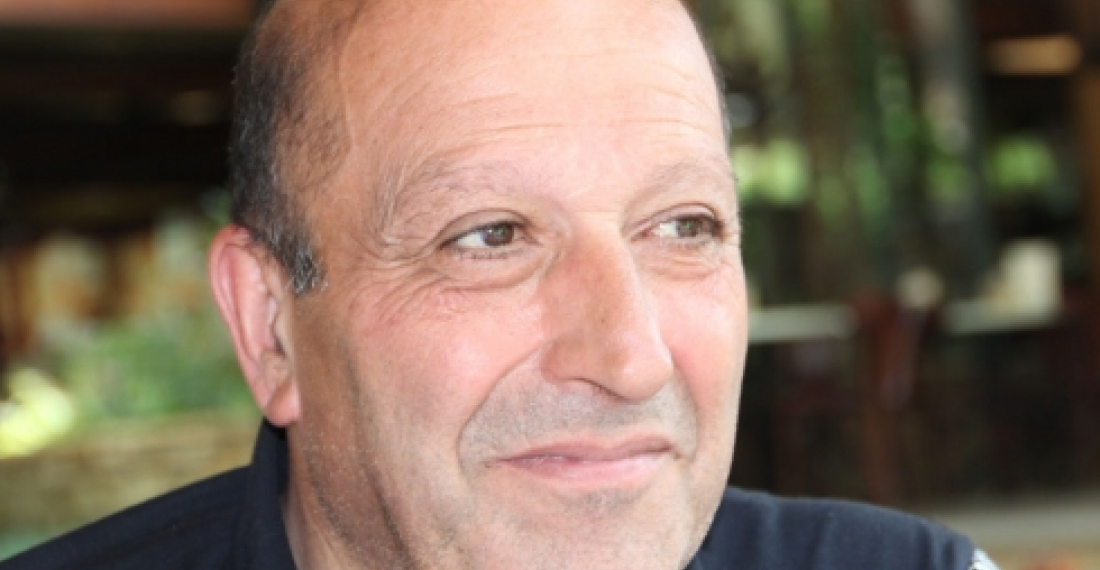
A doctor singing in a choir...

Recently I happened to meet a very interesting person. I was sitting in a café when I heard somebody fluently speaking Armenian with a slight Western Armenian accent. I curiously strained my ears to hear what was being said without being noticed. But I was no longer able to resist my curiosity once I understood that the speaker was from Nagorno-Karabakh! I turned to the table where that man was sitting with a friend, introduced myself and asked if I could join them. The man gave me an amicable smile and welcomed to take the vacant seat. 

His name was Shahen Baleozyan. He was the chief doctor of Kashadagh district. He said he was in Yerevan on holiday but was going to retire upon his return because of some health problems.

An immigrant from Syria, Mr.Baleozyan told me how he had got to Berdzor (Latchin) and why he had stayed there to live and work miles away from his family.

“I remember the year 2007, when I came to Armenia with my son, who was willing to enter the Yerevan Medical Institute. One evening I was watching TV when I saw an announcement inviting doctors to work in Nagorno-Karabakh... My first thought was ‘I must help my country.’ So, the next day I went to the interview. There were twenty of us but only four qualified. We were interviewed by Artsakh Buniatyan, the chief doctor of the Nagorno-Karabakh Republic. It was a strange interview, I must say... He asked a couple of questions, I answered and, then, we began looking at one another. I think it was then that we understood that we could get along well.

And now I was already on my way to Karabakh... I was very lucky: the driver of the car had turned out to me my distant relative and had agreed to give me shelter until I got my own dwelling.

After a while as a surgeon, I was offered the posts of director of the local hospital and chief doctor of the district. I had never been manager before so I was forced to learn some standards and the labor code.

Realizing what a great responsibility it was to take control of a war-ridden business, I started to actively modernize it. The major problem was the shortage of personnel. I pulled the strings and very soon we opened obstetrics, gynecology, surgery and therapeutics departments.

My friends abroad helped me to find drugs and equipment. I did it all without being paid as the social-economic situation was just beginning to improve.”

The friend of Mr.Baleozyan said that he was not only a doctor and manager but also a benefactor: he has restored the local medieval church, has provided his personnel with new uniforms. Mr.Baleozyan was silent all the time while his friend was praising him. Then, he told me a funny story that had made him “famous...”

“I am not a professional singer but I always sang in choirs when I was a child... When the Berdzor Church resumed its services, I talked with the local priest and he agreed to hire me as ... a singer. And then came the day when I first sang. The service was underway when I suddenly noticed that people were looking at me curiously and whispering something to one another. After the service they began approaching me and asking for how long I had been engaged in singing. I don’t remember how it all ended on that day but the fact is that since then people have known me better as a singer than a doctor!”

Saying this, my smiling companion apologized, explaining that he had an appointment and had to go.

The special thing about our conversation was that Mr.Baleozyan was telling about hardships with such an ease that for some moment I forgot who he was and what privations he had gone through...

For a long time after his departure I was still thinking about the small town, its residents, the local church, the district doctor singing in it - the man who tried to bring people to life after destruction by showing them how important it was to have strong will and to believe in eternal values.


Gohar Karapetyan

Related articles

Editor's choice
News
Key European countries back Denmark in the face of Trump's continuing insistence on taking over Greenland

Key European countries back Denmark in the face of Trump's continuing insistence on taking over Greenland

 Six major European countries have declared their support to Denmark following renewed insistence by the US that it must have control over Greenland. "Greenland belongs to its people, and only Denmark and Greenland can decide on matters concerning their relations," said the leaders of the UK, France, Germany, Italy, Poland, and Spain, in a joint statement, issued on Tuesday (6 January), together with Denmark. On Sunday, Donald Trump said the US "needed" Greenland - a semi-autonomous region of fellow Nato member Denmark - for security reasons. He has refused to rule out the use of force to take control of the territory, and Danish Prime Minister Mette Frederiksen warned on Monday that an attack by the US would spell the end of Nato. The issue of Greenland's future resurfaced in the wake of the US military intervention in Venezuela, during which elite troops went in to seize the country's President Nicolás Maduro and take him to face drugs and weapons charges in New York. Following the raid, Trump said the US would "run" Venezuela for an unspecified period of time. He also said the US was returning to an 1823 policy of US supremacy in its sphere of influence in the Western hemisphere - and he warned a number of countries the US could turn its attention to them. The US military raid in Venezuela has reignited fears that the US may consider using force to secure control of Greenland. A day after the raid, Katie Miller - the wife of one of Trump's senior aides - posted on social media a map of Greenland in the colours of the American flag, alongside the word "SOON". On Monday, her husband Stephen Miller said it was "the formal position of the US government that Greenland should be part of the US". In an interview with CNN, he also said the US "is the power of Nato. For the US to secure the Arctic region, to protect and defend Nato and Nato interests, obviously Greenland should be part of the US." Asked repeatedly whether the US would rule out using force to annex it, Miller responded: "Nobody's going to fight the US over the future of Greenland." Stressing they were as keen as the US in Arctic security, the seven European signatories of Tuesday's joint statement said this must be achieved by Nato allies, including the US "collectively" - whilst "upholding the principles of the UN Charter, including sovereignty, territorial integrity and the inviolability of borders". Greenland's Prime Minister Jens-Frederik Nielsen welcomed the statement and called for "respectful dialogue". "The dialogue must take place with respect for the fact that Greenland's status is rooted in international law and the principle of territorial integrity," Nielsen said. Trump has claimed that making Greenland part of the US would serve American security interests due to its strategic location and its abundance of minerals critical to high-tech sectors. Greenland, which has a population of 57,000 people, has had extensive self-government since 1979, though defence and foreign policy remain in Danish hands. While most Greenlanders favour eventual independence from Denmark, opinion polls show overwhelming opposition to becoming part of the US.
Editor's choice
News
Donald Tusk: "One for all, and all for one! Otherwise we are finished."

Donald Tusk: "One for all, and all for one! Otherwise we are finished."

Europe is rattled by events in Venezuela, and there are serious concerns that US disregard for international law may have consequences close to home.  The BBC diplomatic correspondent, James Landale, said, the question is how Europe may respond in the longer term to America's military operation in Venezuela. Will it provide a catalyst for the continent to take greater responsibility for its own security in the face of so much instability from what many see as an unreliable ally? Polish prime minister, Donald Tusk, appears to have answered the question, saying on social media: "No-one will take seriously a weak and divided Europe: neither enemy nor ally. It is already clear now. "We must finally believe in our own strength, we must continue to arm ourselves, we must stay united like never before. One for all, and all for one. Otherwise, we are finished." The US seizing of Venezuela's leader has faced strong criticism from both America's friends and foes at an emergency meeting of the United Nations Security Council, held on Monday, 5 January. Many member states agreed with the US that Nicolás Maduro had been an illegitimate and repressive leader. But many also condemned the US military action as a breach of international law and the UN Charter, and they demanded a democratic transition that reflected the will of the Venezuelan people. (click the image to read the full article).

Popular

Editor's choice
News
Key European countries back Denmark in the face of Trump's continuing insistence on taking over Greenland

Key European countries back Denmark in the face of Trump's continuing insistence on taking over Greenland

 Six major European countries have declared their support to Denmark following renewed insistence by the US that it must have control over Greenland. "Greenland belongs to its people, and only Denmark and Greenland can decide on matters concerning their relations," said the leaders of the UK, France, Germany, Italy, Poland, and Spain, in a joint statement, issued on Tuesday (6 January), together with Denmark. On Sunday, Donald Trump said the US "needed" Greenland - a semi-autonomous region of fellow Nato member Denmark - for security reasons. He has refused to rule out the use of force to take control of the territory, and Danish Prime Minister Mette Frederiksen warned on Monday that an attack by the US would spell the end of Nato. The issue of Greenland's future resurfaced in the wake of the US military intervention in Venezuela, during which elite troops went in to seize the country's President Nicolás Maduro and take him to face drugs and weapons charges in New York. Following the raid, Trump said the US would "run" Venezuela for an unspecified period of time. He also said the US was returning to an 1823 policy of US supremacy in its sphere of influence in the Western hemisphere - and he warned a number of countries the US could turn its attention to them. The US military raid in Venezuela has reignited fears that the US may consider using force to secure control of Greenland. A day after the raid, Katie Miller - the wife of one of Trump's senior aides - posted on social media a map of Greenland in the colours of the American flag, alongside the word "SOON". On Monday, her husband Stephen Miller said it was "the formal position of the US government that Greenland should be part of the US". In an interview with CNN, he also said the US "is the power of Nato. For the US to secure the Arctic region, to protect and defend Nato and Nato interests, obviously Greenland should be part of the US." Asked repeatedly whether the US would rule out using force to annex it, Miller responded: "Nobody's going to fight the US over the future of Greenland." Stressing they were as keen as the US in Arctic security, the seven European signatories of Tuesday's joint statement said this must be achieved by Nato allies, including the US "collectively" - whilst "upholding the principles of the UN Charter, including sovereignty, territorial integrity and the inviolability of borders". Greenland's Prime Minister Jens-Frederik Nielsen welcomed the statement and called for "respectful dialogue". "The dialogue must take place with respect for the fact that Greenland's status is rooted in international law and the principle of territorial integrity," Nielsen said. Trump has claimed that making Greenland part of the US would serve American security interests due to its strategic location and its abundance of minerals critical to high-tech sectors. Greenland, which has a population of 57,000 people, has had extensive self-government since 1979, though defence and foreign policy remain in Danish hands. While most Greenlanders favour eventual independence from Denmark, opinion polls show overwhelming opposition to becoming part of the US.