


"Cynics should hold their peace. Young civil society has much to give"

Opinion: "At a work-shop with young people from 14 countries in Borjomi last weekend I was once more reminded of the great resource of hope, ideas, energy and good will that lies largely untapped, but that is much needed if we are going to seriously engage in tackling global and regional challenges ahead", writes Dennis Sammut in this op-ed.

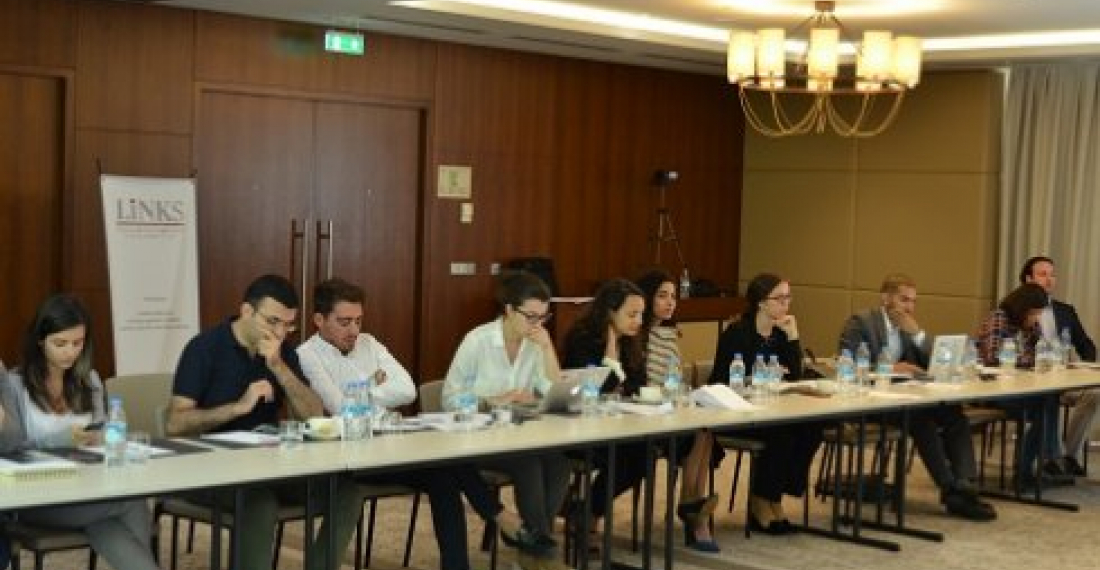
I spent last weekend in the Georgian town of Borjomi, together with a group of forty-five mainly young people, discussing global and regional issues. Whilst many of the participants were from the Caucasus region, others came from other parts of Europe and its neighbourhood.

The event was an initiative of LINKS (Dialogue, Analysis and Research), a small action oriented think tank with a long track record of work in the Caucasus. LINKS is twenty years old this year, and it decided to mark the occasion by going back to the Caucasus to engage with a new generation of activists and thinkers on the main issues of the day.

I have been to hundreds of such meetings over the years, but rarely have I left a meeting so hopeful and so energised. It was not simply the sense of optimism among participants and their ability to think positively and creatively that was most striking, but more so the sense of acute awareness of the challenges ahead.

The timing was not easy - Armenian and Azerbaijan participants were very much sensitive to the fact that in the previous days there had been much bloodshed in the Karabakh conflict zone - Azerbaijani civilians and teenage Armenian conscripts had lost their lives.

Beyond, the crisis in the Gulf was reaching its climax, and on the television screens images of the G20 summit in Hamburg flickered in the background reminding us all of the huge problems facing humanity. But the new generation is no longer willing to accept simplistic answers to complex problems.

The challenge of how to receive and digest information in today's global information jungle may seem daunting, but young people appear to be more discerning than their elders - not quite immune yet to fake news and disinformation, but certainly more aware of it. Social and civil activism is now also taking new forms, cleverly manoeuvring around ever emerging constraints. This is also happening on the global arena where a "third generation" of public diplomacy initiatives and ideas is slowly emerging leaving traditional diplomacy struggling to catch up.

In Borjomi last weekend these difficult issues could be discussed openly and calmly, and what emerged was a wealth of ideas on what can be done better in the future, and how. The tone was set by the keynote speaker, Lord Purvis of Tweed, a member of the Foreign Affairs Committee of the UK House of Lords, who presented a set of challenging and innovative ideas in an excellent and thoughtful opening presentation.

In my work I am often obliged to engage simultaneously with traditional political and diplomatic settings, and in track 2 informal and alternative frameworks. Indeed, an important part of my job is to try to bridge the two. Established politicians and diplomats are often dismissive of civil society initiatives, evaluating them as irrelevant at best. In Borjomi this weekend I was once more convinced of the folly of this approach.

There is a wealth of energy and ideas in many track 2 processes that are much needed if the big challenges of the day are to be resolved. In the Caucasus region, the EU supported EPNK initiative is now engaged in such a venture, despite the fact that the support of governments in the region, as well as the more traditional international diplomatic frameworks, is often lukewarm. Yet despite the all-round cynicism that I encounter every day in the international community, in Borjomi last weekend I was once more reminded of the great resource of hope, ideas, energy and good-will that lies largely untapped, but that is much needed if we are going to seriously engage in tackling global and regional challenges ahead. Cynics should hold their peace. Young civil society has much to give.

Dennis Sammut is the Executive Director and co-founder of LINKS (Dialogue, Analysis and Research). The workshop "Global challenges, shifting regional parameters, and the need for innovative responses" was held in Borjomi, Georgia from 7-9 July 2017 as part of the activities marking the 20th anniversary of LINKS (DAR). For more information please contact office@links-dar.org

photo: Young civil society participants from 14 countries participated at a LINKS (DAR) workshop in Borjomi, Georgia on 7- 9 July 2017
Related articles

Editor's choice
News
Aden under curfew, as problem in Yemen's south deepens

Aden under curfew, as problem in Yemen's south deepens

The port city of Aden, in Yemen's south, has been put under curfew, as the rift in the country between  the Saudi led coalition which  backs Yemen's presidential governing council, and the southern forces led by the Southern Transitional Council (STC), deepens. Abdul Rahman al-Mahrami, a member of the Yemeni Presidential Governing Council and commander of the al-Amalik brigades, has ordered a curfew in the temporary capital, Aden, "to maintain security". "A curfew has been imposed throughout Aden Governorate from 9:00 p.m. to 6:00 a.m., in accordance with the instructions of Commander Abdul Rahman al-Mahrami, a member of the Presidential Management Council," the statement said. It states that only security and military personnel, as well as medical and technical teams with approved permits, will be allowed to move in the area during these hours. Yemen's presidential council, which is backed by Saudi Arabia and which already is in a struggle with the Houthi Movement in the north of the country who also occupy the capital Sanaa, two days ago issued an order for the arrest of the head of the Southern Transitional Council (STC),, Aidarous al Zubaidi. The STC have wide support among people in the South, and advocate that South Yemen restores its independence. The coalition warned of further escalation in Aden, long regarded as an STC stronghold, as the Presidential Leadership Council (PLC) chief accused STC leader Aidarous Al Zubaidi of “high treason” and announced the revocation of his membership in the governing body. The moves mark a sharp escalation in tensions within the anti-Houthi camp, despite National Shield Forces, rivals of the STC and former allies, having recently retaken control of Hadhramaut and Mahra from southern fighters. The STC’s takeover of the two regions last month angered Saudi Arabia and contributed to igniting the current internal conflict. (click the picture to read more)

Popular

Editor's choice
Event
commonspace.eu is getting better

commonspace.eu is getting better

Commonspace.eu will this year celebrate its 15th anniversary. In this period we provided space for different opinions, including to persons from the countries and areas we are focused on, which have included Georgians, Armenians, Azerbaijanis, Yemenis, Ukrainians and many others. We have also, as much as is possible for a news outlet that does not have a network of paid journalists, provided accurate information, especially at times of crises. We have done so whilst remaining inspired by our vision for a just and peaceful world, of a Europe that works in peace and collaboration with its neighbourhood, and to give a voice to youth, women, minorities and other groups that struggle to be heard. This week we are launching new features, and strengthening established ones, to make commonspace.eu more effective, and more useful for our eclectic readership. On Thursday, we launch our new series, THURSDAY INTERVIEW. The interviews will be conducted by Lauri Nikulainen, and the first interview is with Murad Muradov, Vice President of the Topchubashov Centre in Baku. On Friday we will have a selection from our regular newsletters: Caucasus Concise, Arabia Concise and Central Asia Concise. We hope to add a fourth newsletter shortly. On Monday, the Monday Commentary by our Managing Editor, Dr Dennis Sammut, is back. The commentaries reflect the author’s years of experience, but equally his passion for change and a better world. On Tuesday and Wednesday, we feature articles by our regular guest contributors, including Onik Krikorian, Benyamin Poghosyan and Vasif Huseynov. We will of course also feature daily news stories from Europe, and the regions around it, the neighbourhood with which we need to build a common future. We hope that you will find commonspace.eu interesting and useful.
Editor's choice
Event
commonspace.eu is getting better

commonspace.eu is getting better

Commonspace.eu will this year celebrate its 15th anniversary. In this period we provided space for different opinions, including to persons from the countries and areas we are focused on, which have included Georgians, Armenians, Azerbaijanis, Yemenis, Ukrainians and many others. We have also, as much as is possible for a news outlet that does not have a network of paid journalists, provided accurate information, especially at times of crises. We have done so whilst remaining inspired by our vision for a just and peaceful world, of a Europe that works in peace and collaboration with its neighbourhood, and to give a voice to youth, women, minorities and other groups that struggle to be heard. This week we are launching new features, and strengthening established ones, to make commonspace.eu more effective, and more useful for our eclectic readership. On Thursday, we launch our new series, THURSDAY INTERVIEW. The interviews will be conducted by Lauri Nikulainen, and the first interview is with Murad Muradov, Vice President of the Topchubashov Centre in Baku. On Friday we will have a selection from our regular newsletters: Caucasus Concise, Arabia Concise and Central Asia Concise. We hope to add a fourth newsletter shortly. On Monday, the Monday Commentary by our Managing Editor, Dr Dennis Sammut, is back. The commentaries reflect the author’s years of experience, but equally his passion for change and a better world. On Tuesday and Wednesday, we feature articles by our regular guest contributors, including Onik Krikorian, Benyamin Poghosyan and Vasif Huseynov. We will of course also feature daily news stories from Europe, and the regions around it, the neighbourhood with which we need to build a common future. We hope that you will find commonspace.eu interesting and useful.

