


No dinner for Mr Putin! The official dinner at the EU-Russia Summit on 28 January cancelled as EU shows displeasure at Russian policies.

There will be no official dinner at the forthcoming EU-Russia Summit which is scheduled to take place in Brussels on 28 January. The Summit is held twice a year, once in Russia and once in Brussels, and usually starts with an official dinner and continues with talks the following day. It offers Russia and the EU an opportunity to review relations and discuss outstanding problems.

This time round the summit has been shortened to one day and the official dinner has been dropped. Diplomats in Brussels are saying that the EU wants to send a message to the Russian leader that it is not business as usual. The Reuters News Agency also quoted one diplomat as saying that the change in the format of the meeting was "a way to be able to speak a bit more frankly, to have a more strategic discussion, instead of the normal theatrical summit."

Differences over Ukraine and Georgia are some of the issues that have been creating tensions in relations. The EU will use the summit with Russia to talk "honestly and frankly" about problems in the relationship, including raising human rights issues, the diplomat said.

Trade between Russia and the EU totalled 336 billion euros in 2012 and neither side wants to jeopardise this. However the number of problems in the relationship have been increasing and recent Russian attempts to undermine the EU\'s Eastern Partnership has caused great irritation in Brussels.

Russia\'s Ambassador to the European Union, Vladimir Chizhov on Monday (13 January) addressed about two hundred officials, diplomats, and journalists during a rare public appearance at the European Policy Centre, a leading think-tank in Brussels.

Chizhov acknowledged that there is a "lack of trust" between Brussels and Moscow that is feeding "misperceptions" dating back centuries.

"It‘s our common duty to try to break this vicious circle," he said.

He argued that Russia‘s project for a Customs Union with other former Soviet republics was "neither the EU‘s geopolitical rival, nor a Soviet Union 2.0." Moscow also plans to work towards a Eurasian Economic Union. Treaties should be signed and ratified this year, so that ithe Union can enter into force on January 1, 2015, Chizhov said. He called for the EU and Russia to "look for ways to harmonise the European and Eurasian integration processes." He also suggested that progress at the summit on visa-free access to the EU for Russians "would be welcome."

The Russian diplomat also referred in his speech to problems between Russia and the EU on energy issues and said that Gazprom was holding consultations with the European Commission regarding anti-monopoly sanctions against the Russian company but said that he was not aware of the details of these consultations."I can only confirm that the parties are holding consultations," he said.

The EU in September 2012 started an anti-monopoly investigation of Gazprom following a complaint by Lithuania.

source: commonspace.eu with agencies

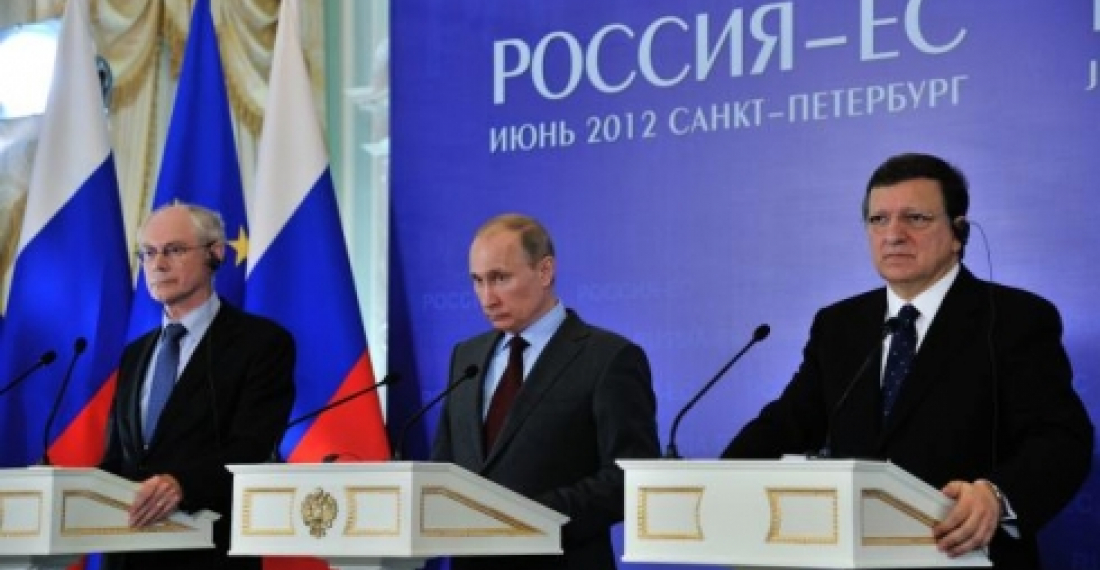
photo: President Putin with EU Council President  Van Rumpoy and Commission President Barroso at the EU Russia Summit in St Petersburg in 2012 (archive picture).


 

Related articles

Editor's choice
News
Borrell tells the European Parliament that the situation in Afghanistan was critical, but the EU will remain engaged

Borrell tells the European Parliament that the situation in Afghanistan was critical, but the EU will remain engaged

Borrell underlined that the European Union will make every effort to support the peace process and to remain a committed partner to the Afghan people. "Of course, we will have to take into account the evolving situation, but disengagement is not an option.  We are clear on that: there is no alternative to a negotiated political settlement, through inclusive peace talks.
Editor's choice
News
Germany accuses Russia of cyberattacks and disinformation campaign

Germany accuses Russia of cyberattacks and disinformation campaign

The German government holds Russia responsible for a cyberattack on German air traffic control, and for targeted disinformation campaigns before the last federal election. According to the German Foreign Office in Berlin, the incidents could be clearly attributed to the Russian military intelligence service, the GRU. In response, the Russian ambassador to Berlin was summoned to the Foreign Ministry. "We have been observing a massive increase in threatening hybrid activities by Russia for some time now," a spokesperson for the Foreign Ministry stated. These range from disinformation campaigns and espionage to cyberattacks and sabotage attempts. The aim is to divide society, sow distrust, and undermine confidence in democratic institutions. The spokesperson added that with these actions, Russia is "very concretely threatening our security, not only through its war of aggression against Ukraine, but also here in Germany."  The Foreign Ministry spokesperson explained that the cyberattack on air traffic control in August 2024 was clearly attributed to the hacker collective "APT28," known as "Fancy Bear," and to the responsibility of the Russian military intelligence service, the GRU. Furthermore, it could now be "conclusively stated" that Russia had attempted "to influence and destabilize both the last Federal election and the ongoing internal affairs of the Federal Republic of Germany." There was "absolutely irrefutable evidence" for this". The so-called "Storm 1516" campaign, which has been running since 2024, is allegedly backed by "reliable information" that the Moscow-based think tank "Center for Geopolitical Expertise" is behind it. The Center is also said to be supported by Russian military intelligence. Its primary aim is to influence democratic elections in the West. (Click the image to read more).

Popular

Editor's choice
News
Germany accuses Russia of cyberattacks and disinformation campaign

Germany accuses Russia of cyberattacks and disinformation campaign

The German government holds Russia responsible for a cyberattack on German air traffic control, and for targeted disinformation campaigns before the last federal election. According to the German Foreign Office in Berlin, the incidents could be clearly attributed to the Russian military intelligence service, the GRU. In response, the Russian ambassador to Berlin was summoned to the Foreign Ministry. "We have been observing a massive increase in threatening hybrid activities by Russia for some time now," a spokesperson for the Foreign Ministry stated. These range from disinformation campaigns and espionage to cyberattacks and sabotage attempts. The aim is to divide society, sow distrust, and undermine confidence in democratic institutions. The spokesperson added that with these actions, Russia is "very concretely threatening our security, not only through its war of aggression against Ukraine, but also here in Germany."  The Foreign Ministry spokesperson explained that the cyberattack on air traffic control in August 2024 was clearly attributed to the hacker collective "APT28," known as "Fancy Bear," and to the responsibility of the Russian military intelligence service, the GRU. Furthermore, it could now be "conclusively stated" that Russia had attempted "to influence and destabilize both the last Federal election and the ongoing internal affairs of the Federal Republic of Germany." There was "absolutely irrefutable evidence" for this". The so-called "Storm 1516" campaign, which has been running since 2024, is allegedly backed by "reliable information" that the Moscow-based think tank "Center for Geopolitical Expertise" is behind it. The Center is also said to be supported by Russian military intelligence. Its primary aim is to influence democratic elections in the West. (Click the image to read more).
