


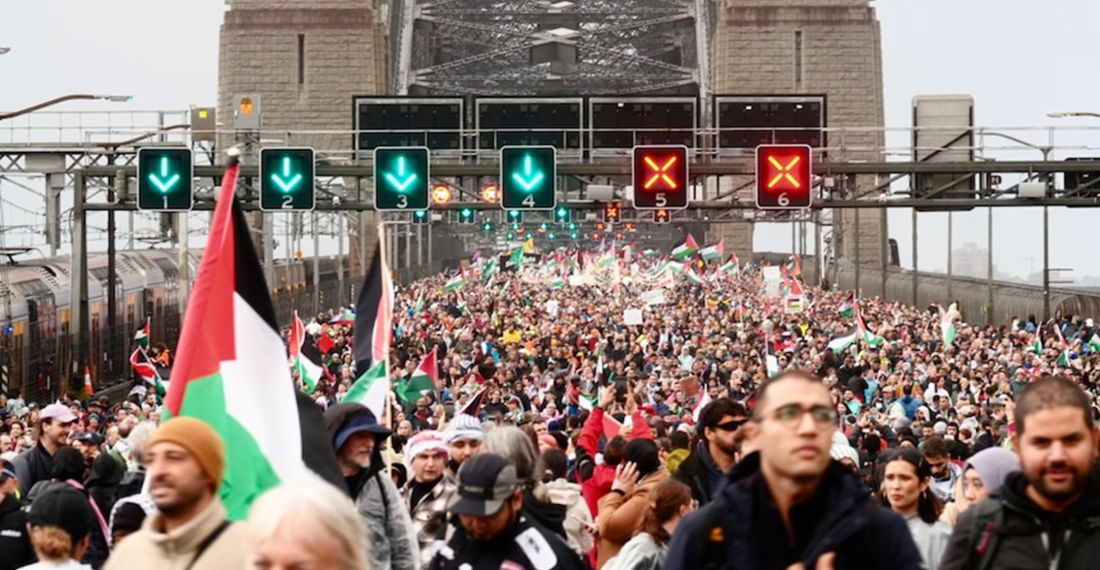
Massive pro-Palestinian march in Australia

A massive pro-Palestinian march has taken place in Australia despite official attempts to stop it.

Tens of thousands turned out for the March for Humanity on Sunday despite torrential rain - with many carrying placards with messages to politicians to stop the war.

"Shame shame Israel, shame shame USA," the crowds chanted. "What do we want? Ceasefire. When do we want it? Now."

Lots of families, many with small babies, came out to support the peaceful demonstration. Alongside them, stationed across the bridge, were police officers from the riot squad.

"I know it's the other side of the world but it affects us here massively as well," says dad Alec Beville, who compares the children in Gaza to his three-year-old son Frankie. "We could be helping a lot more with aid."

"Our government hasn't put any decent sanctions on Israel," says Zara Williams as she carries her baby, Avery, in a sling. "We [Australia] just can't do nothing while there's a forced starvation of an entire population."

Two hours into the march, attendees received a text from NSW Police that read: "In consultation with the organisers, the march needs to stop due to public safety and await further instructions."

It asked everyone on the bridge to stop walking north and turn back toward the city in a "controlled" way.

Police have not yet provided an estimate of the numbers attending the march.

Sydney-based activist organisation Palestine Action Group lodged a notice of intention for the march across the Sydney Harbour Bridge last Sunday, in response to what it called the "atrocity" in Gaza.

Police rejected the application on the grounds that there was not enough time to prepare a traffic management plan, and warned of a potential crowd crush and other safety concerns.

In a statement the following day, NSW Premier Chris Minns said they could not allow Sydney to "descend into chaos" and would not be able to support a protest of "this scale and nature" taking place on the bridge.

The police also made an application to the NSW Supreme Court for a prohibition order for the event, which was declined just 24 hours before the protest was due to go ahead.

According to the Australian Broadcasting Corporation, Justice Belinda Rigg said safety concerns regarding the march were "well founded", but march organiser Josh Lees from the Palestine Action Group had "compellingly" explained the reasons why he believed there needed to be an urgent response to the humanitarian situation in Gaza.

She said there was no evidence that a prohibition order would enhance public safety, and ordered the Sydney Harbour Bridge to be closed to vehicles, in addition to roads surrounding the proposed route.

The final-hour authorisation gives attendees protection under the Summary Offences Act, meaning they will not be charged for offences specifically relating to public assembly, such as blocking traffic.

In a statement published to Instagram, the NSW Jewish Board of Deputies said that it was "disappointed" by the Supreme Court's decision to authorise the protest on the Sydney Harbour Bridge.

Australia has been under mounting pressure to recognise Palestinian statehood, after France, Canada and the UK all separately indicated that they would do so with conditions at the upcoming United Nations General Assembly in September.

Speaking on ABC's 7.30 programme, Prime Minister Anthony Albanese said he wants to see conditions met that achieve lasting security for Israel before Australia commits to recognition of a Palestinian state.

He added that he would not be pushed into the decision by other nations.

source: commonspace.eu with BBC (London), ABC (Sydney and agencies

Related articles

Editor's choice
News
Borrell tells the European Parliament that the situation in Afghanistan was critical, but the EU will remain engaged

Borrell tells the European Parliament that the situation in Afghanistan was critical, but the EU will remain engaged

Borrell underlined that the European Union will make every effort to support the peace process and to remain a committed partner to the Afghan people. "Of course, we will have to take into account the evolving situation, but disengagement is not an option.  We are clear on that: there is no alternative to a negotiated political settlement, through inclusive peace talks.
Editor's choice
News
NATO Chief says war is on Europe's doorstep, and warns against complacency

NATO Chief says war is on Europe's doorstep, and warns against complacency

Russia could attack a Nato country within the next five years, the Secretary General of NATO, Mark Rutte, said in a stark new warning. "Nato's own defences can hold for now," Rutte warned in Berlin, but conflict was "next door" to Europe and he feared "too many are quietly complacent, and too many don't feel the urgency, too many believe that time is on our side. "Russia is already escalating its covert campaign against our societies," Rutte said in a speech in Germany. "We must be prepared for the scale of war our grandparents or great-grandparents endured." Earlier this month, Russia's President Vladimir Putin said his country was not planning to go to war with Europe, but it was ready "right now" if Europe wanted to - or started a war. But similar reassurances were given by Moscow in 2022, just before 200,000 Russian troops crossed the border and invaded Ukraine. Putin has accused European countries of hindering US efforts to bring peace in Ukraine - a reference to the role Ukraine's European allies have recently played in trying to change a US peace plan to end the war, whose initial draft was seen as favouring Russia. But Putin was not sincere, Nato's secretary-general said in the German capital, Berlin. Supporting Ukraine, he added, was a guarantee for European security. "Just imagine if Putin got his way; Ukraine under the boot of Russian occupation, his forces pressing against a longer border with Nato, and the significantly increased risk of an armed attack against us." Russia's economy has been on a war footing for more than three years now - its factories churn out ever more supplies of drones, missiles and artillery shells. According to a recent report by the Kiel Institute for the World Economy, Russia has been producing each month around 150 tanks, 550 infantry fighting vehicles, 120 Lancet drones and more than 50 artillery pieces. The UK, and most of its Western allies, are simply not anywhere near this point. Analysts say it would take years for Western Europe's factories to come close to matching Russia's mass-production of weapons. "Allied defence spending and production must rise rapidly, our armed forces must have what they need to keep us safe," the Nato chief said.

Popular

Editor's choice
News
NATO Chief says war is on Europe's doorstep, and warns against complacency

NATO Chief says war is on Europe's doorstep, and warns against complacency

Russia could attack a Nato country within the next five years, the Secretary General of NATO, Mark Rutte, said in a stark new warning. "Nato's own defences can hold for now," Rutte warned in Berlin, but conflict was "next door" to Europe and he feared "too many are quietly complacent, and too many don't feel the urgency, too many believe that time is on our side. "Russia is already escalating its covert campaign against our societies," Rutte said in a speech in Germany. "We must be prepared for the scale of war our grandparents or great-grandparents endured." Earlier this month, Russia's President Vladimir Putin said his country was not planning to go to war with Europe, but it was ready "right now" if Europe wanted to - or started a war. But similar reassurances were given by Moscow in 2022, just before 200,000 Russian troops crossed the border and invaded Ukraine. Putin has accused European countries of hindering US efforts to bring peace in Ukraine - a reference to the role Ukraine's European allies have recently played in trying to change a US peace plan to end the war, whose initial draft was seen as favouring Russia. But Putin was not sincere, Nato's secretary-general said in the German capital, Berlin. Supporting Ukraine, he added, was a guarantee for European security. "Just imagine if Putin got his way; Ukraine under the boot of Russian occupation, his forces pressing against a longer border with Nato, and the significantly increased risk of an armed attack against us." Russia's economy has been on a war footing for more than three years now - its factories churn out ever more supplies of drones, missiles and artillery shells. According to a recent report by the Kiel Institute for the World Economy, Russia has been producing each month around 150 tanks, 550 infantry fighting vehicles, 120 Lancet drones and more than 50 artillery pieces. The UK, and most of its Western allies, are simply not anywhere near this point. Analysts say it would take years for Western Europe's factories to come close to matching Russia's mass-production of weapons. "Allied defence spending and production must rise rapidly, our armed forces must have what they need to keep us safe," the Nato chief said.


