


Cynical Russian proposal at the UN unlikely to impress international community

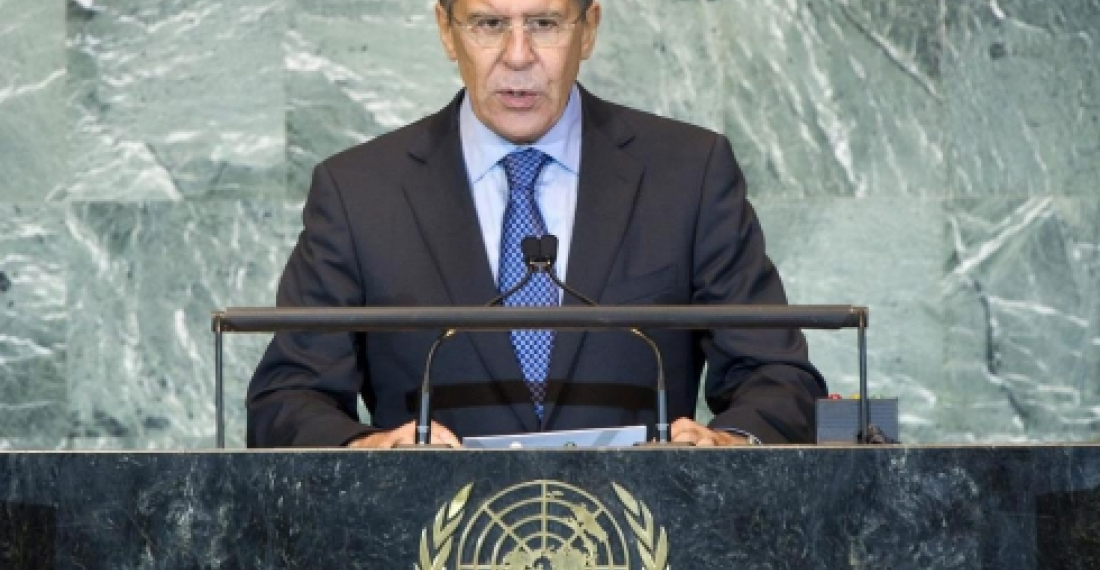
Russian Foreign Minister Sergei Lavrov tod the UN General Assembly in New York that  "Russia is ready to act as a guarantor of arrangements on non-use of force between Abkhazia, Georgia and South Ossetia, taking into account the earlier relevant statements of the leaders of these three countries". Lavrov said that Russia  "would welcome it if the United States and the European Union made similar committments. As guarantors we would be ready to take steps to prevent resumption of violence in the region and in case of wrongful use of force by either side to work towards the early settlement of the situation on the basis of the existing norms of international law".

The Political Editor of commonspace.eu commented that the Russian offer is likely to be received with a lot of cynicism, not only in Georgia but also in the wider international community where Russia has for long stopped being perceived as an honest broker in the conflict between Georgia and its two break-away regions of Abkhazia and South Ossetia. Russia recognised the two regions as indpendent countries after the August 2008 war.

The Russian Foreign Minister did not offer to make similar security guarantees in the context of the Karabakh conflict but said that Russia will promote confidence building and ceasefire measures within the framework of the OSCE Minsk Group co-Chair troika.

source: commonspace.eu

photo: Foreign Minister Lavrov speaking at the 66 UN General Assembly in New York (picture courtesy of the United Nations)
Related articles

Editor's choice
News
Armenia-Azerbaijan Strategic Expert Platform: Members emphasise the importance of the present moment for the South Caucasus and call for the momentum to be used for the long-term peace and prosperity of the region

Armenia-Azerbaijan Strategic Expert Platform: Members emphasise the importance of the present moment for the South Caucasus and call for the momentum to be used for the long-term peace and prosperity of the region

On 27 February 2026, the members of the Armenia-Azerbaijan Strategic Expert Platform met in Antwerp, Belgium, to assess developments in the South Caucasus following the initialling of a peace agreement between Armenia and Azerbaijan on 8 August 2025 at the White House. The members described the present moment as one of major importance for the region and its neighbours, urging leaders and societies alike to use the current momentum to secure long-term peace and prosperity. Established in 2024 with the support of LINKS Europe, the Platform provides a space for direct dialogue and joint analysis between Armenian and Azerbaijani experts. The members also reaffirmed the importance of continued international engagement and expressed strong support for LINKS Europe’s ongoing peacebuilding work in the region. (Click on the image above for the full statement.)

Popular

Editor's choice
Interview
Thursday Interview: Murad Muradov

Thursday Interview: Murad Muradov

Today, commonspace.eu starts a new regular weekly series. THURSDAY INTERVIEW, conducted by Lauri Nikulainen, will host  persons who are thinkers, opinion shapers, and implementors in their countries and spheres. We start the series with an interview with Murad Muradov, a leading person in Azerbaijan's think tank community. He is also the first co-chair of the Action Committee for a new Armenian-Azerbaijani Dialogue. Last September he made history by being the first Azerbaijani civil society activist to visit Armenia after the 44 day war, and the start of the peace process. Speaking about this visit Murad Muradov said: "My experience was largely positive. My negative expectations luckily didn’t play out. The discussions were respectful, the panel format bringing together experts from Armenia, Azerbaijan, and Turkey was particularly valuable during the NATO Rose-Roth Seminar in Yerevan, and media coverage, while varied in tone, remained largely constructive. Some media outlets though attempted to represent me as more of a government mouthpiece than an independent expert, which was totally misleading.  Overall, I see these initiatives as important steps in rebuilding trust and normalising professional engagement. The fact that soon a larger Azerbaijani civil society visits to Armenia followed, reinforces the sense that this process is moving in the right direction." (click the image to read the interview in full)

