


BAKU WANTS TO START WORK ON A MAJOR KARABAKH PEACE TREATY

Azerbaijan has proposed starting work on a major peace treaty with Armenia to resolve the Karabakh conflict, the foreign minister has said.

Interviewed by Azerbaijani news agency Trend, Elmar Mammadyarov said he had made the proposal during recent talks with the co-chairs of the OSCE Minsk Group, the international body mediating a settlement to the conflict.

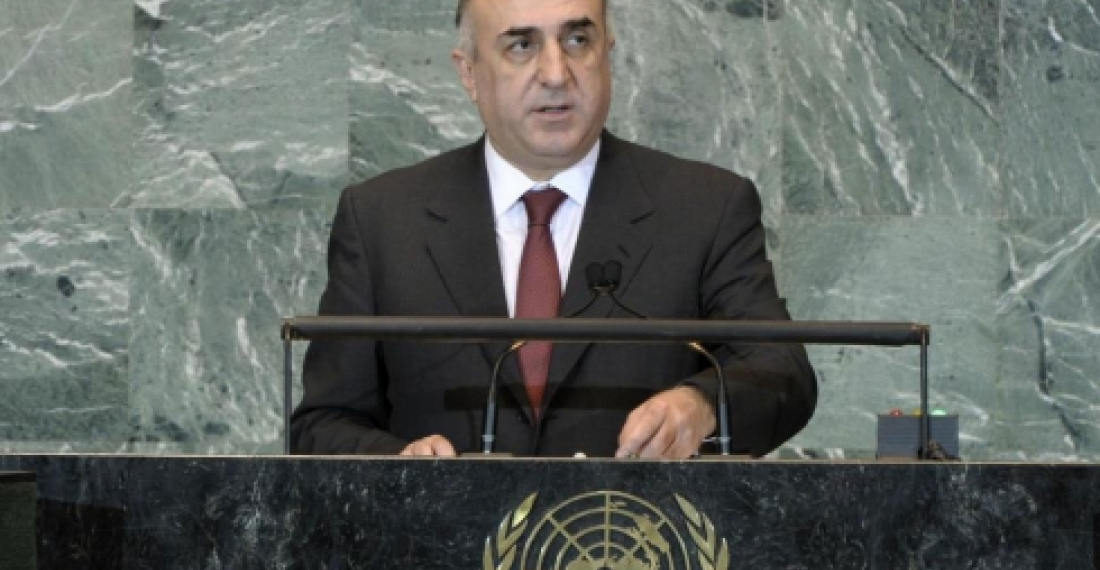
"During my visit to New York to attend the UN General Assembly, I had consultations with the American and Russian co-chairs of the OSCE Minsk Group, which were also attended by Andrzej Kasprzyk, the special envoy of the OSCE chairman-in-office," the minister said.

“The consultations aimed to evaluate the situation and identify directions for our future action. We understand that great work has been done and general contours have been defined. Work is under way on the details at the moment.

"Azerbaijan's position is known. It has been impossible to agree on the principles so far, therefore we suggested starting work on a major peace agreement, with understanding and consideration of all the details currently outstanding in the talks," Elmar Mammadyarov said.

"In my speech at the UN General Assembly I set out again the parameters of a conflict settlement envisaged by Azerbaijan. The Azerbaijani side is committed to continuing the peace talks and we understand where the problem is.

"We also understand that a huge amount of work has been done with the OSCE Minsk Group in order to draw the contours for peace, stability and, most importantly, predictability in the region, and we are ready to continue work on this."

The minister acknowledged the difficulties of the peace process. "Baku always proceeds from the fact that the Karabakh conflict is very complicated and delicate, and at the same time very emotional. The task of the OSCE Minsk Group co-chairs is not so easy, but when three permanent members of the UN Security Council - the US, Russia, France - act as mediators, we cannot expect a better format."

Ways of approaching a solution are another subject, Mammadyarov said. "There is the peace-making approach, when the sides come themselves to agree to the proposals made to them. The second option is to enforce peace, that is, to eliminate the consequences of the armed conflict with a political decision on a final settlement. But as you can see, both approaches are phased, of course, which is what we are moving towards."

He said that the collision of many interests in a small area like the South Caucasus had to be taken into account. "Whenever new elements appear, like the factor of gas contracts, they may, on the one hand, help a solution and, on the other, create obstacles. If we take a sober view of the question, then best format is the OSCE Minsk Group co-chairs with the three permanent members of the UN, which I would say, should bring peace and stability to the region."

Territorial integrity

Elmar Mammadyarov stressed to Trend that self-determination for Nagorno-Karabakh should not be contrary to the territorial integrity of Azerbaijan.

"Under the UN Charter, only people who have been colonized and nobody else, has the right to self-determination. After expelling the Azerbaijani population of Karabakh, how can the Armenians now talk about self-determination? Where is the logic? And to talk about democracy in Nagorno-Karabakh is an absurdity.

"Expelling all the Azerbaijanis from Karabakh and saying that we are a democratic state, and now we are going to determine our status and let the world accept us as we are... I cannot find a logical explanation of Armenia's position," Mammadyarov said.

He was commenting on Armenian President Serzh Sargsyan's remarks to the UN General Assembly that two decades ago, the people of Nagorno-Karabakh had exercised their right to self-determination and survived war and bloodshed to earn their freedom.

Mammadyarov said that he had not seen a more destructive position during his diplomatic career.

"A phrase like 'Armenia gained the independence of Nagorno-Karabakh at the expense of the blood of its sons' defies logic," the minister said.

The Azerbaijani foreign minister described the Armenian president's statement at the UN General Assembly as an aggressive and outspoken call for war.

 source: news.az

Related articles

Editor's choice
News
UAE says it will withdraw from Yemen, but division emerges in Yemeni presidential council

UAE says it will withdraw from Yemen, but division emerges in Yemeni presidential council

In a move seen as an attempt to de-escalate a crises with Saudi Arabia, the United Arab Emirates, on Tuesday (30th December) announced that it was heeding a call to withdraw its troops from Southern Yemen. UAE says that its presence included counter-terrorism teams that were crucial in fighting against Islamist groups. UAE sources said that parts of Yemen not controlled by the Houthis have had Al Qaeda in the Arab Peninsula (AQAP) operatives using the territory to launch attacks on Europe, the US and Middle East. UAE teams have co-ordinated with American and British special forces and intelligence. The sources added that Emirati forces and their Yemeni allies also helped reverse Houthi gains in the south. including the liberation of Aden port. The small UAE contingent has remained in place since the UAE withdrew most of its military personnel in 2019. The leading English-language newspaper in Abu Dhabi, The National, said that the main UAE force was based at Riyan Mukalla International Airport, with access to fixed-wing aircraft and helicopters, but also operated smaller contingents in the port town Balhaf and Shabwa. "It is understood it also flew a number of drones from the airbase that were able to track terrorist movements, pass information back to its allies and assisted special forces' missions." Meanwhile a division has emerged in Yemen's presidential council after four members denounced what they called the 'unilateral decisions' by the chairman. Four of Yemen’s eight Presidential Leadership Council members on Tuesday denounced an announcement by the council’s chairman accusing him of breaching the governing agreement. Tension between Yemeni leaders has been rising for weeks, underscoring the fragility of the country's already fractured political landscape and further complicating efforts to confront the Iran-backed Houthi rebels. The latest rift took an unprecedented turn on Tuesday morning, marked by a Saudi-led coalition “limited operation” striking combat vehicles Riyadh linked to the Southern Transitional Council, which has three members in the PLC. The PLC Chairman, Rashad al Alimi, on Tuesday said that he was seeking to cancel the joint defence agreement with the UAE. “What has been issued … constitutes a clear violation of the Declaration of the Transfer of Power [agreement], which explicitly stipulates that the Presidential Leadership Council is a collective body whose decisions are taken by consensus, or by majority when consensus is not possible,” the statement by the four members said. “It does not, under any circumstances, allow for unilateral decision-making on sovereign, military, or major political matters." The statement was signed by STC chief Aidarous Al Zubaidi, Faraj Al Bahsani, Tariq Saleh and Abu Zaraa al Muharrami. (click the picture to read the full article).

Popular

Editor's choice
News
UAE says it will withdraw from Yemen, but division emerges in Yemeni presidential council

UAE says it will withdraw from Yemen, but division emerges in Yemeni presidential council

In a move seen as an attempt to de-escalate a crises with Saudi Arabia, the United Arab Emirates, on Tuesday (30th December) announced that it was heeding a call to withdraw its troops from Southern Yemen. UAE says that its presence included counter-terrorism teams that were crucial in fighting against Islamist groups. UAE sources said that parts of Yemen not controlled by the Houthis have had Al Qaeda in the Arab Peninsula (AQAP) operatives using the territory to launch attacks on Europe, the US and Middle East. UAE teams have co-ordinated with American and British special forces and intelligence. The sources added that Emirati forces and their Yemeni allies also helped reverse Houthi gains in the south. including the liberation of Aden port. The small UAE contingent has remained in place since the UAE withdrew most of its military personnel in 2019. The leading English-language newspaper in Abu Dhabi, The National, said that the main UAE force was based at Riyan Mukalla International Airport, with access to fixed-wing aircraft and helicopters, but also operated smaller contingents in the port town Balhaf and Shabwa. "It is understood it also flew a number of drones from the airbase that were able to track terrorist movements, pass information back to its allies and assisted special forces' missions." Meanwhile a division has emerged in Yemen's presidential council after four members denounced what they called the 'unilateral decisions' by the chairman. Four of Yemen’s eight Presidential Leadership Council members on Tuesday denounced an announcement by the council’s chairman accusing him of breaching the governing agreement. Tension between Yemeni leaders has been rising for weeks, underscoring the fragility of the country's already fractured political landscape and further complicating efforts to confront the Iran-backed Houthi rebels. The latest rift took an unprecedented turn on Tuesday morning, marked by a Saudi-led coalition “limited operation” striking combat vehicles Riyadh linked to the Southern Transitional Council, which has three members in the PLC. The PLC Chairman, Rashad al Alimi, on Tuesday said that he was seeking to cancel the joint defence agreement with the UAE. “What has been issued … constitutes a clear violation of the Declaration of the Transfer of Power [agreement], which explicitly stipulates that the Presidential Leadership Council is a collective body whose decisions are taken by consensus, or by majority when consensus is not possible,” the statement by the four members said. “It does not, under any circumstances, allow for unilateral decision-making on sovereign, military, or major political matters." The statement was signed by STC chief Aidarous Al Zubaidi, Faraj Al Bahsani, Tariq Saleh and Abu Zaraa al Muharrami. (click the picture to read the full article).


