Lessons from the short-lived South Caucasus republics of the early 20th century can be learned. Celebrations are in order, but a trilateral summit to mark the occasion should be considered too, argues Dennis Sammut in this week's Monday commentary on commonspace.eu.
Armenia, Azerbaijan and Georgia will this year mark the 100th anniversary of the establishment of the first independent republics in the South Caucasus, back in 1918. These republics were short-lived as sovereign independent states, and their short life was caught in the turmoil of the times, yet their existence lit a spark that never extinguished, and their present-day successors owe much to them.
The international order at the start of the 20th century was based on the great European empires of the time: Britain, France, Russia, Austria-Hungary and Germany, with only a few countries existing beyond them. The first world war changed all that. War was a common occurrence between European powers in previous centuries. What made the 1914-18 conflict different was the sheer universality of it, and the way it eventually weakened the belligerents. New technology made mass killings on an industrial scale in battles the norm. No corner of the world seemed spared from the bloodbath.
By 1917, the tide of war had turned against the central powers, which included Germany, Austria-Hungary and the Ottoman Empire. But those that appeared to be winning were also very weakened. The collapse of Tsarist rule in Russia under the pressure of Bolshevik forces, was much hastened by the defeats on the battlefront. In the west, United States intervention in support of Britain and France, turned out to be decisive. The war weakened the victorious empires and led to the dismemberment of the losers.
The Caucasus had for centuries been a space where the Ottoman Empire, Tsarist Russia, and in earlier years Persia, competed for influence and territory. In the region they ruled over peoples with distinct and old cultures and civilisations, but whose moments of glory had long faded away. As the Tsarist and Ottoman empires crumbled the demand for independence in Armenia, Azerbaijan and Georgia overwhelmed fear, and by 1918 politicians in the three republics mustered enough courage and support to declare independence. Yet it was not only the situation on the ground that made this a plausible and significant endeavour. Equally important was the wider international context.
Two developments at the end of 1917 and the beginning of 1918 made self-determination possible, even fashionable. In Russia the Bolsheviks who took power in November 1917, agonised over how to deal with the empire. Lenin, earlier had written that "the proletarian party first of all must advocate the proclamation and immediate realisation of complete freedom of secession from Russia for all the nations and peoples who were oppressed by Tsarism". Shortly after taking power the Bolsheviks published the text of the secret treaties between France, Britain, Italy and Russia that proposed to carve up the territories of the defeated central powers between themselves. In the United States President Woodrow Wilson was determined that the US intervention in the war was not seen as part of this endeavour, but rather as pursuing the values set-up by the founding fathers and America's own declaration of independence. On 8 January 1918 President Wilson addressed congress and outlined his 14 points as the basis of post-war settlement - a new way of doing international relations based on openness and "the principle of justice to all peoples and nationalities, and their right to live on equal terms of liberty and safety with one another, whether they be strong or weak".
In many ways these two declarations from two very different sources became the beacons that guided the leaders in Armenia, Azerbaijan and Georgia, and many other places too, on the road to self-determination and statehood. Yet soon Lenin's theories and Wilson's principles hit the harsh realities of political and diplomatic realism. Lenin was soon convinced that Bolshevik Russia needed a buffer around it for its protection, just like the Tsarist empire did. The Caucasus was an important, even an essential part, of this buffer. Self-determination could be exercised, but only within the framework of the Bolshevik super state now under construction. Woodrow Wilson too soon realised that grand designs sound good, but that the devil was in the detail.
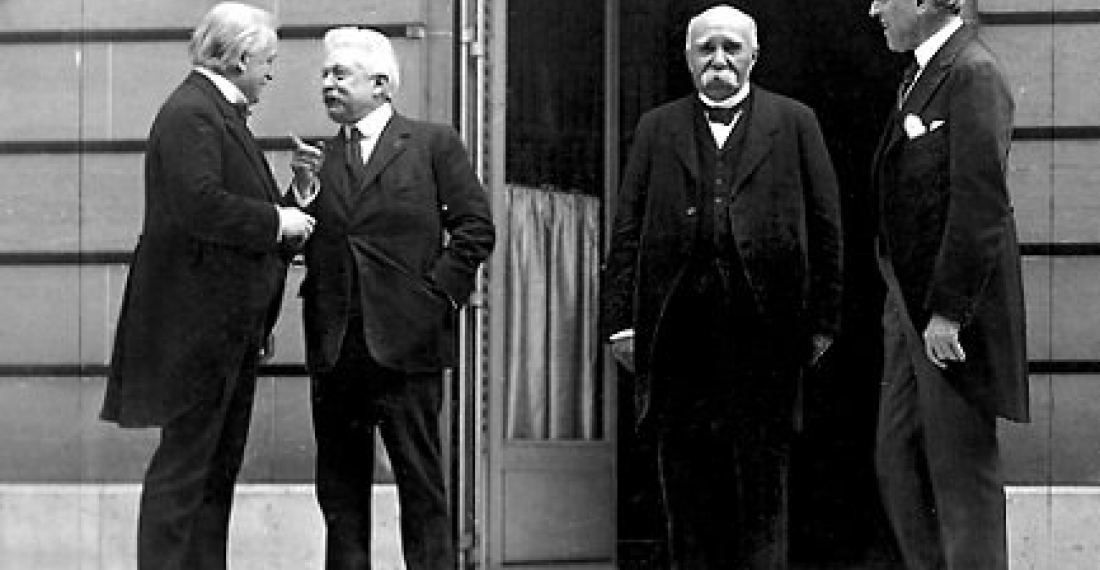
There the dream of the South Caucasus republics for statehood could easily have evaporated, But there was a final piece of high political drama resulting from the consequences of the WWI that still had to play out. The Paris conference (in Versailles) brought together the leaders of the victorious powers to decide the fate of the world. This was Wilson's opportunity to push forward his 14 points, often against the wishes of his reluctant allies. The results contributed much to the map of Europe as we know it today.
The Paris Conference was a chaotic affair, with the victorious powers seeking to protect their competing interests, sometimes failing to understand that the ground was shifting under their feet. Often decisions were taken long after the circumstances had changed, making them all but obsolete. The South Caucasus was a case in point. In 1918 the world knew very little of the South Caucasus, and frankly the region was not a priority. To their credit, the governments that emerged at the helm of Armenia, Azerbaijan and Georgia had the foresight to understand that they needed to be well represented in Versailles. They fielded able, multi-lingual delegations that pushed their cause. Their presence and their work in Versailles was crucial. In contrast the Kurds, whose fate was also being discussed, were leaderless and not properly represented.
Diplomats in Paris were aware of the Armenian issue more than others. News about the atrocities in Anatolia in 1915 had reached the world media, and some of those affected had sought refuge in the US and in European countries. There was sympathy in Paris for the creation of an Armenian state, but where could this state be? What were to be its boundaries? Could it survive as a land locked country? Diplomats were less aware of Georgia, and even less of Azerbaijan, yet all three delegations kept up the pressure for recognition and support. This was needed since on the ground their hold on power was now being seriously challenged by the Bolsheviks. It was only in 1920 however, that the Paris Conference - the equivalent of what we now call the international community, recognised the independence of Armenia, Azerbaijan and Georgia, although it did not go so far as to recognise their borders. It was too late, for within a very short time Bolshevik forces overran the three republics and they were eventually absorbed in what came to be called the USSR.
Nonetheless this was a defining moment. It allowed the governments that emerged in the three countries after the USSR collapsed in 1991 to claim that they were not declaring independence, but restoring it. That is why they will be this year celebrating their 100th anniversary.
There are many lessons to be learnt from 1918-20. For a moment in the early 1990s it looked as if history was going to repeat itself. The three countries were thorn by internal divisions and caught in squabbles between each other - outright war in the case of Armenia and Azerbaijan. Their leaderships in the beginning were often romantic, but hardly pragmatic. The international community hesitated to get involved. It was too busy in other places, and the Caucasus seemed like a remote, lawless, region. Some thought that independent Armenia, Azerbaijan and Georgia would not last.
Fortunately, things turned out differently. Independence has endured, the three countries are now inter-connected with the international system, and progress of a sort is visible. But the situation remains fragile in many ways. Territorial issues remain unresolved; problems with the neighbours remain serious; internal tensions are way beyond the parameters of a normal political system. This year's centenary should therefore remind us that the Caucasus remains unfinished business, and that as long as this situation persists there will remain a high risk to the countries involved, and their people.
The region does not need another Paris Conference were outsiders contemplate places and circumstances that they hardly understand and take uninformed decisions. The region however does need a new level of political maturity that sees the three countries sitting down together and starting to address the issues of the day.
Since 1991 there has not been a single trilateral summit between the leaders of Armenia, Azerbaijan and Georgia. Armenia and Azerbaijan cite the conflict between them over Nagorno-Karabakh; Georgia has preferred to deal with its two neighbours bilaterally saying that trilateral contacts are at this point impossible. This needs to change. This anniversary year offers an opportunity for a trilateral summit to happen - to reflect at least on the past, but hopefully also to look at the future.
Coda
Italy has just taken over the Chairmanship of the Organisation for Security and Co-operation in Europe (OSCE). Their foreign minister was in Vienna last week outlining the priorities of the Italian Chairmanship for this important European security forum.
The last three successive chairmanship's of the OSCE - Switzerland, Germany and Austria were able to give the organisation a new lease of life, providing the organisation with steady leadership, and allowing a continuity in the political direction of the organisation. The Italian Chairmanship will be well advised to build on this.
On many issues the atmosphere within the OSCE councils however remains poisoned - with the participants long since forgetting the principle of co-operation that has been a pillar of the organisation and its predecessor the CSCE, and instead using the organisation for political posturing of the worst kind.
Italian diplomacy is reasonably flexible and is well placed to contribute to creating a better atmosphere within the OSCE. The Russian representative hinted at this at the meeting of the Permanent Council last week. If this is an opportunity, then it should not be lost.
source: The Monday Commentary on commonspace.eu is prepared by Dennis Sammut
photo: The leaders of the four victorious powers - United States, Britain, France and Italy, at the 1919 Paris Peace Conference. The decision of the conference to recognise the independence of Armenia, Azerbaijan and Georgia was a defining moment for the three countries. (archive picture)