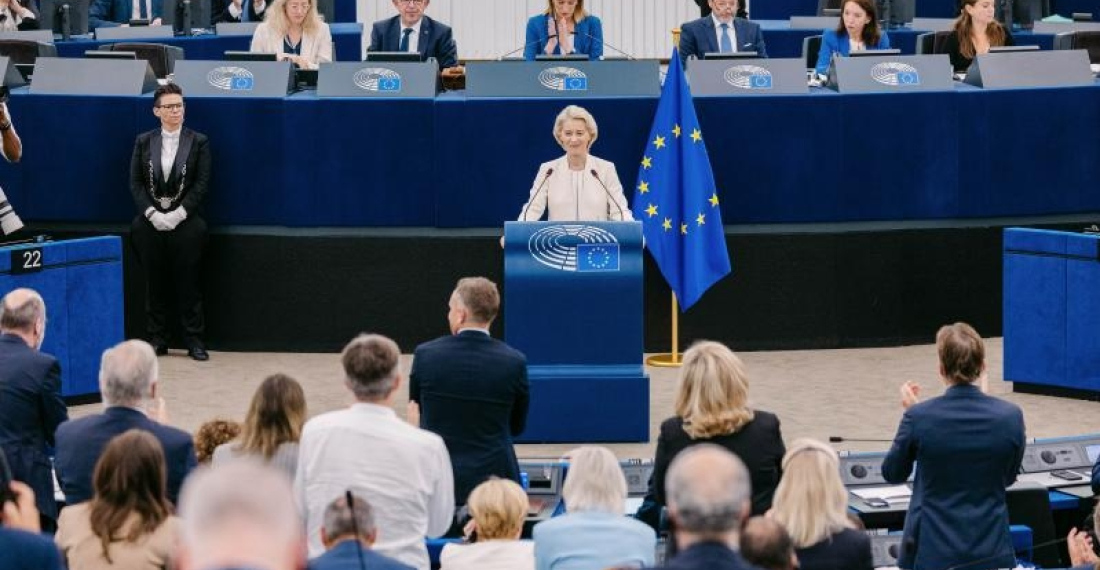
European Commission president, Ursula von der Leyen gave her annual "State of the Union" speech to the European Parliament on Thursday (17 September). The speech was visionary in its scope and ambitious in what it seeks to achieve. But many who are familiar with the Brussels buraucracy do not think that the system that von der Leyen heads, has the stamina, flexibility or even the will to deliver.
Von der Leyen did not mince her words. Her opening statement laid out the vision and the ambition
It was the best of times, it was the worst of times.' This is how Charles Dickens describes Europe in the days of the French Revolution. And it is also a fair description of the world we live in. The speed of change is incredible. The challenges exceptional. So if I look at Europe today, my take is this: the state of our Union is the strongest it has ever been. The state of our Union can also feel as precarious as it has ever been.
These two statements may seem incompatible. But they are both true. And they reflect these exceptional times. This complex age of great possibilities and great perils, which all countries are seeking to navigate.
In this world, Europe has chosen to forge its own path. And a stronger, independent Europe is now emerging.
This is a Europe that is securing its prosperity. One that is breaking free from its toxic dependency on Russian fossil fuels. That has become the greatest trading power on the planet. That is transforming its industrial policy while upholding our unique social model.
This is a Europe better able to defend itself than ever before. One that has radically overhauled its approach to securing our homelands. That has increased defence spending by almost 80 % in the last five years alone.
This is a Europe that stands up for each other. As we are doing by standing with Ukraine as it fights for its future and for our freedom. Or when we stood up for Greenland when it was threatened. Or when drones, hybrid attacks or disinformation target our democracies.
All of this proves one thing. That Europe is there for Europeans. And that in the cold fragility of today's world, only Europe can provide true sovereignty to Europeans.
This is a Europe we can be so proud of.
At the same time, we all know the threats that we are facing. As old assumptions and relationships have frayed, we are now dealing with an openly hostile world. A territorial war of aggression is raging on our continent; others have erupted nearby. A fight for industrial capacities is shaping global competition. And a battle of narratives is seeking to weaken confidence in Europe; to paralyse our democracies.
But people's worries are not only linked to these big, global threats. The effects of the many crises are present for many European families, not least on the cost of living or housing. The dizzying speed of change and technology is impacting our jobs, our livelihoods and our society. And it is also having a profound effect on our democracy and our discourse.
We see this in the rise of the extreme, the decline of nuance – even in the way that we relate to each other.
These real concerns are being weaponised to drive a wedge between us. Sometimes from the outside – and too often from the inside. But our path is clear. Building an independent Europe that has the power to act. Nothing can divert us from this. Because in this world, the fate of Europe must remain in the hands of Europeans.
So our choice is clear. Do we want a strong and independent Europe that stands up for its values in this world? Or do we let divisions and dependencies hold us back? Do we want to rally around our European idea that together we can decide our own destiny? Or do we let our democracies be undermined by the proxies and puppets of authoritarians?
Whether it is the ultranationalists or the anti-Europeans, whether it is Russian interference or disinformation, the names may be different, but their goal is the same. They despise our values, and they want to shatter our European unity. So let's not only fight back against that, let's fight together for our European idea.
The European Commission president used her speech to make the case for a stronger, more independent Europe.
Present in person at the EP in Strasbourg was Canadian Prime Minister Mark Carney The Commission president invited the country to work with Brussels on becoming “the first associate member of the European Union,” adding “we see the world through the same eyes.”
Von der Leyen also said she would propose a new security forum, A European Security Council, for EU and like-minded leaders in response to escalating Russian hybrid attacks and fraying transatlantic relations, with Canada, Ukraine, Norway, and the U.K. also be invited to join.
Putting her point of view to the European Parliament, and being honest about the challenges ahead, was an important challenge. More difficult is the challenge that von der Leyen has, to convince the bureaucracy in the EU instituions in Brussels of the challenges ahead, and of the need to change and adapt to the new realities.
This bureaucracy has often failed to deliver. Its too caught in its own labyrinth and comfort zone; has a problem with engaging with both EU citizens and the wider world; lacks the readiness to learn from its own mistakes, partly because of a flawed institutional memory, and is too slow to adjust.
Von der Leyen has tried to fix some of these probelms, but with limited success. She needs to try harder!
You can read Von der Leyen's speech in full here