Standing before the silent graves at the Srebrenica Genocide Memorial in Bosnia leaves an indelible truth on the human conscience: war, with all its tragedy, has boundaries governed by international law. But the deliberate execution of disarmed captives, the systematic erasure of an indigenous population, and the silent acquiescence of onlookers cross directly into the realm of absolute crimes against humanity.
Today, as a grim convergence of anniversaries passes – six years since the 2020 44-Day War that claimed up to 4,000 lives, four years since Azerbaijan’s September 2022 aggression that cost over 190 Armenian lives while occupying nearly 200 square kilometers of sovereign Armenian territory, and three years since the complete ethnic cleansing of Nagorno-Karabakh in 2023 that forcibly displaced over 115,000 indigenous residents – international engagement faces a critical test. Insulating formal peace negotiations from human rights, heritage preservation, and legal accountability risks establishing a fragile, unsustainable equilibrium rather than a lasting settlement.
Events in Nagorno-Karabakh reflect the mechanics of structural erasure – the physical displacement of a community followed by the imposition of the conqueror’s identity upon a depopulated territory. In Nagorno-Karabakh, that second phase is fully underway. Whole historic residential quarters in Stepanakert are being systematically bulldozed, centuries-old Armenian villages leveled, cemeteries desecrated, and historical sites subjected to state-sponsored revisionism. Reports of the demolition, alteration, and historical revisionism of monuments, churches, and civilian neighborhoods closely align with Lemkin’s framework on cultural destruction: the physical removal of a population is followed by the systematic erasure of its historical footprint.
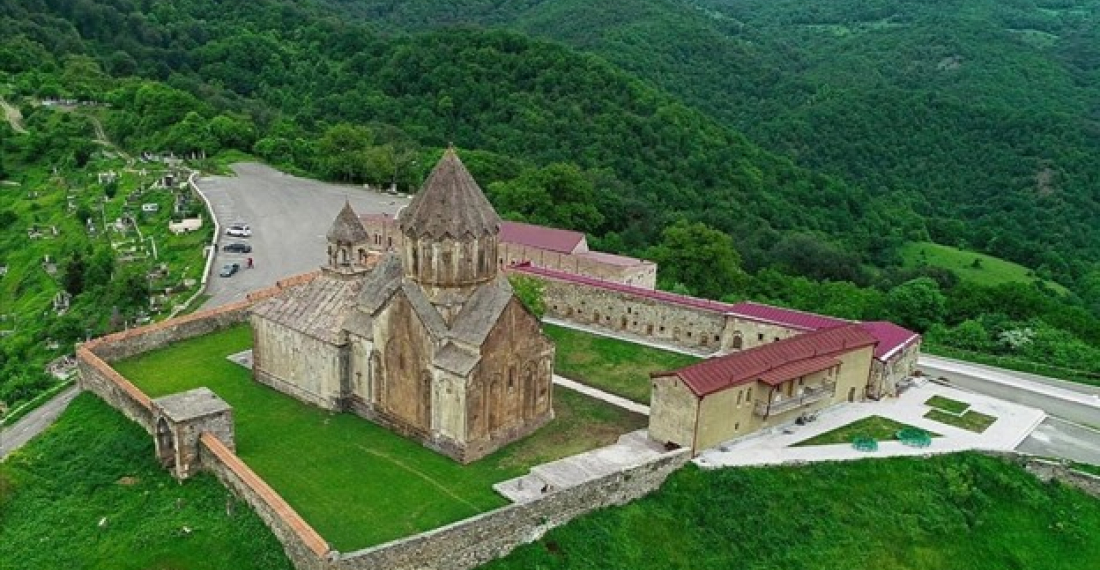
This cultural destruction is exacerbated when international engagement remains selective. Recent diplomatic visits to Nagorno-Karabakh – where international representatives were hosted at sites positioned near damaged Armenian cultural monuments while bypassing destroyed historical structures in the immediate vicinity – highlight the danger of uncritical engagement. Furthermore, allowing state-sponsored revisionist Armenophobic narratives, such as the pseudo-historical “Albanization” of well-known Armenian ancient monasteries like Gandzasar and Dadivank, undermines fundamental principles of cultural preservation. International diplomacy must avoid transactional compromises, where short-term economic interests obscure long-term human rights commitments.
This physical and cultural erasure rests upon an unpunished foundation of grave human rights violations. The extrajudicial execution of unarmed Armenian prisoners of war on the Ishkhanasar heights in September 2022 – authenticated by Human Rights Watch, Bellingcat, and major international media – constitutes a grave breach of the Geneva Conventions. Today, systemic hostility continues to impact detainees. As documented by the U.S. Commission on International Religious Freedom (USCIRF) and other international institutions, Armenian hostages face documented religious persecution, including physical abuse targeting faith-based symbols and explicit bans on receiving religious texts.
The ancient logic of vae victis – “woe to the vanquished” – cannot serve as the foundation of a stable regional order. A sustainable settlement cannot be constructed on erased history, unpunished war crimes, destroyed heritage, and forced peace. Genuine regional stability requires a dignified peace: one grounded in uncompromised state sovereignty, territorial integrity, cultural protection, and strict accountability under international humanitarian law. Those who genuinely seek peace in the South Caucasus must recognize that legitimizing forced realities does not prevent another aggression; it merely guarantees it.
While state policy in Baku shows little inclination toward genuine reciprocity or reversing the realities imposed by force, a limited role may still exist for broader, long-term societal engagement. Initiatives supported by diverse multilateral organizations, independent human rights monitors, and international civil-society bodies – ranging from independent academic research to grassroots, people-to-people dialogue – can play a part in mitigating deep-seated enmity over generations. However, even the most active involvement of independent international actors cannot serve as a substitute for formal state accountability, nor can it cure the structural flaws of a peace constructed on destruction and displacement. Without independent legal oversight, impartial fact-finding mechanisms, and genuine protection for cultural heritage, any diplomatic promise of a “new page” in regional relations remains written in disappearing ink.
Source: Johnny Melikyan is a political scientist and founder of the Center for Political and Legal Studies in Yerevan and a member of the LINKS Europe Strategic Platform of Armenian abd Azerbaijani experts
This op-ed first appeared on Armenian Mirror-Spectator
The views expressed in opinion pieces and commentaries do not necessarily reflect the position of commonspace.eu or its partners
‘