The abolition of the separate Albanian Catholicosate under Russian rule changed the administration of the region’s Christian communities and monasteries. Yet that decision does not resolve questions about the origins of monuments whose histories intertwine Albanian and Armenian church traditions.
The dispute surrounding foreign diplomats’ visits to Christian monasteries in Karabakh has renewed attention to a nineteenth-century church reform in the Russian Empire, regarded in Azerbaijan as a significant step in the loss of independent institutional representation for Albanian religious heritage.
The Albanian-Udi Christian Community of Azerbaijan and representatives of 52 civil society organisations condemned the reaction of Armenian political and public circles to the diplomats’ visit in statements distributed by AZƏRTAC. The authors described Gandzasar and Khudavang as monuments of Albanian heritage and said that presenting these monasteries as exclusively Armenian complicates the peace agenda.
The community’s chairman, Robert Mobili, linked the current controversy to the history of the termination of the Albanian Church’s activities under Russian rule. The community’s appeal alleges that, following its abolition, part of its religious heritage was appropriated by the Armenian Church.
The disagreement rests on differing understandings of historical continuity. Azerbaijanis, particularly the Albanian-Udi community, emphasise their connection to Caucasian Albania and its Christian culture. The Armenian historical tradition associates the monasteries with Armenian-speaking clergy, inscriptions, manuscripts and the longstanding presence of these sacred sites within Armenian ecclesiastical life.
The history of Russia’s presence in Karabakh began before the church reform. Under the Treaty of Kurekchay of 1805, signed by Ibrahim Khalil Khan and General Pavel Tsitsianov, the khan recognised the supreme authority of the Russian emperor. In return, Russia promised to preserve hereditary rule by the khan’s family and internal administration. The treaty provided for a Russian garrison in Shusha and restricted the khanate’s independent foreign relations.
The Treaty of Gulistan of 1813, which ended the Russo-Persian War, formalised Persia’s recognition of Russian sovereignty over Karabakh and other territories. The establishment of a new political authority created the conditions for the subsequent reorganisation of local institutions, including ecclesiastical ones.
At the beginning of the nineteenth century, the Catholicosate of Aghvank, associated with the history of Caucasian Albania, retained a separate ecclesiastical seat centred at Gandzasar. Its relations with the Armenian Church, however, had been complex long before the Russian conquest.
Accounts of the history of the Catholicosate of Gandzasar identify two stages in its dissolution: the abolition of the catholicosal seat and its replacement with a metropolitan structure in 1815, followed by the termination of the separate metropolitanate in 1836. Its ecclesiastical jurisdictions were incorporated into the administrative system of the Armenian Apostolic Church.
The Orthodox Encyclopedia also associates the abolition of the Albanian Catholicosate with the reform of 1836 and states that its dioceses were incorporated into the Catholicosate of Etchmiadzin.
The change therefore involved the dissolution of a separate ecclesiastical centre and a shift in the authority governing its dioceses. The formulation “the Albanian Church was transferred to the Armenian Church” conveys part of the administrative outcome, but leaves out centuries of ambiguous relations between the two traditions.
The legal basis for the new arrangement was the “Regulation on the Administration of the Affairs of the Armenian Gregorian Church in Russia”, approved by Nicholas I on March 11, 1836. As Sergey Lukyanov and Alexander Udodov show in their study of Russian ecclesiastical legislation, the document combined recognition of ecclesiastical rights with state oversight. The emperor gave final approval to the appointment of the catholicos, while the activities of church bodies and the management of property were subject to regulation.
This arrangement allows the reform to be viewed primarily in the context of imperial centralisation. A unified hierarchy under loyal Armenian ecclesiastical leadership made it easier for the administration to engage with the clergy and oversee religious organisations.
It is here that administrative history becomes part of the dispute over historical memory. For the Albanian-Udi community, the disappearance of its own centre represents a break in institutional continuity. In the Armenian interpretation, the monasteries’ longstanding ecclesiastical affiliation serves as evidence of an enduring religious and cultural connection.
The existence of a distinct Albanian culture, meanwhile, is supported by scholarly evidence. Encyclopaedia Iranica describes Caucasian Albania as an ancient state with its own political and religious institutions, interacting with neighbouring societies. Jost Gippert’s research enables scholars to study the Caucasian Albanian written tradition and the relationship between its language and Udi.
These findings, however, do not automatically establish an Albanian origin for every Christian structure in Karabakh. Equally, a monastery’s later inclusion under Armenian ecclesiastical administration does not explain every stage of its early history.
Determining the origins of a particular complex requires a comparison of archaeological layers, construction dates, inscriptions, information about patrons and the history of worship. The antiquity of a sacred site may differ from the age of its surviving church, while the early and later history of a single monastery may belong to different cultural contexts.
Allegations of the destruction of archives or the alteration of inscriptions also require verification against specific documents.
The current dispute is complicated by the use of the history of sacred sites to justify contemporary political positions. As a result, a monument’s origins, sovereignty over the territory and a community’s religious connection to a sacred site are often treated as a single issue.
A balanced examination of the heritage requires these questions to be separated. Modern borders do not change the origins of a medieval inscription, and a monastery’s historical affiliation with a particular church tradition does not, in itself, establish territorial rights.
The Russian reform remains an important part of the explanation: it ended the existence of a separate Albanian ecclesiastical centre and changed the administration of its dioceses. The origins of Gandzasar, Khudavang and other monuments, however, must be determined from evidence concerning their own histories. Open publication of archives and inscriptions, independent expert assessment and the preservation of all historical layers could move the debate from mutual accusations to verifiable facts.
source: Mehman Aliyev is Head of Turan Analytical Service, and a member of the LINKS Europe Strategic Platform on Armenia-Azerbaijan relations
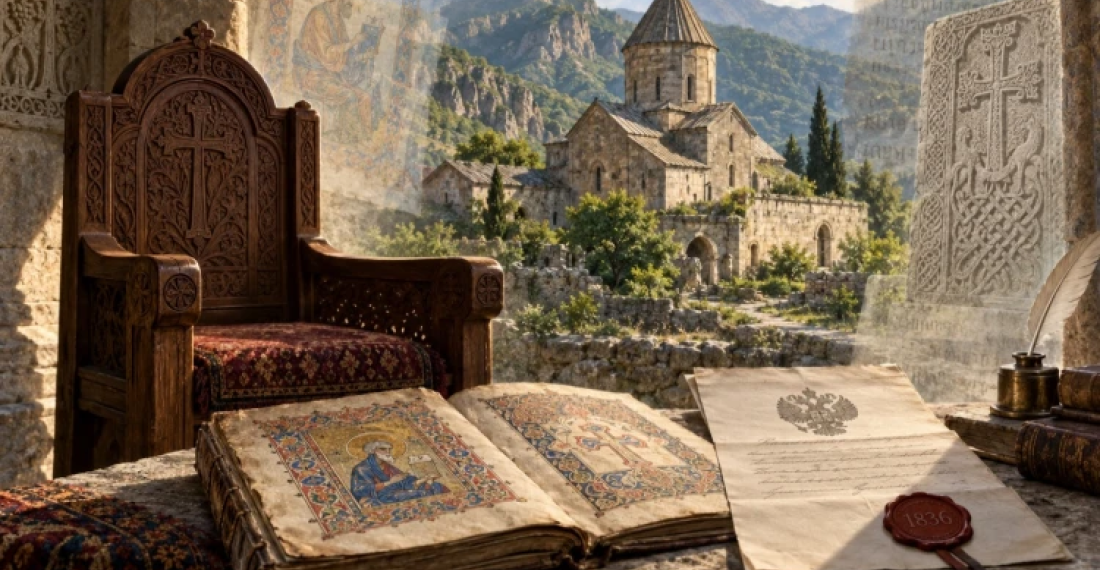
photo: An empty ecclesiastical throne symbolises the loss of an independent centre, the decree of 1836 represents imperial reform, and the monastery and manuscripts reflect the multiple layers of religious heritage. This symbolic illustration was created using AI; it is not a reconstruction of a specific monastery.
The views expressed in opinion pieces and commentaries do not necessarily reflect the position of commonspace.eu or its partners