Opinion: A Routine Visit, a Revealing Reaction

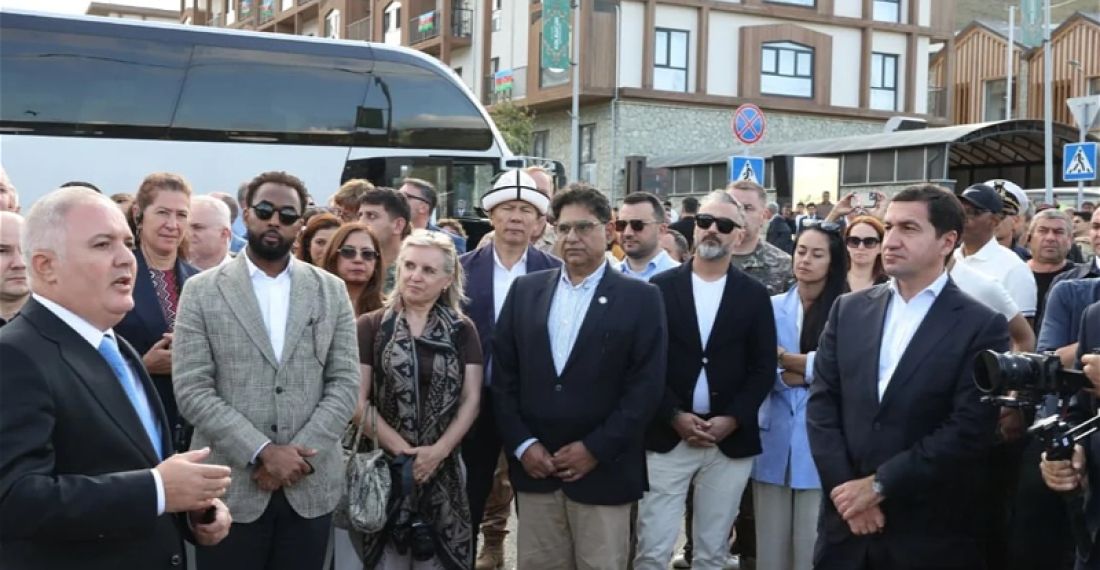
On September 11 and 12, roughly 150 representatives of the diplomatic corps accredited in Baku, drawn from 58 countries and nine international organizations, including the European Union's Special Representative for the South Caucasus, traveled to Azerbaijan's Karabakh and East Zangezur regions. They visited Shusha, Khankendi, and historic sites including the Ganjasar and Khudavang monasteries. By any normal diplomatic standard, this was an unremarkable event. Foreign missions accredited to a sovereign state routinely tour that state's regions, and no government anywhere asks permission from a neighboring capital before showing its own territory to its own diplomatic partners.

What followed in Armenia was not unremarkable. Parliamentarians, government-adjacent commentators, media outlets, and diaspora organizations reacted with a wave of condemnation, describing the visit as an attempt to “legitimize ethnic cleansing,” demanding that diplomats boycott the trip, and reviving the vocabulary of an “Artsakh” cause that Yerevan has, at least on paper, set aside. This reaction deserves attention, not because it changes anything on the ground in Karabakh, which remains Azerbaijan's sovereign and internationally recognized territory, but because of what it reveals about the gap between Armenia's declared peace policy and its domestic political reflexes.

Armenia has repeatedly stated, including in the text of the peace treaty initialed in Washington in August 2025, that it recognizes Azerbaijan's territorial integrity within its Soviet-era administrative borders, which include Karabakh. If that recognition is genuine, a visit by accredited diplomats to Azerbaijani territory cannot logically be treated as a scandal requiring political mobilization. A state cannot simultaneously tell the world it accepts a border and treat any ordinary exercise of sovereignty across that border as an outrage. The fact that this contradiction keeps surfacing, in parliament, in state-adjacent media, and among political experts representing government-linked think-tanks and diaspora bodies some of whom have close ties to Armenian political circles, suggests that recognition on paper has not yet been matched by acceptance in practice. That gap, not any visit by foreign diplomats, is the real obstacle to peace.

It is worth being direct about where this leads if it continues. Every peace process depends on both sides agreeing, implicitly or explicitly, to stop keeping score. Azerbaijan has largely done so. Since the 2020 war and the 2023 restoration of full sovereignty over Karabakh, Baku has focused its energy on reconstruction, the return of displaced families under the “Great Return” program, and one of the most extensive demining operations underway anywhere in the world, rather than on relitigating the conflict’s history in every international forum available to it. That restraint has not been costless. Azerbaijani deminers and civilians, including children, are still killed or maimed by landmines planted during the occupation and, in some documented cases, after the 2020 ceasefire, because Armenia has yet to hand over complete and accurate minefield maps.

If Armenian parliamentarians, officials, and diaspora networks insist on reopening the conflict as a live political and moral argument every time Azerbaijan exercises an ordinary sovereign function, they should understand that this is not a contest Armenia is positioned to win. The record includes the February 1992 Khojaly massacre, in which more than 600 Azerbaijani civilians were killed while fleeing the town, and thirty years of occupation of Karabakh and seven surrounding districts that produced roughly one million Azerbaijani refugees and internally displaced persons. It includes cities such as Aghdam and Fuzuli, leveled so completely during the occupation that international observers labeled Aghdam the “Hiroshima of the Caucasus.” Azerbaijan has, for the most part, chosen not to make this history the centerpiece of its diplomacy. That restraint is a policy choice, made in the interest of a durable peace, not an admission that the record does not exist. Armenian actors who keep pulling the conflict narrative back into public life should weigh whether they actually want that record placed back on the table, because the facts do not run in their favor.

The two monasteries visited during that trip, Ganjasar and Khudavang, fit the same pattern. Azerbaijani officials describe them as part of the ancient Caucasian Albanian Christian heritage, built under the Albanian kingdom that shaped the religious life of the region for centuries before either modern nation staked a claim to it, and preserved by Azerbaijan today as an integral part of its own historical and religious patrimony. Baku has also pointed out that the attention drawn by these two well-documented monuments stands in sharp contrast to the far larger and far less examined loss on the other side: hundreds of mosques, cemeteries, and other monuments built by Azerbaijanis over centuries in what is now Armenia have been destroyed, left to ruin, or erased from the historical record since the expulsion of Azerbaija’s West Azerbaijani community, a loss of heritage that has drawn a fraction of the international attention given to a single diplomatic tour.

None of this serves Armenia’s own stated interests. The gains achieved since August 2025, the initialed peace treaty, and the agreement reached on the Trump Route for International Peace and Prosperity (TRIPP), a corridor set to connect Azerbaijan to Nakhchivan through Armenian territory, together with the broader prospect of a South Caucasus finally free of the frozen-conflict logic that has governed it since the 1990s, are fragile and require sustained political discipline on both sides. Every outburst of this kind, especially when it comes from sitting parliamentarians and officials rather than only from diaspora activists abroad, hands ammunition to those who argue that Armenia's commitment to peace is tactical rather than sincere, and that Yerevan says one thing in Washington and another at home.

Azerbaijan has repeatedly signaled that it is prepared to close this chapter permanently, provided Armenia does the same, including by finally bringing its constitution into line with the borders it says it accepts. A diplomatic visit to Azerbaijani territory should never have become a controversy in the first place. That it did says less about Baku's intentions than about how much work remains in Yerevan before its declared peace policy is matched by its political culture. Armenia's leadership, media, and diaspora institutions would do well to recognize that reopening the conflict as a subject of grievance is a path that damages Armenia's own position far more than it does Azerbaijan's, and that the only outcome it guarantees is the erosion of a peace process both nations have invested too much in to lose.

source: This is an op-ed prepared for commonspace.eu by Dr. Vasif Huseynov, Head of Department at the Center for Analysis of International Relations (AIR Center) in Baku and Adjunct Professor at Khazar University.

The views expressed in opinion pieces and commentaries do not necessarily reflect the position of commonspace.eu or its partners

Latest

Editor's choice
News
Lula wins fourth term in Brazil, Vucic loses in Serbia

Lula wins fourth term in Brazil, Vucic loses in Serbia

In elections on both sides of the Atlantic, that are likely to have deep implications for their respective regions, one incumbent won, another lost. In Brazil, Latin America's biggest country, left-wing President Lula won a fourth term in office, defeating his right-wing challenger Flávio Bolsonaro. The 80-year-old, took just under 52% of the vote in a run-off on Sunday. Lula thanked cheering supporters in São Paulo and said he had defended Brazil's democracy. His opponent, Flavio Bolsonaro - who won the first round - says the result is "inexplicable" and called for it to be annulled. His father, ex-president Jair Bolsonaro, is currently serving a jail sentence under house arrest for plotting a coup after losing the last election. This election was bitterly fought - and it bucks a wider regional trend towards right-wing leaders. On the other side of the Atlantic, in Serbia, long-standing leader Aleksandar Vučić has admitted defeat to the student-led protest movement in snap parliamentary elections. "We still do not have final results... it is clear that we have lost these elections," the right-wing populist leader said as he conceded late on Sunday. Preliminary figures from Serbia's election commission indicated a record high turnout, which commentators had suggested would favour the student movement. Celebrations erupted after Vučić conceded. Vučić called the snap elections after two years of protests triggered by the collapse of a train station canopy in the city of Novi Sad, which killed 16 and was seen as emblematic of corruption and negligence. Both election results are going to have a deep impact on their respective regions.

Popular

Editor's choice
Monday Commentary
Monday Commentary: European-Azerbaijan relations need an intensive and multifaceted dialogue that is frank and honest

Monday Commentary: European-Azerbaijan relations need an intensive and multifaceted dialogue that is frank and honest

Last week I visited Baku, Azerbaijan. My visit was relatively short, but very intensive, and had many meetings with stakeholders and colleagues. When I arrived in Baku first time in 1996,  Azerbaijan was a different country: weak, poor, and shaken by defeat in war. For thirty year the Karabakh issue dominated the agenda: the political agenda but also the popular mindset. Now, thirty years later, Azerbaijan has returned to Karabakh, and peace with Armenia is on the horizon. It is a new era for Armenia-Azerbaijan relations, for the South Caucasus, but also for Europe.  But we cannot be complacent: the Peace agreement has been initialed but not signed; borders remain closed; TRIPP is ambitious but remains an idea; and there are spoilers who want to turn the clock back. We must not allow them, and in this Europe and Azerbaijan must work together. Europe’ vanguard organization is the European Union – it is a free union of 27 member states; it is a strong global economic force, and increasingly a diplomatic and military force too. But it remains “work in progress” and can often appear dysfunctional. It often lacks collective and institutional memory. In its dealings with Azerbaijan the EU has made many mistakes – not least opening the delegation here late – in 2008. It sometimes appears condescending. Some utterances from the European Parliament and from some quarters in some member states are not understandable even for me. They irritate the Azerbaijanis, but serve no other purpose But Azerbaijan has also not handled relations with the EU well. It has failed to respond when the hand of friendship reached out; and it confused irritating actions, sometimes by well-meaning people; sometimes by outright spoilers, with strategic action. In short, EU-Azerbaijan relations have suffered from a lack of proper dialogue. This dialogue must be frank, honest and multi-faceted involving different segments of society on both sides.   Is Azerbaijan Europe? When Azerbaijan applied to join the Council of Europe in the 1990s, there were some who opposed, saying this was not Europe. I was one of the people who argued that Armenia and Azerbaijan may be on the periphery of the continent geographically, but were European in essence. Certainly their elites. During the discussion on 4 September in Baku, my friend Farhad Mammedov, mentioned that Azerbaijan is not interested in joining the EU, and was now close to the Central Asian countries in the 5 plus 1 format. Neither things mean that Azerbaijan is not Europe. There are several European countries that are not in the EU, and do not want to be, for example Norway and Switzerland. Iceland has recently voted to stay out of the EU. The UK was a member and left. Europe is bigger than the EU, and the holding of the European Political Community summit in Baku in 2027 proves that. Despite all the rhetoric, I never heard the president of Azerbaijan  saying that Azerbaijan is not Europe, nor have I heard any European president say it either. Not wanting to join the EU and forging close relations with neighbouring regions does not make Azerbaijan any less European. It is only logical that when Europeans talk to Azerbaijan they talk like family. The conversation is often frank. It must also be honest, and Europeans need always to remember this too. A frank, honest and multi-faceted dialogue A frank, honest and multifaceted dialogue will contribute to relations between Azerbaijan and the rest of Europe: it will avoid misperception, which unfortunately is very common on both sides; it will provide a forum where problems can be discussed and resolved, and it will increase mutual trust, so that together common problems can be addressed. (click image to read the full Monday Commentary)
Editor's choice
Monday Commentary
Monday Commentary: “The barren rocks of Aden” and “These lands of Yemen are so ruthless”

Monday Commentary: “The barren rocks of Aden” and “These lands of Yemen are so ruthless”

There are two early 20th-century tunes that mark foreign attempts to occupy and “pacify” Yemen. The Scottish tune “The barren rocks of Aden” marks the mobilisation of Highland soldiers, enlisted to be deployed to the Yemeni port of Aden, that in 1837 became the last colony to be incorporated into the British Empire. The tune talks of the harshness of the terrain, but is celebratory, It was even played as a farewell tune to Sir William Luce at the parade in Sharjah celebrating his end as “British Viceroy” in the Middle East in 1966. The second tune is an Anatolian lament. As Ilker Sezer reminded us this weekend, in his weekly feature on “Turkiye Today”, it “mourns the tragic fate of Ottoman soldiers dispatched to the harsh, remote deserts of Yemen during the fall of the empire, young men who marched away from their villages and never returned home. Most of their names, and numbers, were never recorded. Yet, their fate left a mark on the Turkish psyche.” Subsequent invaders have discovered that Yemen is a grave that cannot be overcome by the strength of modern technology, and that whilst Yemeni society is splintered and divided, building a reliable alliance with Yemeni factions is difficult. These are the harsh lessons facing Saudi Arabia, as the Kingdom faces its biggest challenge in its modern history. The leadership of the Kingdom now has to respond decisively. At stake is their very credibility. This is likely to be a long and messy conflict. Saudi military objectives need to be focused: to box in the Houthis rather than destroy them. This is likely to include: (a) regaining territory lost on the Red Sea coast; (b) control over Bab el Mandeb Strait; (c) some kind of cordon sanitaire on the Saudi-Yemeni border; and if things go well (d) the capture of Sanaa. All this would not eliminate the Houthi problem, but it will contain it. In the end the Saudis will have to continue managing Yemen with a mixture of carrot and stick. For the moment, the stick is likely, but the carrot cannot be forgotten either. (click the image to read the Monday Commentary in full)