


EU wants to “move fast” on Moldova accession to the bloc

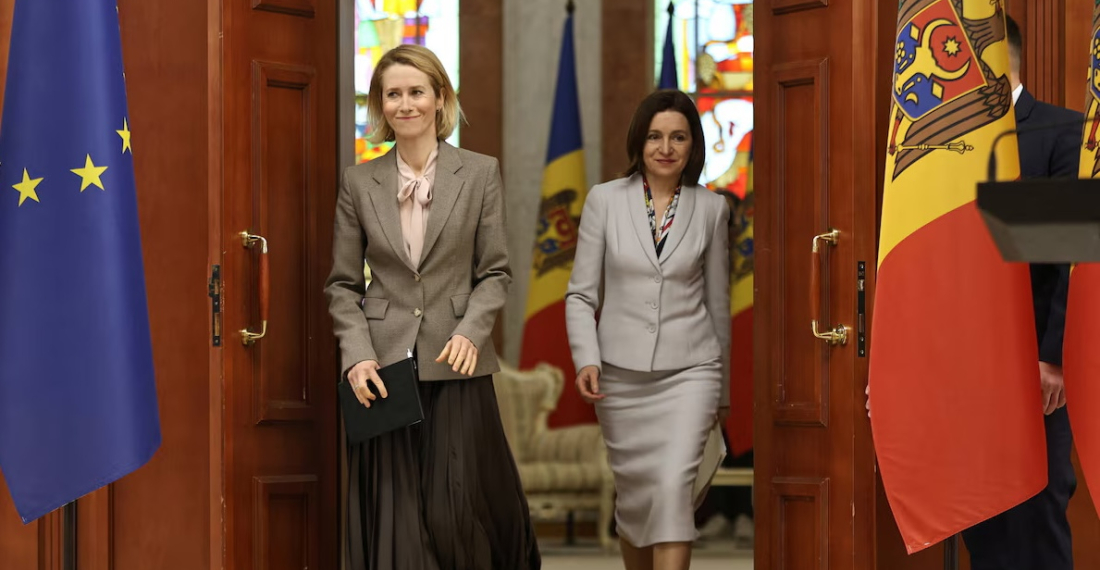
EU High Representative for Foreign Affairs and Security Policy Kaja Kallas said on Friday (8 May) that the EU intends to pick up the pace on Moldova’s admittance to the bloc, although an exact date for formal accession talks has not been set.

In a joint press conference with Moldova’s President Maia Sandu, Kallas stated:

"We haven't set that date, but it's clear that we need ​to move fast." She added that changes of government in other EU countries provide a window of opportunity towards Moldova’s accession. Kallas noted the upcoming national elections in many EU countries, citing the present moment as a reason to “move ‌while nobody is against Moldova”.

“You never know when there comes a government that might have, you know, a ​bilateral issue.”

Kallas ​recognised the progress Moldova has made in pushing through tough reforms, assuring that the ​breakaway region of Transdniestria "will not ​become an obstacle" in Moldova's path to EU accession.

Kallas highlighted the significance of the conference taking place on the eve of Europe Day, standing as “a reminder that Europe is stronger together”.

Sandu reemphasised Moldova’s commitment to signing the accession treaty ​by 2028.

Source: commonspace.eu with Reuters and EEAS

Related articles

Popular

Editor's choice
Interview
Thursday Interview: Murad Muradov

Thursday Interview: Murad Muradov

Today, commonspace.eu starts a new regular weekly series. THURSDAY INTERVIEW, conducted by Lauri Nikulainen, will host  persons who are thinkers, opinion shapers, and implementors in their countries and spheres. We start the series with an interview with Murad Muradov, a leading person in Azerbaijan's think tank community. He is also the first co-chair of the Action Committee for a new Armenian-Azerbaijani Dialogue. Last September he made history by being the first Azerbaijani civil society activist to visit Armenia after the 44 day war, and the start of the peace process. Speaking about this visit Murad Muradov said: "My experience was largely positive. My negative expectations luckily didn’t play out. The discussions were respectful, the panel format bringing together experts from Armenia, Azerbaijan, and Turkey was particularly valuable during the NATO Rose-Roth Seminar in Yerevan, and media coverage, while varied in tone, remained largely constructive. Some media outlets though attempted to represent me as more of a government mouthpiece than an independent expert, which was totally misleading.  Overall, I see these initiatives as important steps in rebuilding trust and normalising professional engagement. The fact that soon a larger Azerbaijani civil society visits to Armenia followed, reinforces the sense that this process is moving in the right direction." (click the image to read the interview in full)


