


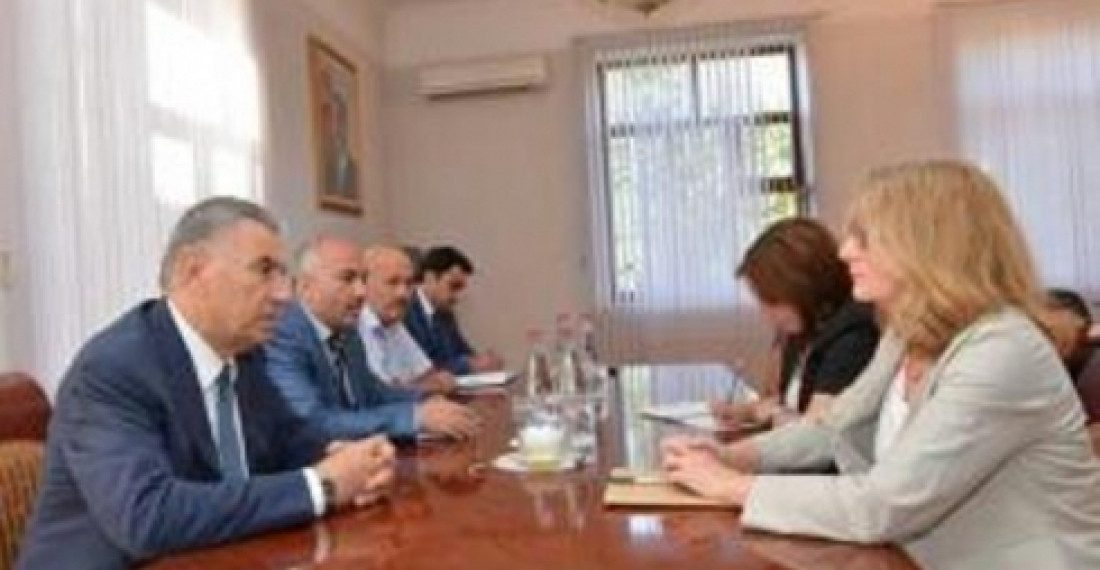
Azerbaijan increases pressure on ICRC amid more incidents on line of contact.

For the second time in less than a week the Azerbaijani government has brought public pressure on the International Committee of the Red Cross (ICRC) following the capture of Azerbaijani civilians near the village of Khaljabar. Deputy Prime Minister, Chairman of the State Committee for Work with Refugees and IDPs, Ali Hasanov again met with Head of the ICRC Delegation to Azerbaijan Denise Duran on July 30 to discuss the issue of Shahbaz Guliyev and Dilgam Asgarov, who were  who are in Armenian captivity,  and the return of the body of Azerbaijani citizen Hasan Hasanov, who was reportedly killed in the same incident. The senior Azerbaijani official publicly rebuked the work that the ICRC has done over these incidents  and said that the work on the return of Hasan Hasanov's body and the release of the two other captives should be conducted more actively. He also noted that all this causes the distrust of civil society, including IDPs to international organizations.

Armenia and Azerbaijan have given different explanations to the incidents that happened in Khaljabar earlier in July. The Azerbaijani side says that the three men were from the areas, which currently is controlled by Armenian forces, and crossed the line of contact because they were nostalgic for their places of birth. On the other hand the Armenian side says that the three were part of a terrorist group, and that since they were in civilian clothes they do not benefit from the protection of the Geneva Convention on prisoners of war.

Armenia initially refused the ICRC access to the two captured men, but the ICRC managed to meet with them at the end of last week. In the meantime the dead person has been buried by the Armenian authorities in Karabakh.

In an ominous development on Monday a car of the ICRC was fired on whilst monitoring the cease fire during the time of harvest in one of the border villages. The ICRC has refused to comment publicly as to where the fire came from. Armenia blamed Azerbaijan for the incident but the Azerbaijani Ministry of Defence categorically denied that Azerbaijani forces fired on an ICRC vehicle.

The situation in Karabakh remains tense and Armenia over the weekend reported one of its soldiers dead and two injured.

In the meantime Armenian Defence Minister Seyran Ohanian over the weekend visited the conflict zone accompanied by the Defence Minister of the self-proclaimed Nagorno-Karabakh Republic.  Armenian media says that Ohanian gave instructions on response in view of increased activity by the Azerbaijani side. No details were given.

Source: commonspace.eu

Photo: The Deputy Prime Minister of Azerbaijan Ali Hassanov in a meeting with the Head of the ICRC Delegation in Baku on 30 July 2014 (picture courtesy of APA).
 

Related articles

Editor's choice
News
Nikol Pashinyan re-appointed as Armenian prime minister after decisive June election victory

Nikol Pashinyan re-appointed as Armenian prime minister after decisive June election victory

Armenia president, Vahagn Khachaturyan has re-appointed Nikol Pashinyan as Armenian prime minister, after the decisive victory of his Civil Contract party in parliamentary elections in June. During a ceremony at the Presidential Palace in Yerevan, President Khachaturyan signed a decree on the appointment of Nikol Pashinyan as Prime Minister of the Republic. President Vahagn Khachaturyan said in short remarks: It is a great honor for me to sign a decree on appointing you to the post of Prime Minister of the Republic of Armenia, for which I received a proposal from the political majority in the National Assembly, under Article 149 of the Constitution of the Republic of Armenia. I sincerely congratulate you, I wish you great patience, endurance, and determination to lead us in these difficult times, to lead the country to the future, a prosperous future. Nikol Pashinyan thanked the president and added,  I must say honestly that in 2018, when I assumed the post of Prime Minister of the Republic of Armenia as a result of the People's, non-violent, velvet revolution, it would have been difficult to predict that we would go down such a path and I think it would have been difficult to predict that we would be able to overcome this path. But we are where we are, and I think that the key role and significance in all this is unequivocally and undoubtedly the people of the Republic of Armenia, who, after all, have demonstrated special expressions of state consciousness and state-centeredness throughout this period. And of course, this is a great obligation and commitment. Of course, the Government will be formed in the near future and all members of the Government, including me, will already enshrine our obligations to our people in the text of the oath.  In the meantime Ruben Rubinyan has been elected Speaker of the National Assembly of Armenia, following a secret vote of MPs. He is a 36-year-old MP from the ruling Civil Contract party, who was one of the deputy speakers in the previous parliament and, until recently, was the special representative in the negotiations on the normalization of relations with Turkey.

Popular

Editor's choice
Interview
Thursday Interview: Murad Muradov

Thursday Interview: Murad Muradov

Today, commonspace.eu starts a new regular weekly series. THURSDAY INTERVIEW, conducted by Lauri Nikulainen, will host  persons who are thinkers, opinion shapers, and implementors in their countries and spheres. We start the series with an interview with Murad Muradov, a leading person in Azerbaijan's think tank community. He is also the first co-chair of the Action Committee for a new Armenian-Azerbaijani Dialogue. Last September he made history by being the first Azerbaijani civil society activist to visit Armenia after the 44 day war, and the start of the peace process. Speaking about this visit Murad Muradov said: "My experience was largely positive. My negative expectations luckily didn’t play out. The discussions were respectful, the panel format bringing together experts from Armenia, Azerbaijan, and Turkey was particularly valuable during the NATO Rose-Roth Seminar in Yerevan, and media coverage, while varied in tone, remained largely constructive. Some media outlets though attempted to represent me as more of a government mouthpiece than an independent expert, which was totally misleading.  Overall, I see these initiatives as important steps in rebuilding trust and normalising professional engagement. The fact that soon a larger Azerbaijani civil society visits to Armenia followed, reinforces the sense that this process is moving in the right direction." (click the image to read the interview in full)

