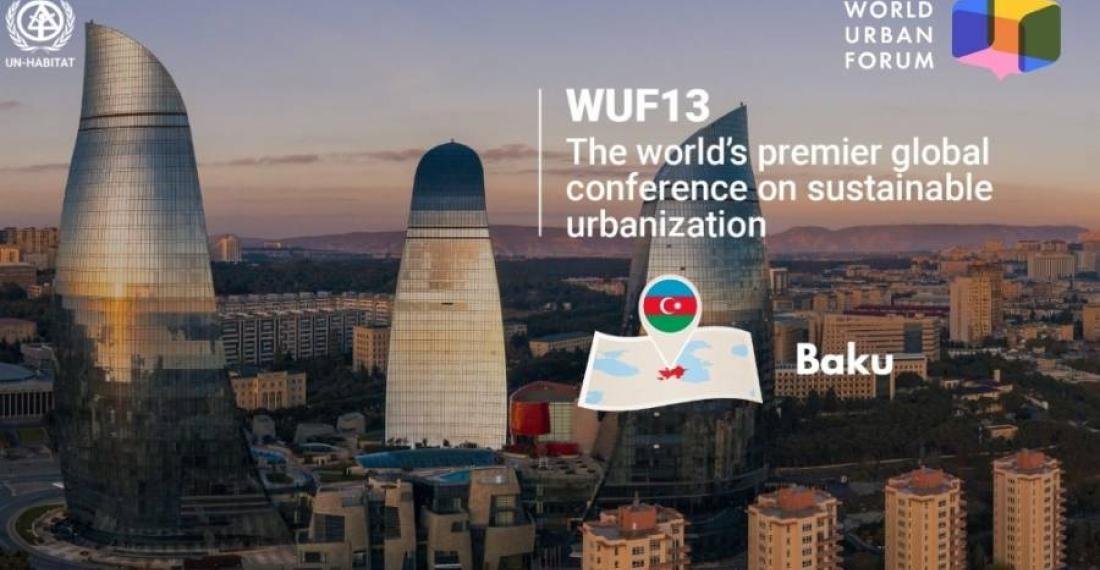
When Baku was selected to host the 13th Session of the United Nations World Urban Forum (WUF13), it was not merely a recognition of Azerbaijan’s growing organizational capacity on the world stage. It was, in many ways, a fitting venue for a conversation about post-conflict reconstruction that the country has been engaged in more urgently than almost any other in the world. Running from May 17 to 22, 2026, under the theme “Housing the World: Safe and Resilient Cities and Communities,” WUF13 attracted over 45,000 registered participants from 182 countries — making it, as President Ilham Aliyev noted at the opening, the largest international event ever held in Azerbaijan after COP29 (November 2024).
Azerbaijan’s decision to interweave the global urban development agenda with its own post-conflict recovery story was deliberate and, on reflection, relevant. The country is simultaneously rebuilding from decades of destruction in Karabakh while hosting a global forum dedicated to exactly the questions — housing, resilience, and the return of displaced populations — that define its national reconstruction mission. President Ilham Aliyev has declared 2026 the “Year of Urban Planning and Architecture” in Azerbaijan, framing the forum not as an isolated event but as part of a broader national transformation.
The scale of what Azerbaijan inherited in its formerly occupied territories is difficult to overstate. Nine Azerbaijani cities were almost completely wiped out. In his opening address at WUF13, President Aliyev returned to this image: “International observers and visitors compared, for instance, Aghdam with Hiroshima. They called it the ‘Hiroshima of the Caucasus,’ because this city just did not exist. It was totally leveled to the ground, and unlike Hiroshima, it was done not in one day as a result of an atomic bomb, but it was done during 30 years of occupation, when the buildings, historical buildings, public buildings, and houses were just dismantled and completely destroyed.”
Beyond the physical destruction, the occupation had uprooted an entire population. Azerbaijan faced one of the largest humanitarian crises in Europe after World War II, with up to one million refugees and internally displaced persons deprived of their homes, living conditions, and social opportunities.
Since the liberation of the territories following the 2020 War, Azerbaijan has launched one of the most ambitious post-conflict reconstruction programmes of the twenty-first century. The budget allocated for reconstruction in the liberated territories from 2021 to 2025 is estimated at over 23 billion manats (approximately $13.5 billion). In 2026 alone, a further 3.7 billion manats ($2.2 billion) are planned for allocation, bringing the total public investment commitment to over 26 billion manats — approximately $15.3 billion.
President Aliyev, during his speech at the opening ceremony of WUF13, offered a summary of what this investment has produced on the ground. “I can, of course, bring a lot of figures, but I will mention only two — the lengths of the tunnels which we are building now. In five years, 70 kilometers have already been built, with five more to be built; 435 bridges have been built out of 500. So this was done along with power stations, along with water supply, water storage facilities, houses, schools, hospitals, three international airports, railroads — and this was done only in five years." Referencing the moral dimension of reconstruction, he concluded: "This is how the owners of the land behave, unlike those who come only to demolish, to destroy, and to bring suffering.”
Over 240,000 hectares have been cleared of mines and unexploded ordnance. The Karabakh University and 19 general education institutions have opened, industrial parks in Aghdam and Jabrayil have been launched, and high-speed internet has been provided across 24 settlements. Karabakh and Eastern Zangezur were declared a green energy zone by presidential decision, and renewable energy projects are being implemented on a large scale, including hydroelectric power stations with a total capacity of 50 megawatts.
Speaking at the special session “Housing at the Center of Global Coalitions”, Hikmet Hajiyev, foreign policy advisor to President Aliyev, elaborated on why Azerbaijan chose to develop its own reconstruction model rather than transplant an external one: “We tried to study international experience during the reconstruction of the liberated territories. To be honest, we could not find a model fully suitable for Azerbaijan. We respect the post-conflict experience of the UN and other international organizations, but we were not satisfied with the speed of the process. The instruction of Azerbaijan’s leadership was to carry out the work on time. Because Azerbaijani refugees and internally displaced persons had lived for 30 years with the dream of returning to their homes. The territories were liberated within a short period, and in the reconstruction process we adopted quality, dignity, and safety as the main principles.”
That commitment to pace has produced visible results. The safe return of 86,000 Azerbaijanis to Karabakh and Eastern Zangazur has been ensured. According to the government's longer-term planning, 1.1 million people are ultimately to be settled in the liberated territories.
Vahid Hajiyev, special representative of the Azerbaijani President in the de-occupied Jabrayil, Gubadli, and Zangilan districts, speaking at the "Revival and Urbcide" panel organized by the Center for Analysis of International Relations (AIR Center) as a side-event within WUF13, highlighted the deliberate character of the destruction wrought during the occupation years: “This devastation was not merely the demolition of buildings; it represented the deliberate eradication of urban life — urbicide. The occupation also triggered widespread environmental degradation and the systematic destruction of cultural heritage. Furthermore, these territories remain heavily contaminated with landmines, posing one of the most severe challenges we currently confront.” He added that the Zangezur corridor, once complete, would serve as a pivotal logistics link connecting the East-West and North-South transport corridors, opening new vistas for trade, tourism, and employment across the region.
Beyond the substance of what was said at WUF13, the forum itself carries a broader significance. By hosting — and shaping the agenda of — one of the most attended iterations of the World Urban Forum in its history, Azerbaijan has turned a domestic reconstruction story into a globally visible case study in post-conflict urban recovery. President Aliyev, in a sideline interview on Euronews, captured the ambition succinctly: “I believe that by now we have developed a unique experience in building cities and villages from scratch.” That claim is no longer a political aspiration. At WUF13, before an audience of 45,000 urban development professionals, it became a documented record — one that Baku has now placed firmly on the global urban agenda.
source: Dr. Vasif Huseynov is Head of the Western Studies Department at the Center for Analysis of International Relations (AIR Center) in Baku and Adjunct Professor at Khazar University.