


Liz Mermin is an American documentary filmmaker based in London. Her latest film, Amazing Azerbaijan!, investigates human rights in Baku at the time of the 2012 Eurovision Song Contest. Nick Maltby interviewed her about the film and its context.
What was the original motivation to make the film - was it social, or did it come from an interest in Azerbaijan?
My films are always on different subjects. I'm always looking for something new and interesting to take on, so I didn't really know anything about Azerbaijan at all.
Some friends of mine who are involved in the activist campaign that was building up in and around Eurovision said, 'this would be an interesting time to pitch a documentary about Azerbaijan - do you know anything about it?' And then I started doing a bit of research and it just seemed like the more I learned about how strategically important Azerbaijan was, the more this Azerbaijan-Europe tie became interesting: what does Europe mean? What does Europe stand for? How do countries like Azerbaijan fit into it? And of course, with Eurovision coming up, we had one of those narrow windows where broadcasters were actually willing to consider a film on Azerbaijan because it's not a story that's very easy to pitch under ordinary circumstances!
How do you characterise Eurovision? It's kind of a comic event in the UK. How can the Azerbaijani government see it as a propaganda tool?
It was interesting to see how the government stacks up victories and how they put Eurovision in rhetorically the same category as being invited to the G20 meeting and all these sort of much more significant achievements. But of course they know the difference between a song contest and something more meaningful.
It's a government that likes to celebrate victories of any sort. I mean, building the tallest flagpole in the world and making a big deal out of that - before Tajikistan broke the record - there is a pride in odd victories, which I think the activists who I was filming with all found embarrassing and ridiculous. But somehow the government trades on that, in the same way that they've made a Baku Magazine, published by Conde Nast. They're trying to compete on the world platform in every level. And somehow Eurovision just seemed to fit into that.
I think also there's this question of ‘Why?' I mean all these people involved in Eurovision were saying that they were part of Europe; it's easy to laugh at that, but it does raise questions about what Europe means?
Do you see Azerbaijan as part of Europe?
I suppose Europe is struggling with a question of what it is and who belongs in it. The Council of Europe creates a definition of Europe, which is essentially that countries should be willing to adopt Europe's values and act on them. It's a strong concept but if it doesn't have any teeth in it, then why bother? So I don't think there's any reason why Azerbaijan couldn't be part of Europe, but they haven't done anything to show that it's anything more important to them than a status symbol; and, similarly, Europe hasn't done anything to show that they really care that people are following the rules. I see the film is as strong an indictment of European values and how they're slipping, as much as it's an indictment of Azerbaijan.
You say that those European values are deteriorating; at which point in history do they begin deteriorating? It seems to be that Europe's always been quite self-interested in a way that most major Western powers are?
I suppose that's probably true, but there's that idealistic moment after World War Two, about creating these organisations that would keep the peace and would raise the discourse to a higher level and prevent horrible things from happening within Europe; I guess it's been a slow decline from that. I'm American and there's a lot more lip service given to human rights here than there is in America. I think that's a good thing - at least some people are fighting to try to keep the principles meaningful - but I'm not enough of a political historian to say when it slipped. I mean, I guess after the end of the Cold War, there was another moment of idealism, where people thought, 'Now we're not breaking everything into this black-and-white world, it's a moment where we can come together and make the world a better place'. And that obviously coincided with the enlargement of Europe.
You were able to gain access from Eurovision: what restrictions were there?
I used Eurovision as a way to get in and see what the government had to say for itself. It's very difficult to get journalist visas to Azerbaijan: the authorities are very suspicious. We got our visas the night before we were supposed to fly out and it was very touch-and-go whether we were going to get them at all. I think there must have been calculations about whether they could trust us or not. It was before they picked up on the fact that Eurovision was being used to launch a human rights campaign.
I know that about two months after we went, the BBC started trying to go and they couldn't get visas. They made that an element of the documentary they eventually made for Panorama. We were there officially as guests of the television channel that was hosting Eurovision: they provided us with a driver and they were the official reason that we were allowed to be there, and they set up the interviews. My plan was always that this was a film about Azerbaijan's place in Europe and we were using Eurovision to explore that. And the authorities kept saying, 'it's not political, is it?' And I said, ‘As far as Azerbaijan's place in Europe is political, it's political'.
I didn't try to meet with any activists and dissidents while we were in Baku because I had a good network of those people once we were out of the country. We were playing it really safe, partly because I was interested in how people in the government would represent themselves.
You obviously focus on what Khadija Ismayilova calls the right ‘side of the happy belt', is there any recognition of what's going on in other areas of Azerbaijan? What was the wider national response to Eurovision?
I didn't run around talking to loads of people on the streets, but the impression I got and from the conversations I had with other people is that, overall, it was, 'this is cool, we won something!' Jamal, the musician, says, 'we don't have a football team, we don't have a volleyball, we're terrible at everything, at least we've finally won something - great!'
I think there's as much of a pride in the Eurovision victory as there would be in any country. My impression was that although people were pleased with it, if you said to them, ‘Should the government be spending tens of millions on the Eurovision contest?' they would probably say, ‘no'. And then of course the young dissidents who were sort of cool and hip: Eurovision is far beneath them!
The victory of the Swedish Eurovision entry, Loreen, and the rebuke Loreen gave to the government about its record on human rights - did that receive attention in Baku?
There was a clip from a news conference where Loreen was asked about the human rights situation and the translator on Azeri TV mistranslated it. She gave a diplomatic answer, which was basically, 'I'm concerned about the people.' But the translator on the Azeri broadcaster said something like, ‘Loreen's being asked if she likes Baku, and she's saying she's very pleased to be here.' Something like that - so as far as I can tell, it was completely erased.
Focusing on the two Americans you interviewed, what do you think is attractive to them about Baku?
I was astonished to find out that America sends Peace Corps Volunteer to Baku. I always thought they sent the volunteers to poor countries that needed development work. The idea of sending Peace Corps volunteers to a country with that much money is absurd. I did ask those volunteers that and they said, 'Well, in the countryside they really do need a lot of development' and that is one of the big critiques of the country - that all the money is going into these ridiculous buildings in Baku and the rest of the country is still very Third World.
The Peace Corps is very idealistic, and Azerbaijan is a very friendly open culture and the people are very hospitable. I'm sure that those volunteers had a wonderful time there, and when you're 20 years old, it's very exciting to go and be welcomed in a new culture - and you don't feel that it's your place to be critical.
What do you think are the successes of the Aliyev government?
I'm not really qualified to answer that. I mean, in the city there's been a lot of development and he's obviously created close ties with a lot of Western governments - I suppose those are successes.
Is there any interesting sequel to the careers of the dissidents that the film features?
Emin who is one of the donkey blogger guys - the one with the glasses - he kind of sees himself as an Azeri Václav Havel. He's an outspoken intellectual who's attacking the regime at every opportunity. He's just started an online television channel, so we'll see what happens with that. He blogs incessantly and he's building an international profile. And Khadija, similarly, is getting more and more international attention. She was just in Brussels having meetings with MEPs. Both of them are facing fines which they're refusing to pay, so there might be some jail time looming there. They're refusing to pay on the principle that they were attending a rally.
What they're doing to Khadija is really disgusting: they released a sex video of her from secret-filming and they've recently created another fake website that poses as a site about politics in Azerbaijan. It has really nasty cartoons about opposition leaders and there's a section on Khadija with a link to a video tape of pure pornography; the woman in it looks a lot like Khadija, but isn't her. It's disgusting. It's had thousands of views already.
These smear campaigns seem astonishingly medieval.
It's so venal, it's kind of embarrassing. Her position is that she doesn't want to play into the hands of any kind of Internet censorship, so she's not asking for these things to be removed. But it's a horrible position for her to be in.
Where are both of them based now?
They're both in Baku.
The documentary seemed to end optimistically. It's quite rare to see that kind of courage in journalism. But there is a side of me that doubts that journalism can have a huge impact.
I'm not sure how optimistic the ending is. Ferdy and Jamal - the two musicians - are certainly not optimistic. Emin and Khadija are certainly up, because there's been this protest and they think it's the beginning of something changing. But the last word goes to Aliyev, who's sort of laughing at them saying, 'We'll triumph and we'll continue to win, and there's nothing to worry about'. I see the ending as a little bit dark; but you have to have a certain amount of optimism, otherwise these guys couldn't continue what they're doing.
The website of the film Amazing Azerbaijan is available at www.amazingazerbaijan.com
source: commonspace.eu
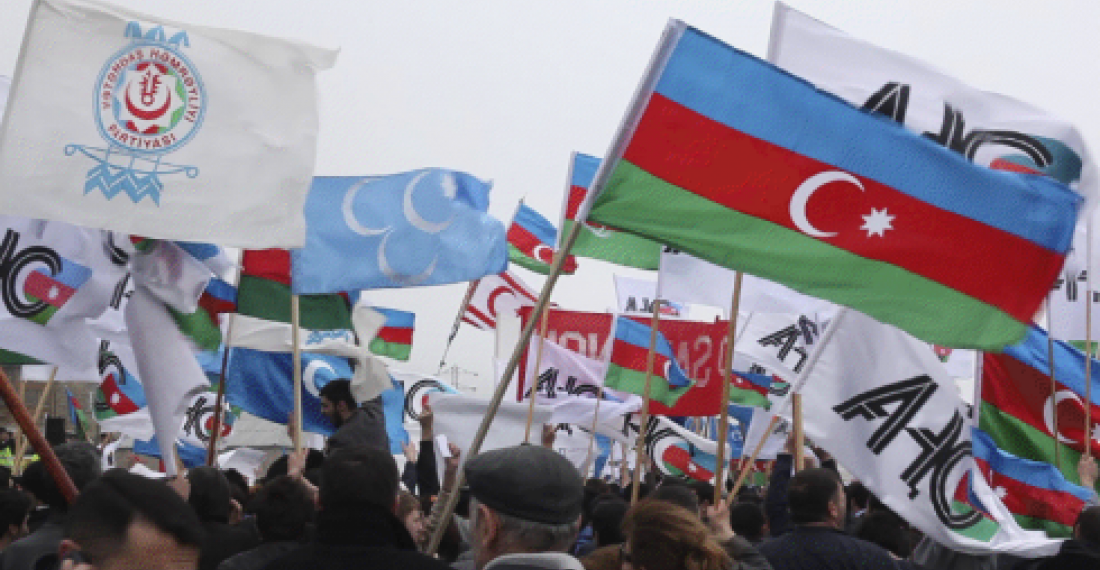
photo: An opposition rally in Azerbaijan at the time of the 2012 Eurovision Song Festival.



