


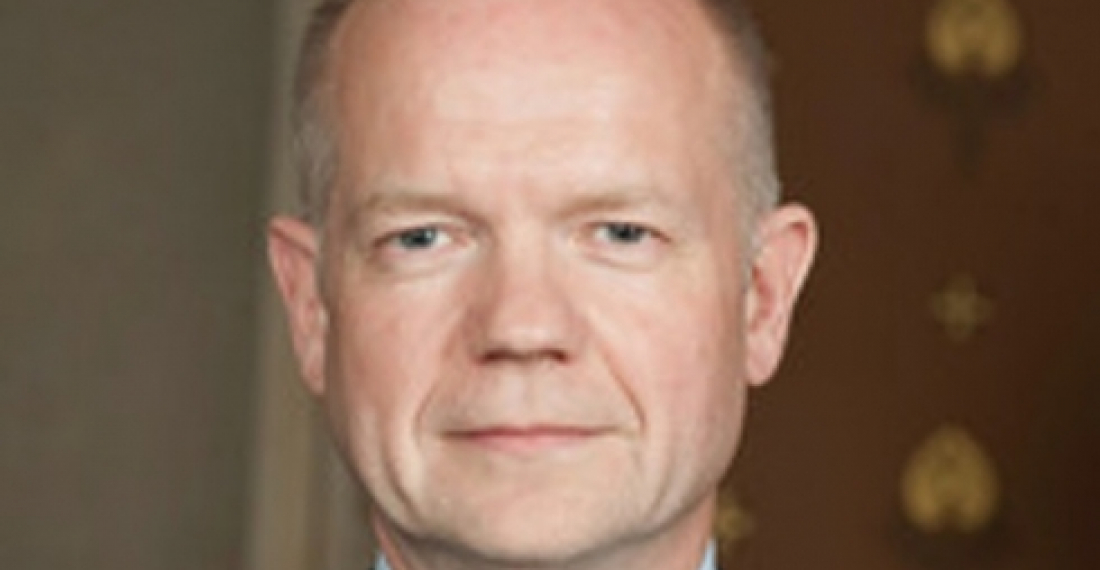
"Russia has invaded a fellow European nation, and used force to change its borders". - UK Foreign Secretary.

The British Foreign Secretary, William Hague,  has highlighted the seriousness of the current situation following the Russian annexation of Crimea, in an article in the London newspaper Daily Telegraph on 22 March. William Hague wrote:

This week European nations adopted unprecedented sanctions on Russia. These are not designed to punish the Russian people. They are a message and a warning to Russia's leaders.

We have not embarked on this course lightly. For twenty years Britain and our allies in Europe and Nato have gradually built a normal relationship with Russia. Russia joined the G8 and the World Trade Organisation, we created the Nato-Russia Council, and we have worked together on the United Nations Security Council from Yemen to Somalia. We have all gained from this cooperation.

But Russia's actions in Ukraine hark back to a wholly different era. The illegal annexation of Crimea is an outrageous land grab, and the referendum that preceded it was a mockery of democracy. Russia has invaded a fellow European nation, and used force to change its borders.

This is the most serious risk to European security we have seen so far in the 21st century. Vital principles are at stake, including the territorial integrity of European nations and the right of democratic countries to choose their own future.

All nations, including Russia, depend on a rules-based international system. For those rules to remain credible there must be costs attached to breaking international agreements. If we do not defend these principles in Ukraine, they will be threatened elsewhere in Europe and the world.

There is a pattern emerging of Russia taking advantage of frozen conflicts from Transnistria to South Ossetia, and seeking to impair the ability of countries to chart an independent future. And with thousands of Russian troops still massed on Ukraine's borders, there is a grave risk of the Ukraine crisis deepening.

That is why the EU, the United States and our allies have imposed sanctions. The European Commission are working now on more far-reaching economic measures that will be imposed if Russia takes further steps to undermine Ukraine.

We want Russia to enter into direct talks with Ukraine, and to work with other nations to resolve this dispute peacefully. We have never given up on diplomacy or sought a path of permanent confrontation with Russia. But nor should European nations run scared before bullying behaviour.

Despite our preference and our work to improve relations with Russia this means, sadly, that we and our allies must be prepared to contemplate a new state of relations with Russia that is very different to the last 20 years. This would involve Russia being outside some international organisations, facing lasting restrictions on military cooperation and arms sales, and having less influence over the rest of Europe.

Some in Russia may think that their actions in Crimea will produce short-term pain in the form of limited sanctions, after which matters will return to the status quo ante. But in fact, the Russian people stand to lose a great deal over time - in Ukraine, in Europe, and internationally.

Russia's actions have done immense damage to its reputation. At the United Nations Security Council last week no other country voted with Russia, which was forced to use its veto alone. The Russian government has alienated the great majority of Ukrainians.

And in Europe, ideas are now being discussed for how we build greater energy security. If necessary, we should be prepared to diversify future sources of natural gas supplies to Europe, including through the Southern Corridor. We would need to boost investment in gas interconnections and terminals in Europe, and develop indigenous European energy supplies for countries wishing to develop their own resources, such as shale gas.

And it would mean helping Ukraine and neighbourhood countries to liberalise their energy markets, increase energy efficiency and ensure more resilient energy supplies. Russia's actions in Ukraine should make it much more likely that the European Union takes such decisions.

Accelerating energy diversity in Europe may have to be part of our answer to recent events. Increasing our focus on supporting democratic institutions in nations vulnerable to interference by Russia may be another.

Russia has been damaged by its failure to develop independent institutions and by an oligarchic economic system. The same oligarchisation has damaged Ukraine, and indeed I have stressed to Ukraine's leaders that tackling corruption, creating independent institutions and the rule of law are fundamental to their country's future.

There is an evident danger of some of the same corrupting habits spreading into democratic countries. In South East Europe and the Balkans in particular, we are seeing the creation of concentrations of economic, political and media power which could inhibit the development of genuine or stable democracy and reverse progress already made. If this is allowed to go unchecked, European democracy could be damaged and undermined over the long term.

Facing up to this and supporting healthy democracy in such countries is now an additional strategic challenge for Europe. Britain has much to offer. We have an unbroken history of democracy for an extraordinary length of time because we have learnt how to guard against excessive concentrations of power.

Focusing on these two challenges would require a serious reappraisal of how Europe thinks about itself in the 21st century, and the readiness to change our long term relationship with Russia if that proves necessary.

Some in Russia may feel temporarily victorious, and think that Russia has won at Europe's expense. What they fail to see is that Russia loses even more than turning the Ukrainian people against Moscow. As things stand today, the arc of Russia's path in world affairs risks once again bending towards isolation and stagnation.

 source: commonspace.eu with the website of the UK Foreign and Commonwealth Office.

Related articles

Editor's choice
News
Russia adds pressure on Armenia ahead of key elections; recalls Ambassador in Yerevan for consultations

Russia adds pressure on Armenia ahead of key elections; recalls Ambassador in Yerevan for consultations

Ahead of key parliamentary elections,scheduled to be held in Armenia on Sunday, 7 June, Russia continues to attempt to put pressure on the Armenian Government led by prime minister Nikol Pashinyan. On 30 May, Russia recalled its Ambassador to Yerevan for consultations. A terse statement, published on the website of the Russian Foreign Ministry, said, "The Ambassador of the Russian Federation to the Republic of Armenia , S.P. Kopyrkin, has been summoned to Moscow for consultations in connection with the steps taken by the Armenian leadership to move closer to the European Union, which are detrimental to cooperation within the EAEU." This followed a statement issued the day before, by the leaders of the Eurasian Economic Union (EAEU) that challenges the Armenian trajectory towards approximating to the European Union. Vladimir Putin is undertood to have personally pushed the other four EAEU leaders to issue the statement, which said: "Taking into account the significant risks to the economic security of the member states of the Eurasian Economic Union (hereinafter referred to as the Union) arising in connection with the preparation of the Republic of Armenia for accession to the European Union, as well as the need to prevent the associated damage to the member states of the Union: decided that the members of the Eurasian Intergovernmental Council from the Republic of Belarus, the Republic of Kazakhstan, the Kyrgyz Republic and the Russian Federation will report at the next meeting of the Supreme Eurasian Economic Council in December 2026 on the possible consequences of the suspension of the Treaty on the Eurasian Economic Union with respect to the Republic of Armenia. We share the position on the need to hold a national referendum in the Republic of Armenia as soon as possible on joining the European Union or continuing to be part of the Eurasian Economic Union."
Editor's choice
News
The leaders of the states of the Eurasian Economic Union issued a tough statement warning fellow-member state Armenia of the consequences of its desire to join the European Union.

The leaders of the states of the Eurasian Economic Union issued a tough statement warning fellow-member state Armenia of the consequences of its desire to join the European Union.

The leaders of the states of the Eurasian Economic Union (EEAS) issued a tough statement warning fellow-member state Armenia of the consequences of its desire to join the European Union. The stark, sharply worded,  warning, comes days before crucial parliamentary elections in Armenia, scheduled for 7 June. The full statement said, “We, the Presidents of the Republic of Belarus, the Republic of Kazakhstan, the Kyrgyz Republic and the Russian Federation, Taking into account the actions of the Republic of Armenia aimed at joining the European Union, including the approval in 2025 by the National Assembly of the Republic of Armenia and the signing by the President of the Republic of Armenia of the Law of the Republic of Armenia "On the Start of the Process of Accession of the Republic of Armenia to the European Union", as well as the confirmation by the European Union of the European aspirations of the Government of the Republic of Armenia, expressed in the joint declaration following the first Armenia-European Union summit, adopted on 5 May 2026, Taking into account the significant risks to the economic security of the member states of the Eurasian Economic Union (hereinafter referred to as the Union) arising in connection with the preparation of the Republic of Armenia for accession to the European Union, as well as the need to prevent the associated damage to the member states of the Union: decided that the members of the Eurasian Intergovernmental Council from the Republic of Belarus, the Republic of Kazakhstan, the Kyrgyz Republic and the Russian Federation will report at the next meeting of the Supreme Eurasian Economic Council in December 2026 on the possible consequences of the suspension of the Treaty on the Eurasian Economic Union with respect to the Republic of Armenia. We share the position on the need to hold a national referendum in the Republic of Armenia as soon as possible on joining the European Union or continuing to be part of the Eurasian Economic Union. Astana, May 29, 2026” A meeting of the Supreme Eurasian Economic Council was held in Astana, Kazakhstan, on May 29, 2026. The meeting of the Supreme Eurasian Economic Council in a restricted format was attended by Russian President Vladimir Putin, Belarusian President Alexander Lukashenko , Kazakh President Kassym-Jomart Tokayev , Kyrgyz President Sadyr Japarov , Armenian Deputy Prime Minister Mher Grigoryan, and Chairman of the Board of the Eurasian Economic Commission Bakytzhan Sagintayev. From the Russian side, the meeting was also attended by Deputy Prime Minister and member of the Council of the Eurasian Economic Commission Alexey Overchuk and Presidential Aide Yury Ushakov . The heads of delegations from EAEU observer states, including President of Uzbekistan Shavkat Mirziyoyev , Vice President of Cuba Salvador Valdés Mesa, Minister of Industry, Mines, and Trade of Iran Mohammad Atabak, and CIS Secretary General Sergei Lebedev, joined the expanded meeting . Following the meeting of the Supreme Eurasian Economic Council, a number of documents were signed .

Popular

Editor's choice
Interview
Thursday Interview: Murad Muradov

Thursday Interview: Murad Muradov

Today, commonspace.eu starts a new regular weekly series. THURSDAY INTERVIEW, conducted by Lauri Nikulainen, will host  persons who are thinkers, opinion shapers, and implementors in their countries and spheres. We start the series with an interview with Murad Muradov, a leading person in Azerbaijan's think tank community. He is also the first co-chair of the Action Committee for a new Armenian-Azerbaijani Dialogue. Last September he made history by being the first Azerbaijani civil society activist to visit Armenia after the 44 day war, and the start of the peace process. Speaking about this visit Murad Muradov said: "My experience was largely positive. My negative expectations luckily didn’t play out. The discussions were respectful, the panel format bringing together experts from Armenia, Azerbaijan, and Turkey was particularly valuable during the NATO Rose-Roth Seminar in Yerevan, and media coverage, while varied in tone, remained largely constructive. Some media outlets though attempted to represent me as more of a government mouthpiece than an independent expert, which was totally misleading.  Overall, I see these initiatives as important steps in rebuilding trust and normalising professional engagement. The fact that soon a larger Azerbaijani civil society visits to Armenia followed, reinforces the sense that this process is moving in the right direction." (click the image to read the interview in full)


