


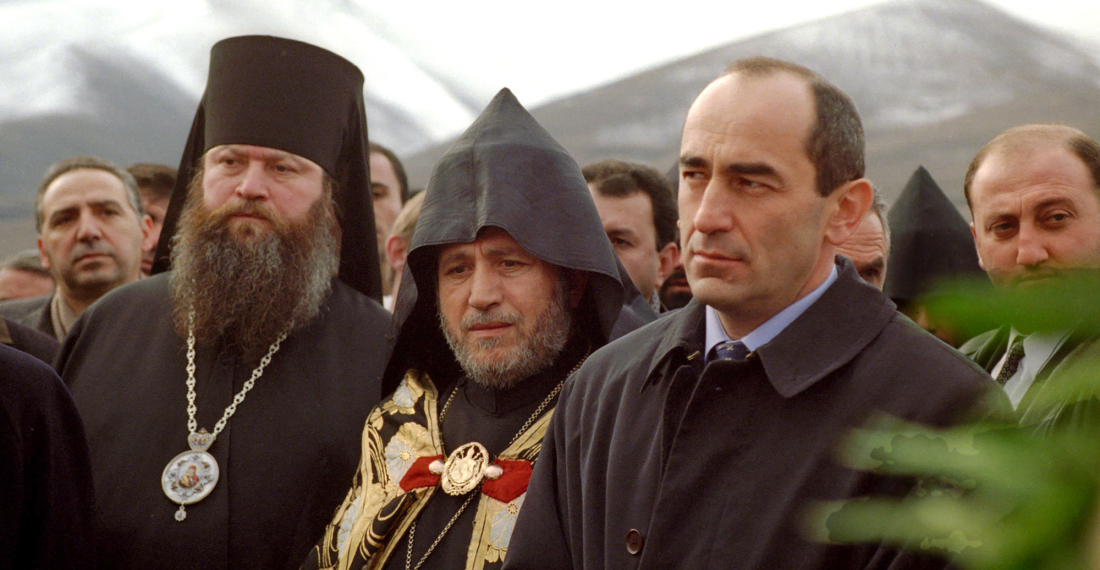
For over a week now, the Armenian public has been subjected to another unedifying spectacle between the country’s political and spiritual leadership. Tirades posted on social media by Prime Minister Nikol Pashinyan targeting Armenian Catholicos Karekin II, who he accuses of fathering at least one child despite an oath of celibacy, have been incendiary. The allegation is not new. Armenian media even named an alleged daughter back in 2013. However, Pashinyan’s wife, Anna Hakobyan, further ratcheted up tensions by referring to some members of the clergy as paedophiles while not presenting any evidence.
Just days before Pashinyan’s posts, Karekin II was in Switzerland where he took part in a conference where Armenian cultural heritage in Karabakh took centre stage, an issue Pashinyan has been careful to avoid at this juncture when the text of a peace treaty has been finalised but not signed. Hakobyan specifically insulted the church for participating in the event now more likely to obstruct a possible peace deal than contribute to one. The government had already signalled that doing so now would carry with it significant national security concerns. It is likely that the new attacks on Karekin II are connected.
They are certainly linked to Pashinyan’s declining ratings with parliamentary elections a year away and a disparate opposition eager to establish a united front to remove the governing party from power. That proved successful in the second-largest city of Gyumri earlier this year but the opposition and the church still have their own crosses to bear.
Even when the Catholicos was elected in 1999, his legitimacy was disputed from the start. Unlike his predecessor, Karekin II’s selection was accompanied by accusations that it had been orchestrated by then-president Robert Kocharyan and supportive groups such as the Armenian Church in Russia. Adding to the intrigue, Karekin II was elected on the same day that gunmen stormed the Armenian National Assembly, killing eight including newly elected prime minister Vazgen Sargsyan and parliamentary speaker Karen Demirchyan. Nobody is suggesting the two events were connected but the coincidence was uncanny.
At any rate, Kocharyan was nonetheless able to consolidate his power with his main political competitors no longer and a perceived loyalist in the Holy See of Etchmiadzin.
Allegations of corruption, fathering children, and entrenching the church in criminal networks have followed Karekin II ever since. In 2000, Karekin II – real name Ktrij Nersessyan – courted additional controversy by dismissing the head of the Diocese of the Armenian Church in Russia, replacing him with his own brother, Yezras Nersessyan. In 2023, incidentally, Archbishop Yezras blessed ethnic Armenians in the Arbat Battalion fighting for Russia in Ukraine. Arbat was also linked last year to an alleged coup attempt against Pashinyan in Armenia.
Certainly, Karekin II isn’t just a symbolic figurehead. He is arguably the last remnant of the Robert Kocharyan-Serzh Sargsyan era that most Armenians turned their backs on seven years ago. Following Pashinyan’s successful attempt to seize power in 2018, there was even a failed attempt by the New Armenia, New Patriarch movement within the church to depose Karekin II as well. The new Pashinyan government was reluctant to intervene, noting the importance of maintaining the separation of church and state, but that was to change when Karekin II openly lobbied for Kocharyan’s release from prison in early 2020.
Following Armenia’s defeat in its war with Azerbaijan later that same year, Karekin II also joined those calling for Pashinyan’s resignation. In 2022 and 2024, he also gave permission for members of the clergy to participate in street protests aimed at toppling the embattled premiere. There was arguably no longer any separation at all. The gloves were off on both sides.
At the heart of this renewed conflict is an increasingly unpopular prime minister and a compromised religious leader that remains synonymous with the Kocharyan and Sargsyan regimes. As Pashinyan seeks to create a new country from the ashes of defeat, the Catholicos remains an obstacle to this vision for post-war Armenia, especially now the church is fully aligned with the opposition.
While that is understandable, as is Pashinyan’s response, both risks causing irreparable damage to the church as an institution at the same time. Others say that Karekin II had achieved that over the past few decades anyway through allegedly authoritarian clerical rule. The Armenian Apostolic Church has anyway lost many of its flock to others such as the evangelicals.
The government has already hinted that it might remove the exclusive nature of the Armenian Apostolic Church in constitutional changes that will likely have to be made in the near future. This now seems unavoidable given the very public and personal nature of the conflict between the two men. Karekin II has anyway made it clear he opposes any concessionary peace deal with Azerbaijan.
That is a far cry from 2010 when Karekin II visited Baku to participate in an international religious summit where he also held amicable meetings with Azerbaijani President Ilham Aliyev and top Shia Muslim cleric, Sheikh-ul-Islam Allahshukur Pashazade. In the event of a long-anticipated peace agreement, religious diplomacy will likely play an important role in bringing the two countries together, but Karekin II now seems unlikely to agree.
Indeed, last weekend Pashazade told the media it was impossible to meet Karekin II again given that he is “beyond religious activities, taking on a political role.” With the Armenian opposition stating it will reject all agreements made by Pashinyan and Aliyev to date, and even relaunch new talks with Russian mediation, this likely makes Karekin II’s continuation as Catholicos untenable in Pashinyan’s eyes.
Instead, there now seems to be a final showdown on the horizon between the pre-revolution regimes of old and what was meant to replace them. In short, a Historical Armenia personified by Kocharyan, Sargsyan, Karekin II, and perhaps even Ter-Petrosyan, locked into an existential battle with Pashinyan’s Real Armenia concept. As the coming year before the 2026 parliamentary elections progresses, the situation is likely to become even more heated and potentially volatile.



