


At the beginning of the month, the Armenian and Azerbaijani border demarcation commissions exchanged documents detailing the regulation of future activities. But this was not the unified document that had been expected. Armenian Prime Minister Nikol Pashinyan had earlier that day refused to answer questions from the media as to whether the deadline set for such a document had been met or not. Even Radio Free Europe were unsure. While its Yerevan Bureau reported that the two sides hadn't in fact managed to agree on the draft regulations, its Prague Headquarters at least reported progress.
As it turned out, the deadline had indeed been missed. “Something worked out, something didn't work out,” one of Pashinyan’s MPs cryptically told the media three days later. “It's okay, […] the deadline is not important.”
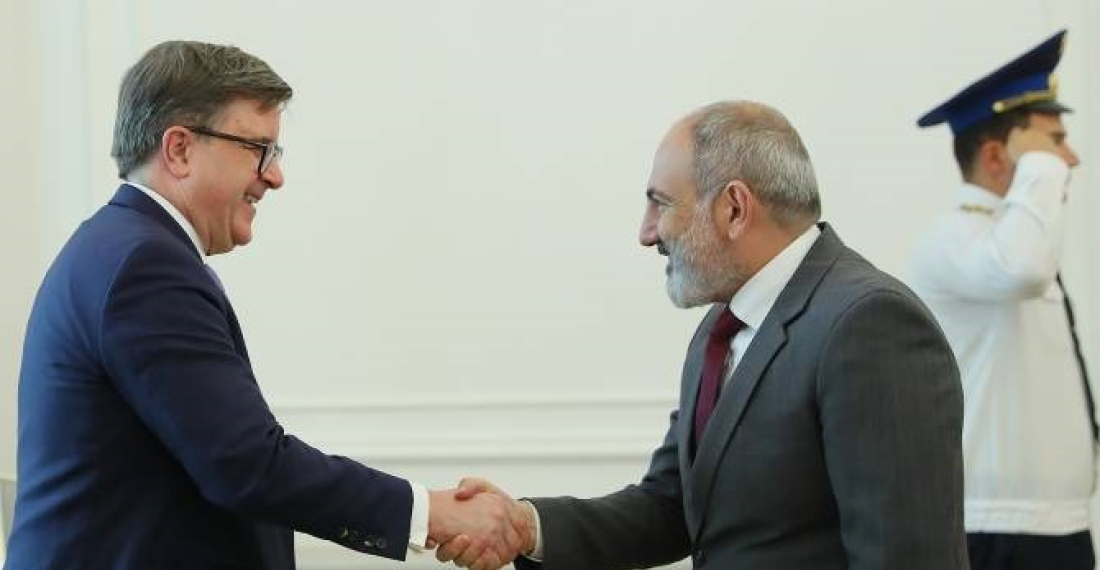
And maybe it wasn’t. Opposition protests led by a revanchist cleric had failed to disrupt the actual border delimitation and demarcation process on the Tavush-Gazakh section. Though Galstanyan recently toured the southernmost Siunik region of the country with a message of imminent disaster and an Azerbaijani and Turkish conspiracy to connect the two by force, something international commentators parroted consistently, that never really made any sense. On 10 June, US Assistant Secretary of State James O’Brien visited Yerevan and highlighted how unblocking regional communications was a priority for everyone.
Yerevan should agree to the road and rail link between Azerbaijan and its exclave of Nakhchivan. By doing so, he argued, Armenia could better diversify its economic dependency away from Russia and evict Moscow from the South Caucasus. On 27 June, O’Brien delivered the same message in Baku while also underlying how Azerbaijan could use the connection to help Central Asia also diversify away from Russia. The objective would be to again bypass and even exclude both Beijing and Moscow from regional projects. Following the Shanghai Cooperation Organization meeting in Kazakhstan, that does not look likely.
It was always assumed that the US had geopolitical interests in facilitating an Armenia-Azerbaijan peace, just as Russia does. Now it was official. As a result, in recent days, some opposition commentators now no longer talk of a conspiracy to link Turkiye with Central Asia through a Zangezur Corridor, but what they aggressively refer to as the Washington Corridor.
Certainly, the United States seems particularly eager to have a peace deal signed immediately and has openly said so, possibly because its own window of opportunity could close if President Biden does not secure a second term in office later this year. It has already invited the Armenian and Azerbaijani foreign ministers to participate in a side event for partner countries at the NATO Summit marking the 75th anniversary of its founding in Washington DC on 9-11 July. Though the two officials could hold bilateral talks there, there has so far been no announcement of any with some suggesting such a possibility only if US interests are accommodated.
And despite being listed as a panellist at the Dubrovnik Forum in Croatia on 29 June, Armenian Foreign Minister Ararat Mirzoyan unexpectedly changed his mind. His planned counterpart was not Azerbaijani Foreign Minister Jeyhun Bayramov but deputy Elnur Mammadov. Mirzoyan was instead shifted to another panel with Georgian Deputy Foreign Minister Teimuraz Janjalia but pulled out of that too. There was no explanation as to why. The Armenian Foreign Ministry instead highlighted how successful Mirzoyan’s visit to Croatia had been by highlighting meetings he had held with others on the sidelines of the forum.
Meanwhile, Baku continues to insist that no agreement can be signed until a controversial preamble to the Armenian constitution is removed. But even here there are questions. Does this refer to initialing a framework agreement, as Azerbaijani President Ilham Aliyev has recently suggested, or for the signing of a later comprehensive peace treaty. That remains unclear, but while Yerevan refuses to be dictated to, Armenian analysts refuse to discuss the problem at all. In contrast, a number of Azerbaijani analysts have suggested simply including a commitment in any any agreement to making the change later.
The first indication of whether that obstacle has been resolved will perhaps be if Bayramov and Mirzoyan do hold bilateral talks in the US next week. There is also the next European Political Summit (EPC) to be held in the United Kingdom on 18 July. Some are already speculating that Aliyev and Pashinyan could use the opportunity as they did prior to the ill-fated EPC in Granada last year. That ended multilateral talks and Armenia and Azerbaijan have since shifted to a bilateral format though at the expense of what little transparency did exist. There are clearly more questions than answers.
U.S. Secretary of State Antony Blinken says a deal is within reach just as he has so many times before. Later this month we will discover if that was just wishful thinking or if it finally becomes reality. If it does, there will also be the long overdue need to clearly communicate what comes next to the societies of both republics, especially if the unofficial deadline of the UN Climate Change Conference in Baku in November is still being considered. Hopefully, that too will not be missed.
source: Onnik James Krikorian is a journalist, photojournalist, and consultant from the U.K. who has covered the Armenia-Azerbaijan conflict since 1994.
photo: US Assistant Secretary of State James O'Brian visited Yerevan on 10 June and met with Prime Minister Nikol Pashinyan as part of a shuttle diplomacy to support the unblocking of regional communications. (picture courtesy of the press service of the government of Armenia
The views expressed in opinion pieces and commentaries do not necessarily reflect the position of commonspace.eu or its partners



