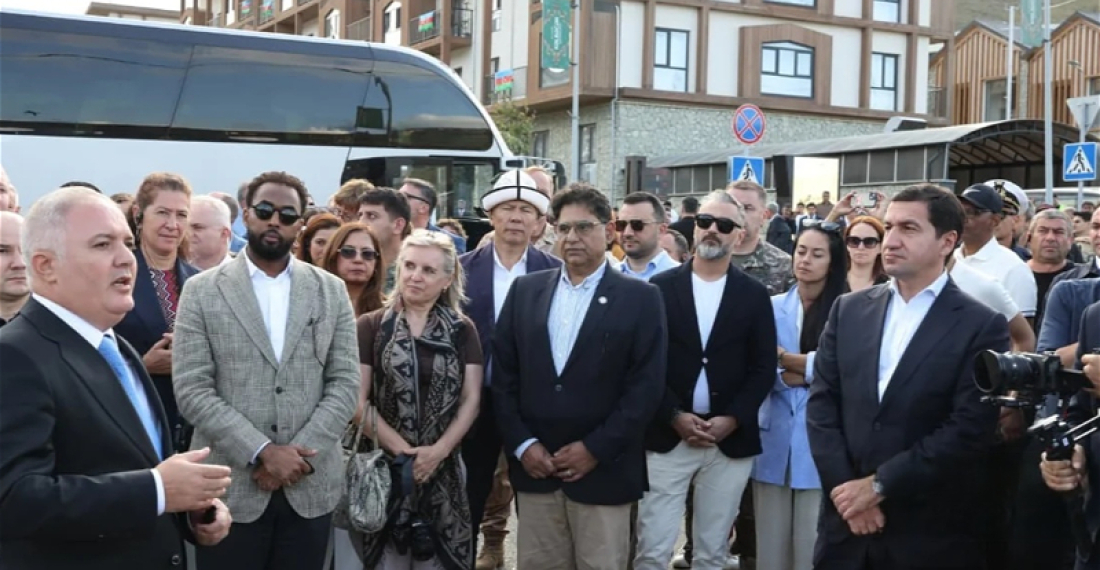
On September 11 and 12, roughly 150 representatives of the diplomatic corps accredited in Baku, drawn from 58 countries and nine international organizations, including the European Union's Special Representative for the South Caucasus, traveled to Azerbaijan's Karabakh and East Zangezur regions. They visited Shusha, Khankendi, and historic sites including the Ganjasar and Khudavang monasteries. By any normal diplomatic standard, this was an unremarkable event. Foreign missions accredited to a sovereign state routinely tour that state's regions, and no government anywhere asks permission from a neighboring capital before showing its own territory to its own diplomatic partners.
What followed in Armenia was not unremarkable. Parliamentarians, government-adjacent commentators, media outlets, and diaspora organizations reacted with a wave of condemnation, describing the visit as an attempt to “legitimize ethnic cleansing,” demanding that diplomats boycott the trip, and reviving the vocabulary of an “Artsakh” cause that Yerevan has, at least on paper, set aside. This reaction deserves attention, not because it changes anything on the ground in Karabakh, which remains Azerbaijan's sovereign and internationally recognized territory, but because of what it reveals about the gap between Armenia's declared peace policy and its domestic political reflexes.
Armenia has repeatedly stated, including in the text of the peace treaty initialed in Washington in August 2025, that it recognizes Azerbaijan's territorial integrity within its Soviet-era administrative borders, which include Karabakh. If that recognition is genuine, a visit by accredited diplomats to Azerbaijani territory cannot logically be treated as a scandal requiring political mobilization. A state cannot simultaneously tell the world it accepts a border and treat any ordinary exercise of sovereignty across that border as an outrage. The fact that this contradiction keeps surfacing, in parliament, in state-adjacent media, and among political experts representing government-linked think-tanks and diaspora bodies some of whom have close ties to Armenian political circles, suggests that recognition on paper has not yet been matched by acceptance in practice. That gap, not any visit by foreign diplomats, is the real obstacle to peace.
It is worth being direct about where this leads if it continues. Every peace process depends on both sides agreeing, implicitly or explicitly, to stop keeping score. Azerbaijan has largely done so. Since the 2020 war and the 2023 restoration of full sovereignty over Karabakh, Baku has focused its energy on reconstruction, the return of displaced families under the “Great Return” program, and one of the most extensive demining operations underway anywhere in the world, rather than on relitigating the conflict’s history in every international forum available to it. That restraint has not been costless. Azerbaijani deminers and civilians, including children, are still killed or maimed by landmines planted during the occupation and, in some documented cases, after the 2020 ceasefire, because Armenia has yet to hand over complete and accurate minefield maps.
If Armenian parliamentarians, officials, and diaspora networks insist on reopening the conflict as a live political and moral argument every time Azerbaijan exercises an ordinary sovereign function, they should understand that this is not a contest Armenia is positioned to win. The record includes the February 1992 Khojaly massacre, in which more than 600 Azerbaijani civilians were killed while fleeing the town, and thirty years of occupation of Karabakh and seven surrounding districts that produced roughly one million Azerbaijani refugees and internally displaced persons. It includes cities such as Aghdam and Fuzuli, leveled so completely during the occupation that international observers labeled Aghdam the “Hiroshima of the Caucasus.” Azerbaijan has, for the most part, chosen not to make this history the centerpiece of its diplomacy. That restraint is a policy choice, made in the interest of a durable peace, not an admission that the record does not exist. Armenian actors who keep pulling the conflict narrative back into public life should weigh whether they actually want that record placed back on the table, because the facts do not run in their favor.
The two monasteries visited during that trip, Ganjasar and Khudavang, fit the same pattern. Azerbaijani officials describe them as part of the ancient Caucasian Albanian Christian heritage, built under the Albanian kingdom that shaped the religious life of the region for centuries before either modern nation staked a claim to it, and preserved by Azerbaijan today as an integral part of its own historical and religious patrimony. Baku has also pointed out that the attention drawn by these two well-documented monuments stands in sharp contrast to the far larger and far less examined loss on the other side: hundreds of mosques, cemeteries, and other monuments built by Azerbaijanis over centuries in what is now Armenia have been destroyed, left to ruin, or erased from the historical record since the expulsion of Azerbaija’s West Azerbaijani community, a loss of heritage that has drawn a fraction of the international attention given to a single diplomatic tour.
None of this serves Armenia’s own stated interests. The gains achieved since August 2025, the initialed peace treaty, and the agreement reached on the Trump Route for International Peace and Prosperity (TRIPP), a corridor set to connect Azerbaijan to Nakhchivan through Armenian territory, together with the broader prospect of a South Caucasus finally free of the frozen-conflict logic that has governed it since the 1990s, are fragile and require sustained political discipline on both sides. Every outburst of this kind, especially when it comes from sitting parliamentarians and officials rather than only from diaspora activists abroad, hands ammunition to those who argue that Armenia's commitment to peace is tactical rather than sincere, and that Yerevan says one thing in Washington and another at home.
Azerbaijan has repeatedly signaled that it is prepared to close this chapter permanently, provided Armenia does the same, including by finally bringing its constitution into line with the borders it says it accepts. A diplomatic visit to Azerbaijani territory should never have become a controversy in the first place. That it did says less about Baku's intentions than about how much work remains in Yerevan before its declared peace policy is matched by its political culture. Armenia's leadership, media, and diaspora institutions would do well to recognize that reopening the conflict as a subject of grievance is a path that damages Armenia's own position far more than it does Azerbaijan's, and that the only outcome it guarantees is the erosion of a peace process both nations have invested too much in to lose.
source: This is an op-ed prepared for commonspace.eu by Dr. Vasif Huseynov, Head of Department at the Center for Analysis of International Relations (AIR Center) in Baku and Adjunct Professor at Khazar University.