Benyamin Poghosyan argues in this op-ed for commonspace.eu that it is time for Armenia to deepen its relations with Iran and China, out of necessity rather than choice.
Armenia continues to face a hard geopolitical reality. The 2018 Velvet revolution has brought hope of the possibility of significant and systemic changes in domestic policy - including in the fight against corruption, furthering the rule of law, and reducing monopolies over key imports and exports from and to Armenia.
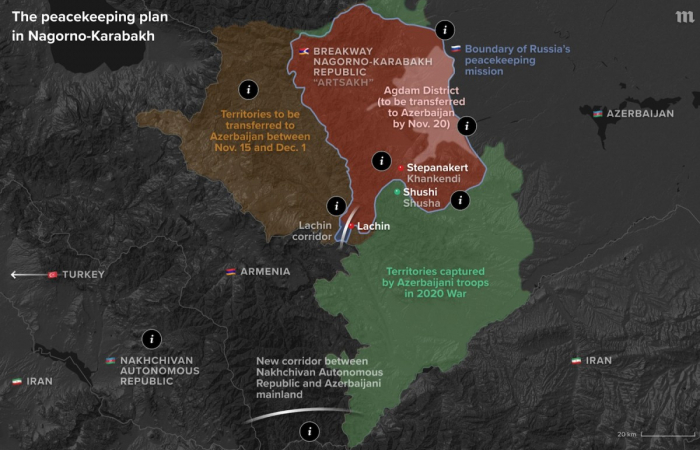
However, the revolution did not change the geopolitical juncture around Armenia. Yerevan continues to face joint Azerbaijani-Turkish pressure to make concessions in the Karabakh conflict settlement process. Azerbaijan has rejected Armenia proposal to restore the previous negotiation format and bring Nagorno Karabakh back to the negotiations' table. The Russia - US, and in general the Russia-West tensions show no sign of abating, and the South Caucasus continues to be one of the battlegrounds. The West is seeking to diminish Russian influence as part of a "Russia containment" strategy - seeking to increase its involvement in the region and boosting Georgia as its main partner. The NATO Secretary General's recent visit to Georgia is another example of such policy.
Meanwhile the Kremlin views the region as a buffer space which allows Moscow to move the fight against the West further away from its borders. Reacting to NATO's policy, Moscow is inclined to tighten its control over the South Caucasus, or, in the worst-case scenario not to lose its current positions, including its level of influence over Armenia as a key bastion of Russian dominance.
In the meantime, the US makes targeted efforts to implement its "maximum pressure" campaign against Iran, demanding from the South Caucasian states to significantly reduce their cooperation with Tehran in various fields. It is worth mentioning that if former US administrations had milder policy towards Armenia concerning its ties with Iran, given the blockade on Armenia imposed by Azerbaijan and Turkey, President Trump's administration is not inclined to make such concessions to Yerevan. They are hinting to Armenia that time has arrived to solve conflicts with Azerbaijan, normalize relations with Turkey and thus be able to downgrade relations with Iran without being dependent only on Georgia for connections to the outside world.
Another key goal of the US administration is to further the Southern Gas corridor which will bring Azerbaijani gas to Europe, circumventing Russia. Despite the fact that Azerbaijani resources are not sufficient to significantly alter the energy geopolitics of Europe and seriously threaten Russian positions, nevertheless, from an American point of view, any alternative to Russia is worth supporting, especially given the fact that theoretically, gas from other sources may in a long term perspective also be directed to Europe via the Southern Gas Corridor, thus making it a significant tool in overall US strategy to contain and weaken Russia.
As for the EU, Brussels is busy with its internal mess, including tantalizing negotiations over Brexit, the growing influence of right-wing populist movements which may result in the establishment of a strong anti-EU parliamentary faction in the new European Parliament, and the debt crisis of some of its southern members. This spring, the EU celebrates the 10th anniversary of its Eastern Partnership initiative, launched to deepen EU relations with Armenia, Azerbaijan, Belarus, Georgia, Moldova and Ukraine. This anniversary will bring some momentum to the EU policy in the South Caucasus. However, strategically, the EU has less resources to spend on the region, and probably will be less actively involved in the South Caucasus in comparison with 2009.
Meanwhile, to successfully realize the promises of the revolution, among which the key was the quick and significant improvement of the standard of living of the average Armenian, there needs to be a rapid influx of foreign money - in the form of either direct assistance or foreign direct investments. The fight against corruption and monopolies are necessary, but by themselves not sufficient conditions to reach those goals.
However, neither the US nor EU can be a source of such an influx as they lack strategic interest, as well as the necessary resources, especially so in the case of the EU. Large scale US support could be an option if Armenia significantly changes its foreign and security policy, and drifts away from Russia, but Yerevan has very limited options in this regard since such development will create significant security risks and threats.
In this context, deepening relations with Iran and China may play a key role in Armenia's long-term strategy towards economic recovery, without rattling its strategic alliance with Russia and jeopardizing Russian support in providing the necessary level of hard security. Till now Armenia lacks any strategic vision in its relations with China, with bilateral partnership mainly restricted to the provision of small-scale assistance from China in terms of public transport and ambulance vehicles. Armenia is not a part of the Chinese flagship "Belt and Road" strategy, and is not a member of the Asian Infrastructure Investment bank, which already has provided multimillion loans to Azerbaijan and Georgia.
Armenia should make concrete efforts to raise its partnership with China to a strategic level with a view to reaching a comprehensive strategic partnership in the future. In this context, the relations with Iran should play a key role. Armenia itself is too small and facing multiple security challenges to be able to attract Chinese attention alone. Meanwhile, Iran is already involved in the "Belt and Road" initiative, is a key oil supplier to China, and plays a significant role in Beijing's overall strategy to counter the US unilateral actions on the world stage. A joint proposal to China to consider a "Persian Gulf - Black Sea" multimodal transport corridor passing through Iran - Armenia - Georgia, as a part of the "Belt and Road" initiative is one of the ways to bring a strategic vision into China - Armenia relations. As the first step towards this direction the launch of an Armenia - Georgia - Iran trilateral cooperation format could be an interesting option. It will break the isolation of Armenia from regional cooperation formats, create a viable connecting path to Iran for Georgia, and increase Iran's involvement in the South Caucasus. Even if Georgia, due its special relationship with the US, would be skeptical towards such a move, an Armenia - Iran bilateral proposal to China could be a cornerstone on which to build up Armenia - China relations, and for creating the necessary conditions to involve Chinese investments in Armenia in the medium to long term perspective.
source: Benyamin Poghosyan is the the Executive Director of the Political Science Association of Armenia.
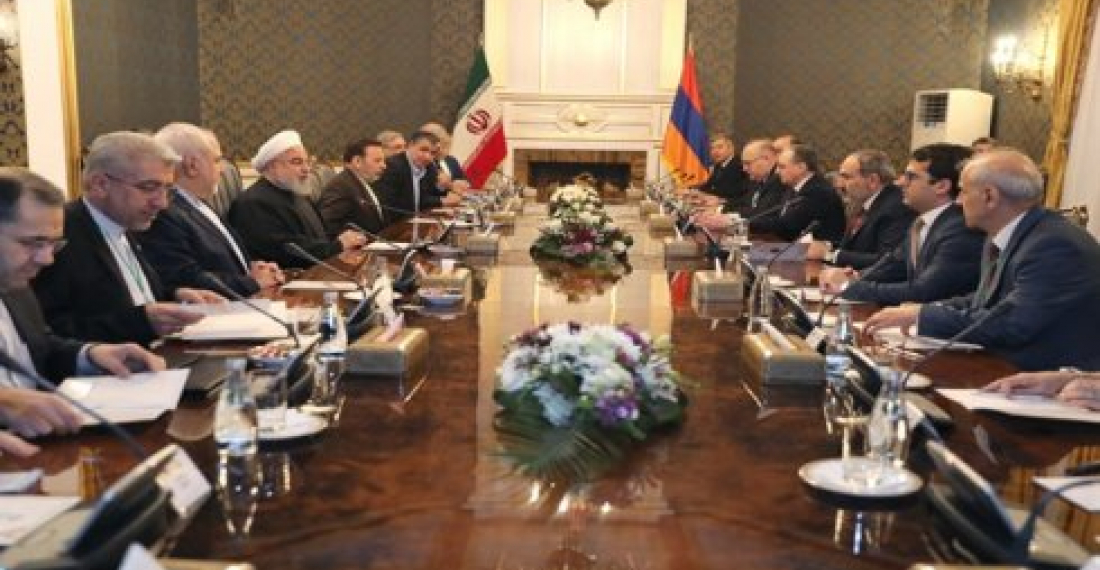
photo: President Rouhani of Iran and prime Minister Pashinyan of Armenia led their countries delegations in talks in Tehran in February 2019. (archive picture)
The views expressed in opinion pieces and commentaries do not necessarily reflect the position of commonspace.eu or its partners