Israel aims to bury idea of Palestinian state by announcing new West Bank settlement

Israel’s far-right finance minister announced approval of contentious new settlement construction in the Israeli-occupied West Bank on Thursday 14 August, which Palestinians and rights groups worry will scuttle plans for a future Palestinian state by effectively cutting the West Bank into two separate parts. The announcement, reported by international agencies, comes as many countries, including Australia, the United Kingdom, France and Canada, said they would recognise a Palestinian state in September. “This reality finally buries the idea of a Palestinian state, because there is nothing to recognise and no one to recognise,” said Finance Minister Bezalel Smotrich during a ceremony on Thursday.

“Anyone in the world who tries today to recognise a Palestinian state — will receive an answer from us on the ground,” he said. Prime Minister Benjamin Netanyahu did not publicly comment on the plan on Thursday, but he has touted it in the past. 

Development in E1, an open tract of land east of Jerusalem, has been under consideration, for more than two decades, but was frozen due to U.S. pressure during previous administrations. On Thursday, according to AP, Smotrich praised President Donald Trump and U.S. ambassador to Israel Mike Huckabee as “true friends of Israel as we have never had before.”

The E1 plan is expected to receive final approval Aug. 20, capping off 20 years of bureaucratic wrangling. The planning committee on Aug. 6 rejected all of the petitions to stop the construction filed by rights groups and activists. While some bureaucratic steps remain, if the process moves quickly, infrastructure work could begin in the next few months and construction of homes could start in around a year. 

The approval is a “colonial, expansionist, and racist move,” Ahmed al Deek, the political adviser to the minister of Palestinian Foreign Affairs, told The Associated Press on Thursday. “It falls within the framework of the extremist Israeli government’s plans to undermine any possibility of establishing a Palestinian state on the ground, to fragment the West Bank, and to separate its southern part from the center and the north,” al Deek said.

Rights groups also swiftly condemned the plan. Peace Now called it “deadly for the future of Israel and for any chance of achieving a peaceful two-state solution” which is “guaranteeing many more years of bloodshed.”

The announcement comes as the Palestinian Authority and Arab countries condemned Israeli Prime Minister Benjamin Netanyahu’s statement in an interview on Tuesday that he was “very” attached to the vision of a Greater Israel. He did not elaborate, but supporters of the idea believe that Israel should control not only the occupied West Bank but parts of Arab countries.

Israel’s plans to expand settlements are part of an increasingly difficult reality for Palestinians in the occupied West Bank as the world’s attention focuses on Gaza. There have been marked increases in settler attacks against Palestinians, evictions from Palestinian towns and checkpoints that choke freedom of movement. There also have been several Palestinian attacks on Israelis during the course of the war. 

More than 700,000 Israelis now live in the occupied West Bank and east Jerusalem, territories captured by Israel in 1967 and sought by the Palestinians for a future state. The international community overwhelmingly considers Israeli settlement construction in these areas to be illegal and obstacles to peace.

Israel’s government is dominated by religious and ultranationalist politicians with close ties to the settlement movement. Finance Minister Smotrich, previously a firebrand settler leader, has been granted cabinet-level authority over settlement policies and vowed to double the settler population in the West Bank.

Israel captured the West Bank, east Jerusalem and the Gaza Strip in the 1967 Mideast war. The Palestinians claim all three territories for a future independent state.

Israel has annexed east Jerusalem and claims it as part of its capital, which is not internationally recognised. It says the West Bank is disputed territory whose fate should be determined through negotiations, while Israel withdrew from Gaza in 2005.

Meanwhile,  the Israeli military said on Wednesday it had approved the "framework" for a new offensive in the Gaza Strip, days after the security cabinet called for the seizure of Gaza City. Armed forces chief Lieutenant General Eyal Zamir "approved the main framework for the IDF's operational plan in the Gaza Strip," a statement released by the army said. 

Prime Minister Benjamin Netanyahu's government has not provided a precise timetable for when Israeli troops will enter the territory's largest city, where thousands have taken refuge after fleeing previous offensives. Gaza's civil defence agency said Israeli air strikes on Gaza City have intensified in recent days, with the residential neighbourhoods of Zeitoun and Sabra hit "with very heavy air strikes targeting civilian homes, possibly including high-rise buildings". 

The Netanyahu government's plans to expand the Gaza war after more than 22 months of fighting have sparked an international outcry as well as domestic opposition. UN-backed experts have warned of widespread famine unfolding in the territory, where Israel has drastically curtailed the amount of humanitarian aid it allows in.

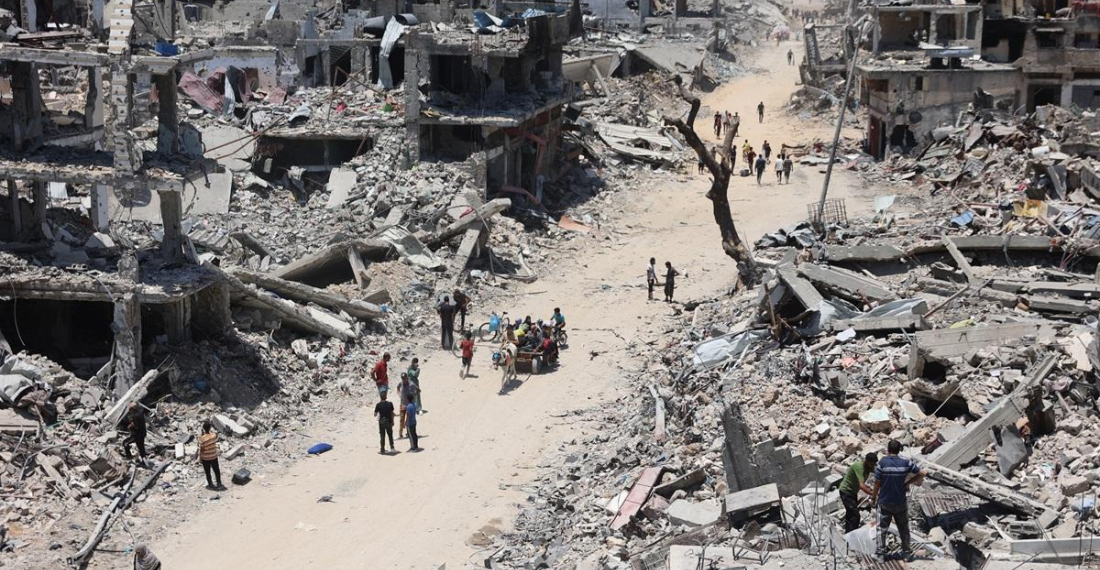
Source: commonspace.eu with AP and agencies. Photo: Palestinian residents walk along a road now dirt, past destroyed and razed buildings after the Israeli military withdrew following a two-week offensive from the Shujaiya neighbourhood, east of Gaza City/AFP

Related articles

Editor's choice
News
Borrell tells the European Parliament that the situation in Afghanistan was critical, but the EU will remain engaged

Borrell tells the European Parliament that the situation in Afghanistan was critical, but the EU will remain engaged

Borrell underlined that the European Union will make every effort to support the peace process and to remain a committed partner to the Afghan people. "Of course, we will have to take into account the evolving situation, but disengagement is not an option.  We are clear on that: there is no alternative to a negotiated political settlement, through inclusive peace talks.
Editor's choice
News
NATO Chief says war is on Europe's doorstep, and warns against complacency

NATO Chief says war is on Europe's doorstep, and warns against complacency

Russia could attack a Nato country within the next five years, the Secretary General of NATO, Mark Rutte, said in a stark new warning. "Nato's own defences can hold for now," Rutte warned in Berlin, but conflict was "next door" to Europe and he feared "too many are quietly complacent, and too many don't feel the urgency, too many believe that time is on our side. "Russia is already escalating its covert campaign against our societies," Rutte said in a speech in Germany. "We must be prepared for the scale of war our grandparents or great-grandparents endured." Earlier this month, Russia's President Vladimir Putin said his country was not planning to go to war with Europe, but it was ready "right now" if Europe wanted to - or started a war. But similar reassurances were given by Moscow in 2022, just before 200,000 Russian troops crossed the border and invaded Ukraine. Putin has accused European countries of hindering US efforts to bring peace in Ukraine - a reference to the role Ukraine's European allies have recently played in trying to change a US peace plan to end the war, whose initial draft was seen as favouring Russia. But Putin was not sincere, Nato's secretary-general said in the German capital, Berlin. Supporting Ukraine, he added, was a guarantee for European security. "Just imagine if Putin got his way; Ukraine under the boot of Russian occupation, his forces pressing against a longer border with Nato, and the significantly increased risk of an armed attack against us." Russia's economy has been on a war footing for more than three years now - its factories churn out ever more supplies of drones, missiles and artillery shells. According to a recent report by the Kiel Institute for the World Economy, Russia has been producing each month around 150 tanks, 550 infantry fighting vehicles, 120 Lancet drones and more than 50 artillery pieces. The UK, and most of its Western allies, are simply not anywhere near this point. Analysts say it would take years for Western Europe's factories to come close to matching Russia's mass-production of weapons. "Allied defence spending and production must rise rapidly, our armed forces must have what they need to keep us safe," the Nato chief said.

Popular

Editor's choice
News
NATO Chief says war is on Europe's doorstep, and warns against complacency

NATO Chief says war is on Europe's doorstep, and warns against complacency

Russia could attack a Nato country within the next five years, the Secretary General of NATO, Mark Rutte, said in a stark new warning. "Nato's own defences can hold for now," Rutte warned in Berlin, but conflict was "next door" to Europe and he feared "too many are quietly complacent, and too many don't feel the urgency, too many believe that time is on our side. "Russia is already escalating its covert campaign against our societies," Rutte said in a speech in Germany. "We must be prepared for the scale of war our grandparents or great-grandparents endured." Earlier this month, Russia's President Vladimir Putin said his country was not planning to go to war with Europe, but it was ready "right now" if Europe wanted to - or started a war. But similar reassurances were given by Moscow in 2022, just before 200,000 Russian troops crossed the border and invaded Ukraine. Putin has accused European countries of hindering US efforts to bring peace in Ukraine - a reference to the role Ukraine's European allies have recently played in trying to change a US peace plan to end the war, whose initial draft was seen as favouring Russia. But Putin was not sincere, Nato's secretary-general said in the German capital, Berlin. Supporting Ukraine, he added, was a guarantee for European security. "Just imagine if Putin got his way; Ukraine under the boot of Russian occupation, his forces pressing against a longer border with Nato, and the significantly increased risk of an armed attack against us." Russia's economy has been on a war footing for more than three years now - its factories churn out ever more supplies of drones, missiles and artillery shells. According to a recent report by the Kiel Institute for the World Economy, Russia has been producing each month around 150 tanks, 550 infantry fighting vehicles, 120 Lancet drones and more than 50 artillery pieces. The UK, and most of its Western allies, are simply not anywhere near this point. Analysts say it would take years for Western Europe's factories to come close to matching Russia's mass-production of weapons. "Allied defence spending and production must rise rapidly, our armed forces must have what they need to keep us safe," the Nato chief said.