The new Hong Kong security law also threatens the territory's prosperity and character argues Maximiliaan van Lange in this op-ed for commonspace.eu
While the international community is busy dealing with the humanitarian and economic consequences of the Covid-19 pandemic Beijing last week decided to impose a new national security law on Hong Kong. The new law criminalises support for secession from China, as well as foreign interference in Hong Kong affairs, terrorism, and insulting Chinese symbols such as the flag and anthem. It also opens the prospect of Chinese security agencies operating in the territory.
Following its approval by the country's National People's Congress last week, the law is now expected to be incorporated directly into Hong Kong's Basic Law. This puts into question the guarantees for Hong Kong's autonomy that were enshrined in the Basic Law by the Chinese authorities in 1997 as part of the deal brokered with Britain. When the British renounced power in 1997, it was agreed that for 50 years, until 2047, Hong Kong would not be subject to the same laws as China in an arrangement referred to as "One country, two systems". Many in the international community consider that by introducing the new security law China has broken the 1997 agreement. The introduction of the new law is therefore seen as yet another Chinese challenge to a rules-based international system.
Given the ban on public demonstrations in Hong Kong because of Covid-19, Beijing hoped to quietly push through the security law without too much opposition in the territory itself, and avoiding a stand-off with the international community, particularly the United States (US). However, last Friday (29 May) President Donald Trump ordered his government to withdraw trade and other concessions that the US had granted Hong Kong because of its special status. The Secretary of State, Mike Pompeo, stated in an interview with Fox News (31 May) that President Trump will take steps against Chinese and Hong Kong officials directly involved in the administration of the new law, and that a stricter supervision policy on Chinese students in the US will be introduced. The US and Hong Kong enjoyed visa-free travel, and import and export duties were low. This helped make, Hong Kong one of the most important business centres in Southeast Asia. The revocation of the concessions will have significant consequences for the territory. China itself sees American sanctions as nothing but a show of political posturing.
The international community has a keen interest in Hong Kong's prosperity and stability. It is a major trading hub. In 2019 Hong Kong's exports amounted to $535.7 billion and its imports to $578.6 billion. Hong Kong is a major export market for EU products. The US has 1,300 companies and about 85,000 US citizens currently live in Hong Kong. Compared to China's gross domestic product (GDP), which was worth $14200 billion in 2019, Hong Kong, with 7.4 million citizens accounted for $365.10 billion of GDP. Currently, 60 to 70 per cent of all Chinese foreign direct investments go through Hong Kong and many Chinese companies are listed on the Hong Kong stock exchange. The new situation is likely to very negatively impact the commercial interests of Western businesses who have invested heavily in the territory, and of westerners who live there. The restrictions on Hong Kong's civil liberties put in question its autonomy, and the "One country, two systems" system that has enabled it to become so prosperous, so the new law is also seen as detrimental to the very character of the territory, and its prosperity.
For the moment, the US appears to have taken the lead in responding to the new law, and it has secured the support of the United Kingdom (UK), Australia and Canada. In a joint response to the new Beijing Security Act, the four countries stated that the territory has "flourished as a bastion of freedom" and that the international community has a "substantial and lasting interest" in Hong Kong's prosperity and stability. They said that the new law threatens confidence in the Chinese government, and will undermine international cooperation. The four Western governments added that the new security law is in direct conflict with China's international obligations under the principles of the legally-binding, Sino-British Joint Declaration that was deposited with the United Nations on 27 May 1985.
Europe has so far reacted cautiously to developments in Hong Kong. The High Representative's statement on behalf of the EU, issued on 29 May 2020, declared the EU's "grave concern" about the situation and said that it will "raise" Hong Kong as part of its ongoing dialogue with China. German Chancellor Angela Merkel of Germany, who will take over the rotating presidency of the EU on 1 July, and High Representative Joseph Borrell, have already stated that the EU will not follow the US in imposing trade sanctions against China.
Many consider that the EU's response on Hong Kong has been too weak. As a self-proclaimed defender of freedom and democracy, the EU has a responsibility to provide a strong response to ensure Hong Kong's autonomy. Only Sweden asked for sanctions against China during the meeting of the European Ministers of Foreign Affairs on Friday (29 May). But it is also possible that the EU is for the moment keeping its powder dry. With a whole range of issues on which China is now at odds with the rest of the international community - ranging from trade to territorial disputes in the South China Sea and the Himalayas, China's power projection in Africa and the Pacific, and repression of dissent inside China itself - there are going to be plenty of problems on which a stand will need to be taken, and appropriate action executed.
It is clear however that it is necessary for the EU to quickly update its China policy to address the new realities to reflect considerations beyond trade, and to address serious geo-strategic challenges coming from China, many of which have been around for some time, but which the coronavirus pandemic has somehow made more starkly clear.
source: Maximiliaan van Lange is a Research Associate on Safety, Security and Transparency in the EU and beyond at LINKS Europe and currently studies History at Leiden University.
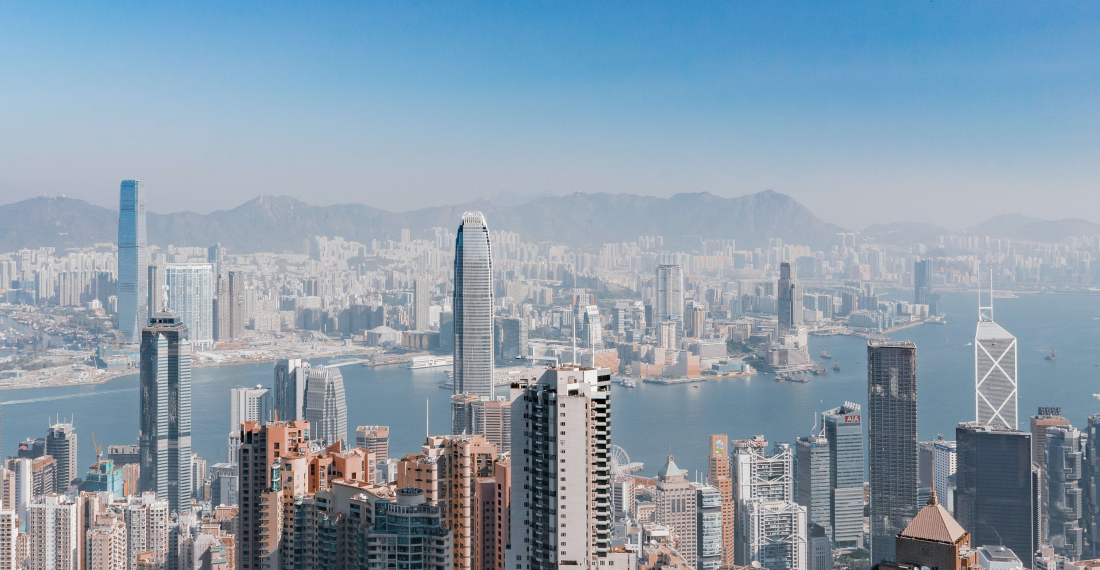
Photo: Hong Kong general view (archive picture)
The views expressed in opinion pieces and commentaries do not necessarily reflect the position of commonspace.eu or its partners