


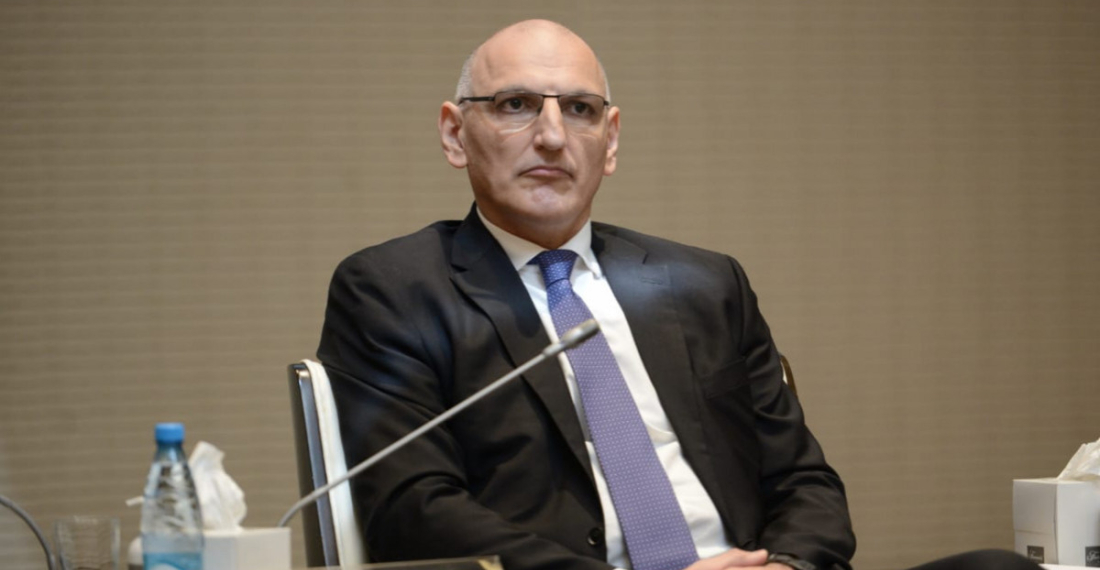
On Thursday (3 September), in an important speech to the 4th International Mine Action Conference, organised in Baku by ANAMA and the United Nations, Ambassador Elchin Amirbayov, Representative of the President of Azerbaijan on special assignments, spoke about the importance of mine action in the wider context of peace, with particular reference to the South Caucasus.
He said:
"Azerbaijan and Armenia have a unique opportunity to turn a page. The political process has created the conditions for a different South Caucasus — one based on peace, connectivity, economic cooperation and good-neighbourly relations. But if we want peace to be sustainable, durable and irreversible, we must remove the remnants of war both from the ground and from existing political and legal framework. Because: above all, peace needs the next generation to inherit a landscape without mines – both beneath the ground and in our discourse.
So the idea is to turn mine action from a legacy of war into an instrument of peace. Jointly, we can accelerate this. And let us make sure that, when we speak about peace in the South Caucasus, we are not speaking only about the absence of war. Let us make peace something people can walk on, live on, build on — and pass on to their children".
Here is the speech of Elchin Amirbayov in full:
It is a pleasure to welcome you all in Baku and thank you for being here, since your presence carries an important message. The challenge of landmines is far too great for any country to face alone. It requires solidarity and partnership. And above all, it requires sustained international commitment.
This year’s Conference focuses on humanitarian demining for safe settlements and recovery. In my remarks, I would like to address this topic from an angle of mine action’s role as part of peacebuilding.
And the central message here is simple: Peace cannot be considered complete while the physical consequences of war continue to threaten lives, block movement, limit economic activity, slow down return of IDPs and stand in the way of normalization of inter-state relations.
It is about whether people can return home. Whether communities can be rebuilt.
Whether children can walk safely to school. And, ultimately, whether peace can become a lasting reality that people can actually live in from now on.
Let me put this very directly: The shooting has stopped. But the mines have not.
And this is why humanitarian demining has become much more than a humanitarian task. It has become a peacebuilding task. The UN Peacebuilding Commission, in discussion on mine action two months ago, also recognized demining as an enabler of peacebuilding, reconciliation and recovery. The logic is clear. You cannot build peace on unsafe ground.
A little more than a year ago, on 8 August 2025, Azerbaijan and Armenia took a historic step in Washington. The text of the peace agreement was initialled by Foreign Ministers, and the leaders signed the Washington Joint Declaration, which set out a vision of a future no longer bound by the conflict of the past. By the way, we hope that very soon the remaining obstacle will be removed to enable the parties to sign the peace agreement and to codify peace.
Since Washington, we have lived in conditions of de-facto peace. There has been no military escalation between our countries. Dialogue between governments and civil societies has continued. Trade and economic interaction have begun. Connectivity projects are being advanced.
And our societies are gradually being asked to look towards a different future. This is truly a historic opportunity.
But peace is not created only by political agreements. Peace has to be made visible on the ground.
And in Azerbaijan, one of the greatest obstacles to making peace visible is beneath the ground.
Since the end of the 2020 war, 437 people in Azerbaijan have been killed or injured by landmines.
And every single new victim is more than a humanitarian tragedy. It is a psychological blow to families. It is also a reminder to society that the war is not yet completely behind us.
And it inevitably negatively affects public confidence in the process of normalization.
This is why I would argue that every mine explosion today has consequences far beyond the immediate victim. It hampers the atmosphere in which peace is being built.
This is particularly important in Azerbaijan because we are not dealing with a small, isolated contaminated area. More than 13 percent of our territory was polluted by mines and unexploded ordnance. And almost 6 years after the end of the war, 75 percent of landmine-infested territory is still full of seeds of death. This is a serious human security and return problem.
There is another dimension which makes this particularly urgent. Azerbaijan today is undertaking one of the largest post-conflict reconstruction efforts in our region, if not in the world.
Former IDPs are returning to their homes. Villages and towns are being rebuilt. Roads, schools, hospitals and economic infrastructure is constructed.
But there is a very simple truth:
You cannot rebuild a community before you can safely clear the ground beneath it.
So, when we talk about demining, we should also talk about the right to return, the right to rebuild and the right to live without fear.
This brings me to the question: What can the international community do more?
Azerbaijan is very grateful to each and every country and organization that have till today supported our mine-action efforts. We do take this as a sign of friendship and solidarity both with those directly affected and with Azerbaijan. But the scale of international support remains very limited.
Approximately 95 percent of the financing comes from Azerbaijan’s own state resources.
Only around 5 percent comes from the outside. We believe that this imbalance can and needs to change.
And I would like to suggest several thoughts of how this may be done.
First: make mine action part of the international peace agenda.
When we speak about peace in the South Caucasus, we speak about borders, connectivity, trade and confidence-building. We should add one more item: clearing the physical legacy of war.
Mine action should be treated as an investment in the durability of peace.
Second: in addition to a major national effort, to think of creating a long-term international funding mechanism for Azerbaijan’s mine action.
Not only emergency contributions. Not only individual projects.
But predictable, multi-year funding that allows Azerbaijan to plan, recruit, train, invest in equipment and accelerate clearance. We need to finance the solution, not simply manage the problem. And predictable funding was particularly mentioned by H.E. President Ilham Aliyev in his welcoming remarks to this Conference yesterday.
Third: establish a stronger international technology partnership.
Artificial intelligence, drones, satellite imagery, advanced surveying, mechanical demining and data technologies can dramatically improve both the speed and safety of clearance.
Azerbaijan has the ambition to become a regional centre of excellence in mine action and is open to such cooperation.
And last but not least: make mine action part of confidence-building in the region.
Humanitarian issues can sometimes create space for practical cooperation even when political questions remain sensitive.
The removal of the remnants of war is one such area. It is about saving lives. It is about the future.
And it should be approached accordingly.
There is also a larger point I would like to leave with you.
A mine is designed to stop movement. It prevents people from returning. It keeps land unproductive.
It separates communities. It preserves fear. In that sense, the mine is almost a physical symbol of the conflict.
Demining does exactly the opposite. It opens roads, reconnects communities, restores livelihoods and enables return. It also creates confidence in the future
So perhaps we should begin to think of every mine clearance not simply as a humanitarian operation, but as a small part of peace infrastructure.
And let me conclude with this.
Azerbaijan and Armenia have a unique opportunity to turn a page.
The political process has created the conditions for a different South Caucasus — one based on peace, connectivity, economic cooperation and good-neighbourly relations.
But if we want peace to be sustainable, durable and irreversible, we must remove the remnants of war both from the ground and from existing political and legal framework.
Because: above all, peace needs the next generation to inherit a landscape without mines – both beneath the ground and in our discourse.
So the idea is to turn mine action from a legacy of war into an instrument of peace.
Jointly, we can accelerate this. And let us make sure that, when we speak about peace in the South Caucasus, we are not speaking only about the absence of war.
Let us make peace something people can walk on, live on, build on — and pass on to their children.



