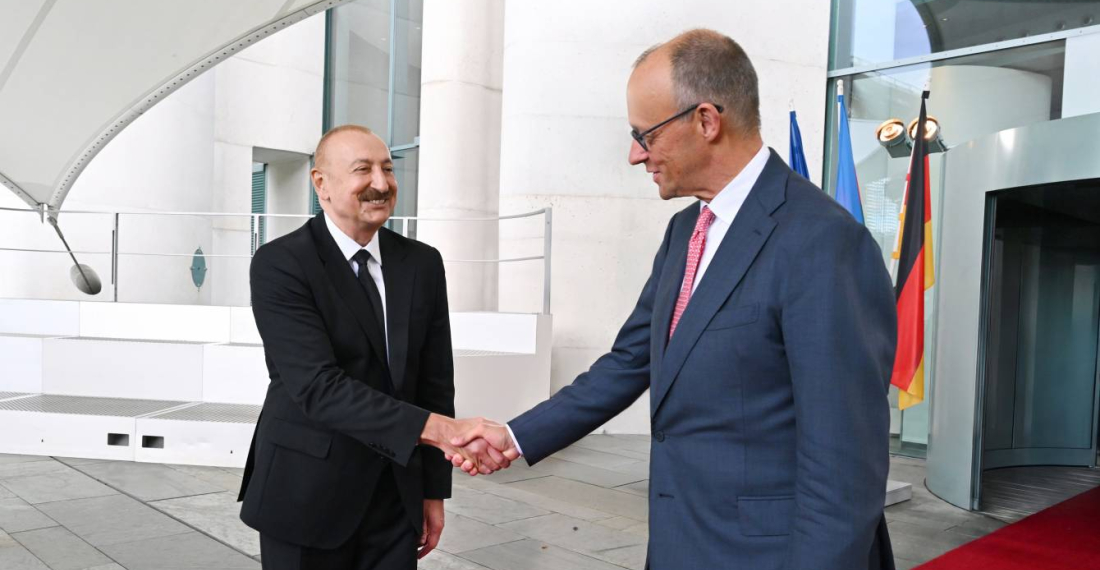
Azerbaijan president Ilham Aliyev visited Berlin on Tuesday, 21 July. He met German Chancellor, Friedrich Merz, and the two signed a Joint Declaration on the Strategic Agenda for Bilateral Partnership.
In the Joint Declaration, Azerbaijan and Germany confirm their mutual desire to deepen bilateral partnership and cooperation based on mutual trust and coincidence of interests in various fields. They recalled their respect for each other’s state sovereignty, independence and territorial integrity, reaffirm their common commitment to the Charter of the United Nations, the Helsinki Final Act, the European Convention for the Protection of Human Rights and Fundamental Freedoms, and other international legal instruments promoting peace and security.
The two sides welcomed the historic progress in Azerbaijan-Armenia relations, in particular the outcomes of the Washington Summit of August 8, 2025, and the subsequent peaceful steps taken towards the normalization of relations between the Republic of Azerbaijan and the Republic of Armenia. The Federal Republic of Germany reaffirms its full support for the efforts of the two countries aimed at achieving lasting peace in the region.
The Parties underline the strategic importance of the Azerbaijan-European Union (EU) partnership and note the increased cooperation aimed at further deepening political dialogue and practical cooperation. They also underline the importance of adopting the updated Azerbaijan-EU Partnership Priorities and making full use of the existing dialogue mechanisms between the Republic of Azerbaijan and the EU. The Parties also highly appreciate the efforts to strengthen cooperation between Azerbaijan and the EU Member States.
You can read the Joint Declaration in full on the website of the president of Azerbaijan here
Speaking to the media after the meeting with the Azerbaijani president, Chancellor Merz said
"Our countries cannot avoid the major crises and wars of today. This applies to both the Middle East and Russia's aggressive war against Ukraine. These wars have had a major impact on Germany and Azerbaijan in terms of their security and economic interests. Although the details of both conflicts may differ. We encourage negotiated solutions in any case. We are united by the common conviction that ultimately only a negotiated settlement can bring lasting peace, security and stability.
Mr. President, peace, security and stability in the South Caucasus are also essential for us. Germany and the European Union have a great interest in achieving lasting peace in this geopolitically important region. Therefore, Mr. President, we are particularly pleased to welcome you to Germany. We congratulate you on the initialing of the peace agreement between Azerbaijan and Armenia. This is a historic agreement. It provides an opportunity to end a conflict that has lasted for decades. We would be happy to do whatever we can from a German and European perspective.
Greater stability in the region creates new opportunities for broad cooperation between our countries in the economic sphere. I am very pleased that relations between our countries are developing on an upward trajectory. In the spring of 2025, President Steinmeier became the first German head of state to visit Azerbaijan. This year, there have also been intensive exchanges between our parliaments. By signing the Joint Declaration today, we have laid the foundation stone for further expansion of our bilateral relations. You also witnessed during the ceremony that an agreement was reached on the establishment of the Azerbaijan-Germany Business Council.
This is an important signal to companies in both countries. We are serious about expanding relations between Germany and Azerbaijan. In the current crisis, cooperation in the supply of crude oil and natural gas via the Southern Gas Corridor is of particular importance. "
source: commonspace.eu with Deutche Welle (Cologne), president.az (Baku) and agencies