


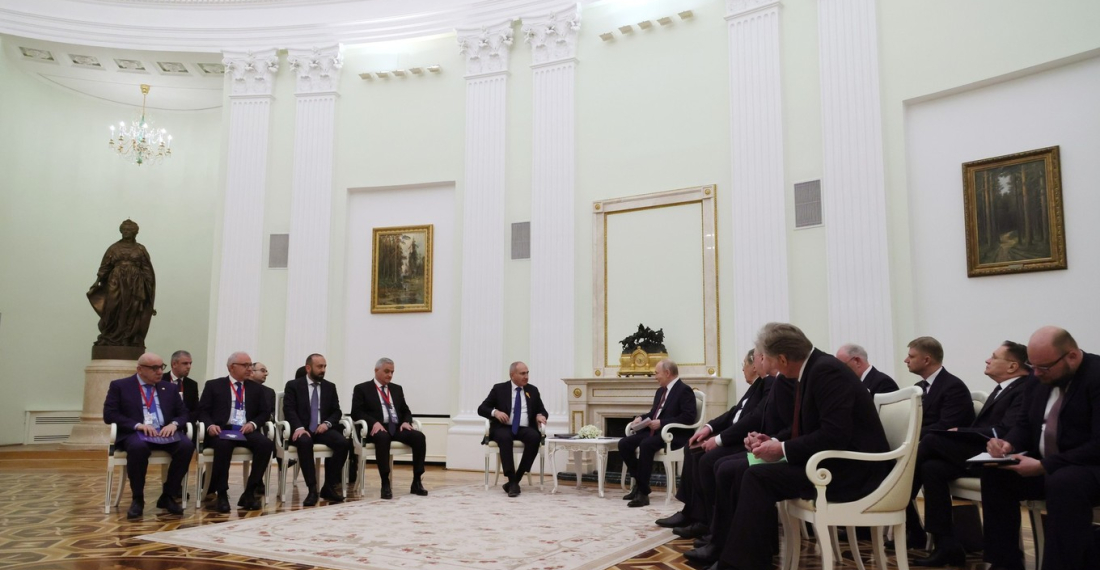
Armenian prime minister, Nikol Pashinyan, met at the Kremlin in Moscow, on Wednesday 1, April, with Russian president Vladimir Putin.
The current state and prospects of Russian-Armenian strategic partnership and alliance, integration cooperation in the Eurasian region, and current issues on the regional agenda, in particular the development of economic and transport-logistics ties in the South Caucasus, were discussed, according to the Kremlin website.
In his remarks before the meeting, Prime Minister Pashinyan said our relations with the Russian Federation are very deep, they are very important to us, and, in my opinion, they are developing dynamically in the context of the new realities in our region, when peace has finally been established between Armenia and Azerbaijan.
And I think this has a positive impact on our relations with the Russian Federation, because for the first time since our independence, we have a railway connection with the Russian Federation. We import goods from Russia via Azerbaijan by rail. I hope we will also export in the near future. This, of course, strengthens our traditional economic ties, and it strengthens our ties within the Eurasian Economic Union.
Regarding the European Union, of course, we know that, in principle, membership in the two associations is incompatible. But what we're doing and the agenda we have, at least for now, are compatible. That's a fact. And as long as there's an opportunity to combine these agendas, we will. And when processes develop to the point where a decision must be made, I'm confident that we, the citizens of the Republic of Armenia, will make that decision.
Of course, in this context, our relations with the Russian Federation have never been and never will be in question, because, as I have already said, these ties and relations are very deep and not subject to discussion.
Of course, we cooperate in the energy sector. We traditionally have very strong ties and cooperation here, too. I must say that we are currently working very closely with the Russian side to develop [interaction] in the area of new technologies—I mean new technologies in the energy sector, because new energy technologies, solar energy, and so on, are developing very well in Armenia. You know that we are also discussing the construction of a new nuclear power plant with the Russian Federation. But we are completely transparent on these matters, because we do not hide the fact that we are discussing these issues not only with our Russian partners but also with other partners, because we are looking for the most advantageous offer for the Republic of Armenia.
As I already said, peace has been established between Armenia and Azerbaijan. You mentioned President Trump, and it's clear he contributed to this process. But it's also clear that you personally played, and continue to play, a key, very important role in the normalization of relations between Azerbaijan and Armenia. You've always been supportive throughout all these processes; we've always been in close contact, and I've always kept you informed periodically of ongoing developments.
And by the way, last August, when I returned from Washington and called you, I said that what happened in Washington also opened up new opportunities for our relations, and now that's a fact. I already mentioned the railway connection between Russia and Armenia. We've been working on this issue for decades, but unfortunately, we've never been able to reach such a conclusion.
Regarding issues related to Karabakh, I have already very transparently and publicly announced, stated in the Republic of Armenia, that we should not continue the Karabakh movement because peace has already been established between Armenia and Azerbaijan. Armenia and Azerbaijan recognized each other's territorial integrity, political independence, and sovereignty on the basis of the Alma-Ata Declaration of 1991, which means that we mutually recognize that an independent Armenia is 100 percent identical to Soviet Armenia, and an independent Azerbaijan is 100 percent identical to Soviet Azerbaijan. And I think this is a fairly solid foundation for the further development of peace. And, of course, I want to once again thank you for the support I have always felt in the process of establishing peace between Armenia and Azerbaijan.
Regarding Karabakh: we have discussed this repeatedly, primarily in a working format. Yes, we recognized Karabakh as part of Azerbaijan. But we did so only after the Russian Federation's top leadership publicly stated this twice, and you remember, we have spoken about this repeatedly. We have also never hidden our problems with the CSTO, because we had a specific situation in 2022, and, in my opinion, the CSTO mechanisms should have worked, but they did not. And this, of course, led to the situation we have in our relations with the CSTO. We are currently not participating in the CSTO for a simple reason: we still cannot explain to our people, our citizens, why the CSTO has not responded, and has not responded despite the obligations it has under the Collective Security Treaty.
Regarding our domestic political processes, you know, Armenia is a democratic country, and we practically always have political processes, and this has become a routine thing for us. And we actually hold municipal elections twice a year. They are also highly politicized, because based on the results of our political reforms, people also vote for or against political parties. I mean, not very many, but there are citizens who think there's too much democracy in Armenia.
But this is a matter of principle for us. Our social media, for example, is 100 percent free. There are no restrictions whatsoever. And many citizens think this is too much. And in the general context, frankly, we don't have any remote participants in the political process in our localities.
I'd like to point out that, for example, we have parliamentary elections coming up, elections for members of parliament, and based on these elections—which, de facto, will also be the election of the Prime Minister. I'd like to point out that only citizens who hold Armenian passports can participate in these elections. That is, with all due respect, according to the Constitution of the Republic of Armenia, people with Russian passports cannot be candidates for either parliament or prime minister. So, there are no restrictions here.
And I'm 100 percent sure that you know that both our relations with the Russian Federation and our personal relationships have been through many trials over the past few years. I'm very pleased and would like to thank you once again for the trusting atmosphere that you, first and foremost, have created. Because if you hadn't wanted us to have such an open, trusting relationship, I think, obviously, I wouldn't have been able to do this, and I want to thank you again.
And I am confident that, following the results of our upcoming elections, democracy in Armenia and the power of the people in Armenia will be further strengthened, and our relations will also continue to develop dynamically following the elections.
I've already said that our agenda is very rich, but there are still many untapped opportunities. I'm confident that these opportunities will be exploited as a result of our dialogue, the Armenian Prime Minister concluded.
source: commonspace.eu with kremlin.ru and agencies



