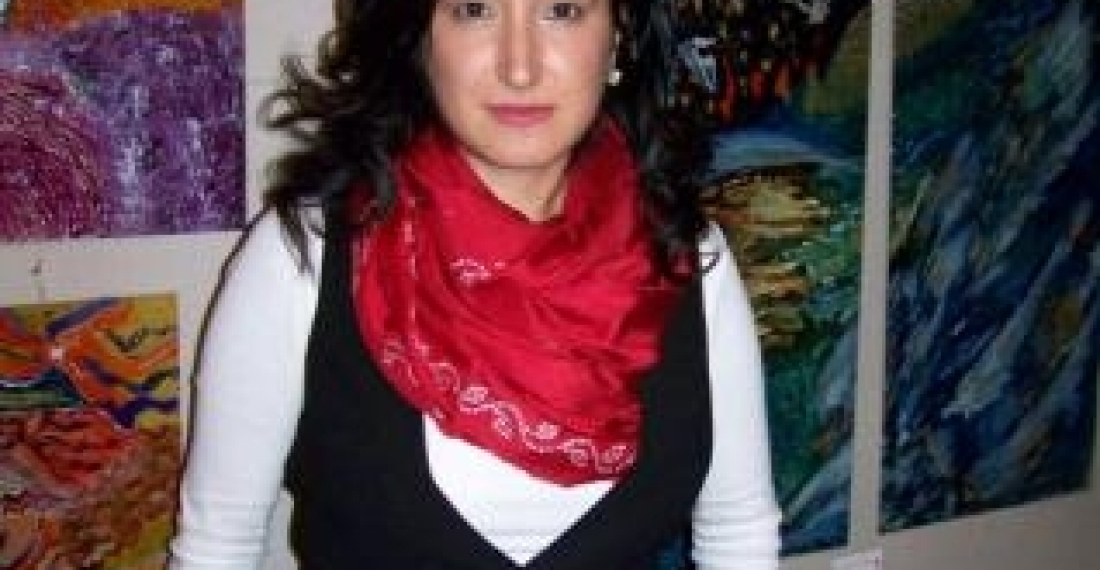
Azerbaijani born artist Ulvi Pepinova creates glass paintings inspired by natural minerals and images of earth taken from space. She is also a board member at Vatan (International Society of the Meskhetian Turks), External Communications Officer of Conservative Friends of Turkey and has just launched the Chelsea Young Writers Club for children. On the eve of the opening of an exhibition of her work in London Nicholas Maltby talked to her about her work, her life and her vision on relations between Armenians and Azerbaijanis. Pepinova speaks about the importance of tolerance and pragmatism. Ulvi Pepinova ends with a quote by Nelson Mandela, which she says is an appropriate message for Armenians and Azerbaijanis alike.
Glass is a strange choice of material to work with; why did you choose it?
I like the texture of painted glass; its transparency, its brightness and its glossiness. I just love it: glass has its own sensual qualities of smoothness, silk and gloss, which create a stunning effect.
What is the technique you use to paint on glass? Please talk us through it in detail - presumably, for example, you blow the glass before you begin the painting?
I am not a glass blower, I only paint on glass. I originally only adopted traditional glass painting techniques, solely using glass paints. However, my passion was for natural minerals, rock patterns and minute intricate structures that echo my admiration for images of the earth taken from the air and space. This stimulated my imagination with regard to the materials at my disposal.
In addition to glass paints, I enjoy experimenting with various recently-developed decorative base materials, such as pitches, resins, textured paints, liquid stone, marble, granite and glass granules. I also use flexible stone comprising a unique extraction of natural stone patterns suspended in a smooth paste, with a viscosity akin to paint. I sometimes feel that I am in a chemistry laboratory where I am testing new reactions and awaiting the outcome. In my last series of Buta, alongside glass paints I used small stone crystals and glass textured beads. Glass is resistant to certain chemical compositions; however, it can also be flexible and malleable, giving successful results, in most cases. In my opinion, glass is a considerably more accommodating material than is generally acknowledged.
What inspired the technique? What kind of precedents are there?
My own imagination! My love for colours, my love for minerals and the beauty of their patterns; and my love for images of earth from space.
What experience do you have of other artistic techniques and why do you find glasswork is your niche?
Glass is the first medium I have worked with that is truly unusual. Generally it serves as the canvas on which the first sketches are made by artists; but in my case the process works the other way round. In my upcoming show, I will be exhibiting two paintings on canvas, where the aim was to reach the same glossy effect as you find on glass.
You illustrated the book the May Winds Whisper? What was the genesis and purpose of that project?
The author is a keen admirer of my artwork and she felt my paintings would be a good companion to her writing.
There is a long tradition of art inspiring poetry and vice versa - who are your icons?
I was nurtured with a Muscovite spirit during my formative years: I have inherited love for the Russian poetry. But I don't have icons. Whilst the list can be long when referring to ‘Silver Age' poets - beloved by so many of us - my occasional reading of Pushkin to my daughter has re-affirmed my belief that he was a true master - a father of Russian rhyme. I also follow contemporary poets such as Dimitry Bykov and Vera Polozkova; both are incredibly rich in thought and word. When I'm feeling nostalgic for eastern wisdom, I tend to glance through Fuzuli and Rumi's ghazals.
I do believe that art inspires poetry and vice versa. For example, I owe the title of one of my paintings, ‘Rainbow of Fire', to the Irish poet, Alan Patrick Traynor, who dedicated a beautifully written poem to the painting.
You use images of the earth from space to inform your glasswork - is that a comment on the fragility of earthly experience?
I didn't have any underlying message in reflecting the images of the earth from space at the outset in my experiments with glass painting - I was just captivated by the mesmerizing images, and somehow I wished to share my passion for them. Yet, the more you look at them, the more you plunge into grand thoughts about the pettiness we witness in our daily lives and which entices us into fighting mode, rather than into a peaceful co-existence.
How long have you been painting for? Did you study art as part of a degree?
I started painting in 2008. I have no degree in any arts subject. My previous degrees are in Business Management and European Public Policy. I never had an ambition or desire to be an artist, I was happy to be an admirer of art. It just so happened that at certain point of your life you suddenly find yourself doing what you never thought you would be involved in. Even now, I am not very accustomed to being called an artist - but there is no other appropriate label, I suppose! I may be wrong in my presumption, but I have a fear that if I sign up for a fine art course I would feel restrained in my explorations. I am very interested in getting more practical experience on working with fused glass though.
You've been educated in Moscow and Turkey - do you find that displacement important to self-development?
Displacement, in my view, is not paramount to self-development per se, but changing scenes certainly has its own effect on your perceptions and it gives you more food for thought. I loved everything about Turkey - from its incredibly rich cuisine to the wisdom and spirit of the Turkish people - something I witnessed in particular during the earthquake of 1999 - it's the way the Turkish build up relationships and cherish family values, friendship - how they are so supportive of one another. My sense was that the Turkish culture is extrovert and introvert at the same time; this makes it more puzzling for outsiders, and thus misperceptions prevail. It was challenging for me to feel fully integrated - but that is understandable. I have the same sense in the UK!
Why do you live in London now? Do you still feel connected with Azeri art?
I've been living in London over a decade and this is officially my home! London is a distinct love story for me. It was not love at the first sight, I did not have butterflies in my stomach when I first came, but I do have them now every time I go back to London and realise how much I miss my lover. Having a strong bond with Azerbaijan, Turkey and Russia, it was in Britain where I discovered the full meaning of free-thinking, creativity and fearlessness in persevering whatever is meaningful or sacred to you. To me, London is a homeland of innovative ideas, creative ideas and of lots of rain!
You've written a piece on Nagorno-Karabakh that is quite critical of the EU's intervention within the region; what kind of future role does the EU have in the region? Do politics and art mix?
Politics and art mix only if an artist has a deliberate intention to deliver a particular message in a political context, or, when politicians want to see a political message in the art. This is not the case with my art, I don't think.
In general terms, within the region the EU is not regarded as a serious broker with a fat belly, but I would argue that the EU is a heavyweight darling - cautiously, scrupulously and gently making steps following its long-term vision. The EU is a credible peacemaker and its peacemaking role was re-affirmed by the Nobel Peace Prize last year. As a pan-European, and as a well-wisher for Azerbaijan and Armenia, I would like to see more daring steps in the EU's involvement with Nagorno-Karabakh however.
The desperate attempts by weak (or almost non-existent) civil societies to look for the right recipe in establishing face-to-face contact is always complicated by the geopolitical game, and hardline agendas. However, such attempts should not be buried. My belief is that there are two missing ingredients in attempts to construct a dialogue between the two sides and what the EU can explore more bravely - namely pragmatism and tolerance. We need to be taught and coached at a societal level what these two concepts actually mean. To me, being pragmatic and tolerant does not mean I need to drastically change my core position.
We should see more of the EU's resources allocated to tolerance and educational programmes, workshops, and seminars. This needs to be carried out in a more consistent way, rather than merely as one-off projects. There are two suffering segments in Azerbaijani and Armenian societies: a generation who went or lived through the war years (which has an internal pain), who need psychological work done by professionals to help them overcome this pain, and a younger generation which does not have that internal pain, but carries an artificially imposed hatred. I would like to see more educational programmes on tolerance online, for example.
We should look for ways to work with each other and peacefully co-exist with each other. We should resist an imposed doctrine of ethnic hatred and make efforts in being as pragmatic and tolerant as possible and having a genuine dialogue, which eventually may disentangle the Gordian knot.
Hating each other is self-destructive. Cultivating hatred does not bring joy to our lives - although it may bring a desirable effect and outcome in the geopolitical game. I take a leaf out of Nelson Mandela's book in my advice to all Armenians and Azerbaijanis: ‘If you want to make peace with your enemy, you have to work with your enemy. Then he becomes your partner.'
An exhbition of the work of Ulvi Pepinova opens at the Hollywood Arms in London on Thursday, 23 May. This interview was first published on www.links-dar.org