Zelenskyy Warns Wartime Elections Could “Split Ukraine”

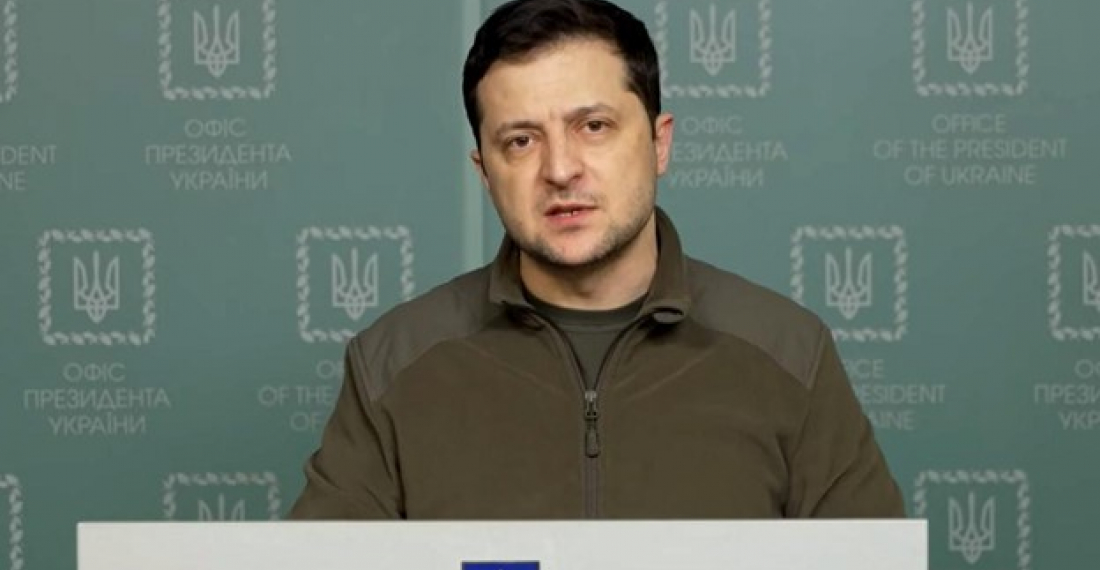
Ukrainian President Volodymyr Zelenskyy has firmly rejected calls for elections while Russia’s full-scale war continues, warning on Sunday (August 23) that a wartime vote could destabilise and divide Ukraine. “If we want to destroy the country, then during a war like this we can move toward elections,” Zelenskyy told reporters. He described elections under current conditions as “a tsunami for the state” that would split the country.

The comments were Zelenskyy’s first response to a call for elections by former Defence Minister Mykhailo Fedorov, who was dismissed in July. In a video address published on YouTube on August 18, Fedorov argued that Ukraine should develop a “legal, safe, and realistic mechanism” to restore the democratic process despite the prolonged war. He acknowledged that any vote would need to address major obstacles, including the participation of soldiers, Ukrainians living abroad, and residents of frontline areas, as well as the security of polling and public confidence in the result.

Zelenskyy said an election could only be considered if conditions allowed it to be conducted safely, legitimately and democratically. This would require ensuring participation by military personnel, residents of frontline areas and millions of Ukrainians abroad, while protecting voters from Russian attacks. He said Ukraine’s international partners had not presented a concrete plan capable of meeting these requirements.

Ukraine has not held a presidential election since 2019, when Zelenskyy won 73 per cent of the vote against incumbent Petro Poroshenko. Although his five-year term was scheduled to end in May 2024, elections are prohibited under Ukrainian law while martial law remains in force. Martial law was introduced following Russia’s full-scale invasion on February 24, 2022.

The debate has also drawn international attention. U.S. President Donald Trump criticised Ukraine’s lack of elections in December 2025, arguing that Ukrainians “should have that choice.” Zelenskyy previously responded that he could hold an election within 60 to 90 days if the United States and European allies helped guarantee the security of the process.

The election dispute comes amid a broader rupture between Zelenskyy and Fedorov. The president said the former minister had become involved in a serious conflict with military commander Oleksandr Syrskyi over the relationship between the Defense Ministry and the military command. Fedorov’s dismissal has then triggered widespread protests in Kyiv and other Ukrainian cities: on July 16 only, more than 1,000 people reportedly gathered outside Zelenskyy’s office to demand his reinstatement. However, his recent call for elections also drew criticism from some soldiers and protesters who had supported his return. Fedorov has not explicitly stated whether he would run in a future presidential election.

Source: commonspace.eu with Kyiv Independent (Kyiv) and The Epoch Times (New York).
 

Related articles

Editor's choice
News
The European Parliament approved the temporary elimination of customs duties on goods exported from Armenia to the EU in a plenary session.

The European Parliament approved the temporary elimination of customs duties on goods exported from Armenia to the EU in a plenary session.

The European Parliament, during its plenary session in Strasbourg, approved the European Commission's proposal to apply a system of trade measures for "Made in Armenia" products, which means there will be a temporary elimination of customs duties on a wide range of products imported from Armenia to the European Union.   The proposal presented by the European Commission was adopted at the plenary session of the Council of Europe with 583 votes in favor, 49 against and 39 abstentions. According to the proposal, the European Union plans to eliminate customs duties on a number of Armenian goods for a period of two years. At the same time, it is planned to establish duty-free import quotas for eight types of Armenian agricultural products. These include grapes, apricots, cherries, peaches, and cucumbers. The draft also provides for safeguard mechanisms that will allow the European Union to intervene, if necessary, if increased imports from Armenia have a negative impact on European producers. This step is due to the restrictions imposed by Russia on a number of important Armenian export products since May 2026. They relate, in particular, to alcoholic beverages, mineral waters, fruits and vegetables, as well as their transit through Russian territory. According to the European Commission, these restrictions have disrupted Armenia's traditional supply chains and significantly limited the country's access to traditional export markets. The situation has had a particularly severe impact on small and medium-sized enterprises, as well as agricultural producers, while creating challenges for Armenia's economic resilience. The EU sees the initiative as a temporary measure to support the Armenian economy and create additional opportunities for exporters to access the EU market. The next step for the proposal is formal approval by the EU Council. The regulation will enter into force the day after its publication in the Official Journal of the European Union. Let us recall that on September 2, the Council of the European Union approved the proposal to establish temporary trade liberalization measures for Armenian products and sent the draft to the European Parliament for approval. 

Popular

Editor's choice
Interview
Thursday Interview: Murad Muradov

Thursday Interview: Murad Muradov

Today, commonspace.eu starts a new regular weekly series. THURSDAY INTERVIEW, conducted by Lauri Nikulainen, will host  persons who are thinkers, opinion shapers, and implementors in their countries and spheres. We start the series with an interview with Murad Muradov, a leading person in Azerbaijan's think tank community. He is also the first co-chair of the Action Committee for a new Armenian-Azerbaijani Dialogue. Last September he made history by being the first Azerbaijani civil society activist to visit Armenia after the 44 day war, and the start of the peace process. Speaking about this visit Murad Muradov said: "My experience was largely positive. My negative expectations luckily didn’t play out. The discussions were respectful, the panel format bringing together experts from Armenia, Azerbaijan, and Turkey was particularly valuable during the NATO Rose-Roth Seminar in Yerevan, and media coverage, while varied in tone, remained largely constructive. Some media outlets though attempted to represent me as more of a government mouthpiece than an independent expert, which was totally misleading.  Overall, I see these initiatives as important steps in rebuilding trust and normalising professional engagement. The fact that soon a larger Azerbaijani civil society visits to Armenia followed, reinforces the sense that this process is moving in the right direction." (click the image to read the interview in full)