


UN report highlights increase in Islamist insurgency across Africa

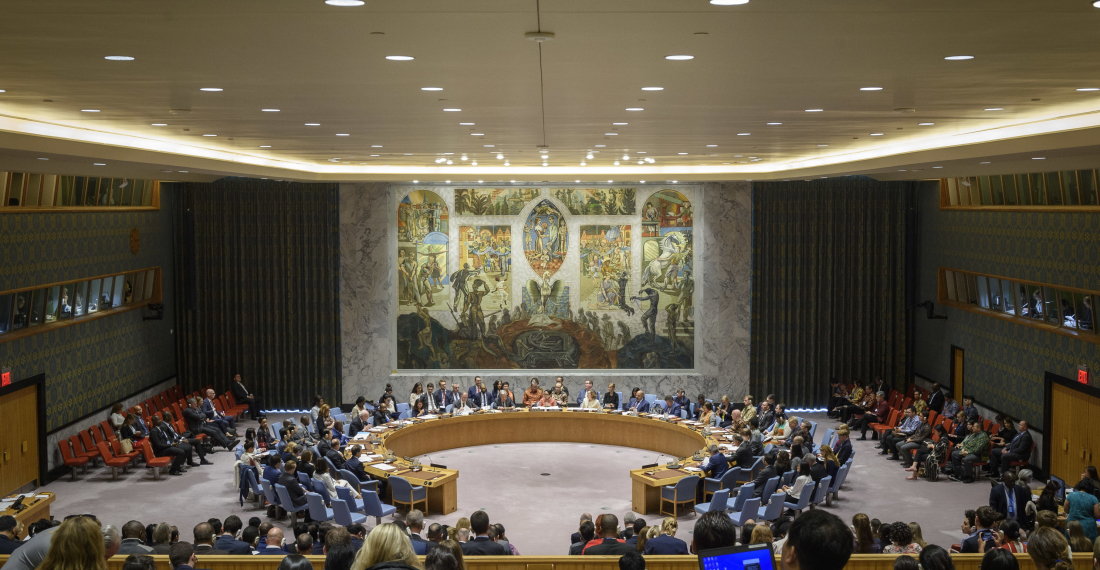
On Wednesday morning (4 February), the UN Security Council will convene for a briefing on the Secretary-General’s 22nd biannual strategic-level report on the threat posed by ISIL- the Islamic State in Iraq and Levant group, to international peace and security.  Chris Elmore, the UK’s Parliamentary Under-Secretary of State in the Foreign, Commonwealth and Development Office, travelled to New York to chair the meeting. Britain in February holds the rotating Chairmanship of the UN Security Council.

The Secretary-General’s report, which was circulated to Council members on 31 January, says that the threat posed by ISIL has increased steadily since the previous report was issued in August 2025, becoming more complex and intensifying in multiple theatres. It notes that ISIL continues to exploit armed conflict, political instability, and weak governance and stresses that the group remains a threat to human rights and development, as well as to international peace and security more broadly.

The situation is particularly serious in Africa. The report says that ISIL affiliates, including the Islamic State Sahel Province (ISSP) and Islamic State West Africa Province (ISWAP), are asserting control over vast areas in West Africa and the Sahel, leading to significant casualties, large-scale displacements, loss of livelihoods, and ongoing interruptions of humanitarian assistance. In the Lake Chad Basin, ISWAP became more prominent, entrenching its positions across the central and southern areas of Borno State in northeastern Nigeria and intensifying raids against isolated communities in northern Cameroon and western Chad. On 25 December 2025, the US said that it had carried out an airstrike targeting ISIL operations in Sokoto State in northwestern Nigeria, in coordination with Nigerian authorities.

The Islamic State in the Greater Sahara (ISGS) has remained active in Niger, targeting security forces and civilians and clashing with Al-Qaida affiliate Jama‘a Nusrat ul-Islam wa al-Muslimin (JNIM), which the report describes as the dominant group in the Sahel. ISIL also claimed responsibility for a 28 January attack on Niger’s main airport in Niamey, which was reportedly repelled by Nigerien armed forces with assistance from Russian troops. Given the seriousness of the situation in the region, the Secretary-General’s report highlights the need for regional member states to forge unified responses to challenges they face. In this regard, it stresses the importance of preserving the cohesion of the Multinational Joint Task Force (MNJTF), a regional security coalition comprising forces from Benin, Cameroon, Chad, and Nigeria that is mandated to combat Boko Haram and ISWAP. Niger announced its withdrawal from the MNJTF in March 2025.

In Somalia, the threat posed by ISIL was significantly reduced as a result of counter-terrorism operations conducted by national security forces working with regional and international partners. ISIL in Somalia is estimated to have approximately 200-300 fighters, many of whom were killed or arrested during counter-terrorism operations. In late January, Somalia and the US carried out a series of airstrikes targeting ISIL’s Somali affiliate. In the Democratic Republic of the Congo (the DRC), the ISIL-affiliated Allied Democratic Forces (ADF) has continued to pose a substantial threat, while ISIL has increased its propaganda coverage of attacks in both the DRC and Mozambique. According to media reports, militants linked to ISIL killed at least 22 civilians in a village in eastern DRC on 25 January.

source: commonspace.eu with Security Council Report (New York) an agencies.

photo: UN Security Council in session (archive picture)

Related articles

Editor's choice
News
Nearly half a million Russians killed in Ukraine but Moscow far from reaching its objectives despite the bombing of civilian targets in Kyiv (updated)

Nearly half a million Russians killed in Ukraine but Moscow far from reaching its objectives despite the bombing of civilian targets in Kyiv (updated)

Nearly half a million Russians have died in fighting in Ukraine, as Vladimir Putin continues to push his country to the brink. His aim of completely controlling the Donbass region, which he annexed after invading Ukraine in 2022, seems more distant than ever. However, Putin can still bomb civilian targets in Kyiv. The Ukrainian Air Force says a "serious shortage" of interceptor missiles meant none of the 23 ballistic missiles fired by Russia at Kyiv on Sunday night were shot down. At least 15 people were killed in the second large-scale Russian attack on the Ukrainian capital in a week, officials said. Seven more were killed in the wider Kyiv region. Ukrainian President Volodymyr Zelensky has appealed for allies to take "strong decisions" at this week's Nato summit to provide Kyiv with air defences. After the strikes, he said the Ukrainian military had been successful in intercepting cruise missiles and drones – but not ballistic missiles. Sunday's "massive Russian attack" consisted of 68 missiles and 351 strike drones, he said in a post on X. The air force shot down or suppressed 37 missiles and 326 drones, it said. Zelensky warned that Moscow would continue to hit residential buildings as long as defensive Patriot missiles "remain in our allies' stockpiles". After a bleak winter which saw months of fierce Russian bombing of Ukrainian energy infrastructure, the future is beginning to look more positive for Kyiv Russia’s frontline advances have slowed almost to a halt, as Ukrainian counter-attacks and defensive tactics become more effective. Successes in local counterattacks have become more frequent, as Ukrainian forces scale up their use of ground robots and sshort-range drone warfare. The Centre for Strategic and International Studies (CSIS) paints a bleak picture of Russian casualties. Between February 2022 and June 2026, there have been as many as 450,000 Russian battlefield deaths and 1.4 million casualties, it says. The UK’s biggest spy agency, GCHQ, has produced a similar figure. In May, GCHQ director Anne Keast-Butler said in her inaugural public speech that nearly 500,000 Russian soldiers had been killed. The massive death toll is a product of several factors, including an attritional warfare strategy in which Moscow sends thousands of troops towards fortified Ukrainian defences, attempting to grind Kyiv’s forces down with sheer manpower. (click image to read more)

Popular

Editor's choice
Interview
Thursday Interview: Murad Muradov

Thursday Interview: Murad Muradov

Today, commonspace.eu starts a new regular weekly series. THURSDAY INTERVIEW, conducted by Lauri Nikulainen, will host  persons who are thinkers, opinion shapers, and implementors in their countries and spheres. We start the series with an interview with Murad Muradov, a leading person in Azerbaijan's think tank community. He is also the first co-chair of the Action Committee for a new Armenian-Azerbaijani Dialogue. Last September he made history by being the first Azerbaijani civil society activist to visit Armenia after the 44 day war, and the start of the peace process. Speaking about this visit Murad Muradov said: "My experience was largely positive. My negative expectations luckily didn’t play out. The discussions were respectful, the panel format bringing together experts from Armenia, Azerbaijan, and Turkey was particularly valuable during the NATO Rose-Roth Seminar in Yerevan, and media coverage, while varied in tone, remained largely constructive. Some media outlets though attempted to represent me as more of a government mouthpiece than an independent expert, which was totally misleading.  Overall, I see these initiatives as important steps in rebuilding trust and normalising professional engagement. The fact that soon a larger Azerbaijani civil society visits to Armenia followed, reinforces the sense that this process is moving in the right direction." (click the image to read the interview in full)


