Thailand and Cambodia agree ceasefire after weeks of deadly clashes

Thailand and Cambodia said they have signed a ⁠ceasefire ​agreement to end weeks of fierce fighting along their border that has killed more than 100 people and displaced more than half a million civilians in both countries.

“Both sides agree to an immediate ceasefire after the time of signature of this Joint Statement,” ‍the Thai and Cambodian defence ⁠ministers said in a statement on Saturday.

“Both sides agree to maintain current troop deployments without further movement,” the ministers said.

The ceasefire took effect at noon local time (05:00 GMT) on Saturday and extends to “all types of weapons” and “attacks on civilians, civilian objects and infrastructures, and military objectives of either side, in all cases and all areas”.

The agreement, signed by Thai Defence Minister Natthaphon Narkphanit and his Cambodian counterpart Tea Seiha, ‌ends 20 days of fighting, the worst between the two Southeast Asian neighbours in years.

As part of the deal, Thailand agreed to return 18 Cambodian soldiers – captured in previous clashes – 72 hours after the ceasefire “has been fully maintained”. 

At the same time, the two sides agreed to refrain from taking “provocative actions that may escalate tensions” and avoid “disseminating false information” in order to de-escalate tensions.

A team of observers from the Association of Southeast Asian Nations (ASEAN) will monitor the implementation of the current agreement, the deal states, adding that both countries have also agreed to maintain open communication “to resolve” any possible issues on the ground.

On Sunday, Cambodian Foreign Minister Prak Sokhonn is scheduled to travel to Yunnan, China, to hold a trilateral meeting with his Thai counterpart and Chinese Foreign Minister Wang Yi.

The meeting is being billed as a “mutual confidence” building initiative aimed at restoring “peace, security, and stability” along the border, according to a statement on Saturday.

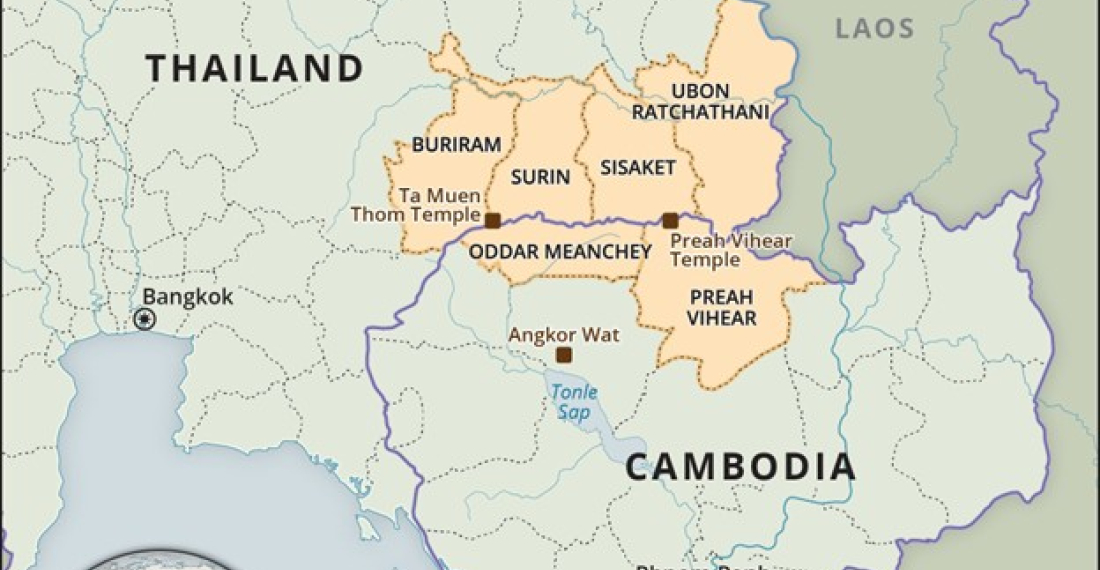
The conflict stems from territorial disputes along the neighbours ‘ 800-kilometre (500-mile) border, where ancient temples are claimed by both sides and colonial-era frontier demarcations have been resented by both countries for more than a century.

In the most recent outbreak of violence, five days of fighting in July killed dozens of people before a truce was brokered by the United States, China and Malaysia. That truce was broken earlier this month.

Each side blamed the other for instigating the fresh fighting and have traded accusations of deliberate attacks on civilians.

source: commonspace.eu with Al Jazeera (Doha), and agencies


Related articles

Editor's choice
News
EPC summit in Armenia was an expression of European support for Nikol Pashinyan

EPC summit in Armenia was an expression of European support for Nikol Pashinyan

Leaders from more than 45 European countries and beyond gathered today in Yerevan for the eighth summit of the European Political Community (EPC). The summit was the largest gathering of European leaders ever held in the South Caucasus. Apart from the set piece events in plenary session, many leaders also held private bilateral meetings. commonspace.eu special correspondent, Alex Verge, was at the summit, from where he filed this report: European Union Commission President Ursula von der Leyen, France President Emmanuel Macron, Italian Prime Minister Giorgia Meloni, UK Prime Minister Keir Starmer, and Ukrainian President Volodymyr Zelensky were amongst the myriad of European leaders that gathered on Monday for 8th summit of the European Political Community. Prime Minister of Canada Mark Carney was also present, making him the first non-European leader to take part in an EPC summit. The summit marked the first of two days of high-level diplomacy in Yerevan, with the city also hosting the first ever bilateral EU-Armenia summit tomorrow. Both summits are signals of support from Europe for the policies of Armenian Prime Minister Nikol Pashinyan, in power since 2018. In particular, the Pashinyan administration has looked to develop new foreign partnerships, reduce Armenia’s reliance on historic partner Russia, and pursue a difficult peace process with Azerbaijan. A polarising figure in Armenian politics, Pashinyan is seeking re-election in June this year in parliamentary elections. (click image to read the report in full).

Popular

Editor's choice
Interview
Thursday Interview: Murad Muradov

Thursday Interview: Murad Muradov

Today, commonspace.eu starts a new regular weekly series. THURSDAY INTERVIEW, conducted by Lauri Nikulainen, will host  persons who are thinkers, opinion shapers, and implementors in their countries and spheres. We start the series with an interview with Murad Muradov, a leading person in Azerbaijan's think tank community. He is also the first co-chair of the Action Committee for a new Armenian-Azerbaijani Dialogue. Last September he made history by being the first Azerbaijani civil society activist to visit Armenia after the 44 day war, and the start of the peace process. Speaking about this visit Murad Muradov said: "My experience was largely positive. My negative expectations luckily didn’t play out. The discussions were respectful, the panel format bringing together experts from Armenia, Azerbaijan, and Turkey was particularly valuable during the NATO Rose-Roth Seminar in Yerevan, and media coverage, while varied in tone, remained largely constructive. Some media outlets though attempted to represent me as more of a government mouthpiece than an independent expert, which was totally misleading.  Overall, I see these initiatives as important steps in rebuilding trust and normalising professional engagement. The fact that soon a larger Azerbaijani civil society visits to Armenia followed, reinforces the sense that this process is moving in the right direction." (click the image to read the interview in full)