


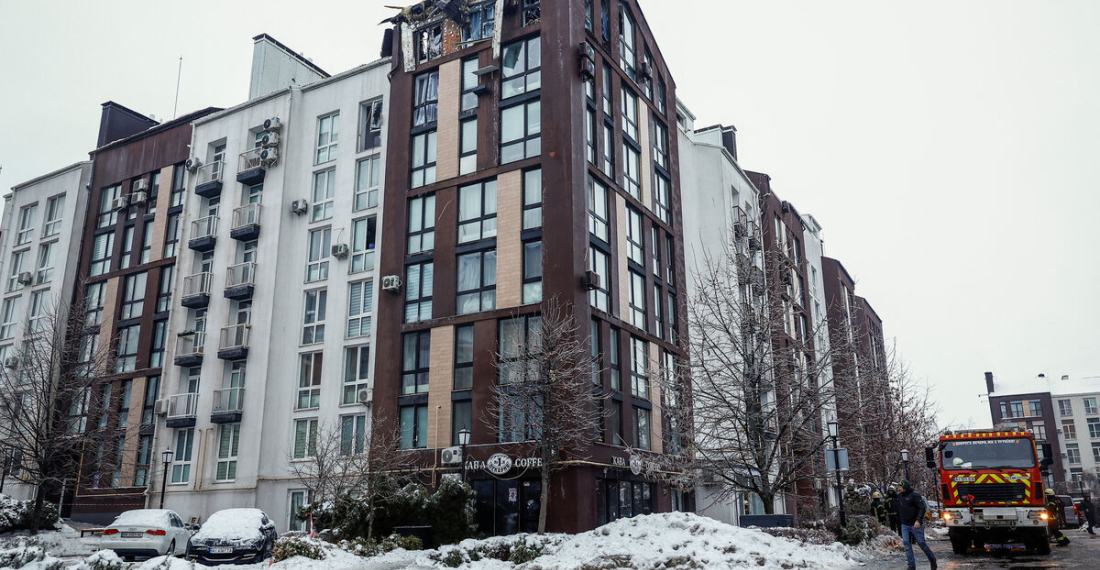
Russia agrees to temporary halt of Kyiv airstrikes amid winter cold

Russia has agreed to President Donald Trump’s request to halt airstrikes on Kyiv until February 1. Ukraine said it is ready to reciprocate, but President Volodymyr Zelenskyy stated that no formal truce exists.

Attacks on energy infrastructure left hundreds of thousands without heating in temperatures dropping below minus 15°C. Temperatures are forecast to plunge to minus 26°C from Sunday.

Kremlin spokesman Dmitry Peskov confirmed Putin accepted Trump’s request to create “favourable conditions” for further peace talks in Abu Dhabi this weekend. The Kremlin also invited President Zelenskyy to meet Putin in person in Moscow, which is a bid which he summarily turned down due to safety concerns. Ukraine may suspend attacks on Russian refinery sites, Zelenskyy said, calling it “an opportunity rather than an agreement.”

From President Zelenskyy’s X account, shortened, January 30: 

“I held a special coordination call on the situation in Ukraine’s regions and on recovery efforts. There were no strikes on energy facilities last night, but yesterday afternoon our energy infrastructure in several regions was hit. We are now observing a shift by the Russian army toward strikes on logistics.

Drone attacks on ordinary residential areas in cities are also continuing. Furthermore, a ballistic missile was used against the Kharkiv region – warehouses belonging to a civilian production facility were damaged, and this is an American company.

Additional forces are being deployed for Kyiv – as of this morning, 378 high-rise residential buildings were without heating.”

Source: commonspace.eu with Reuters, with additional information from President Zelenskyy’s X account. 

Related articles

Editor's choice
News
European Political Community Summit opens in Yerevan

European Political Community Summit opens in Yerevan

The 8th Summit of the European Political Community (EPC) opened on Monday morning (4 May) in the Armenian Capital Yerevan. It is held under the slogan "Building the future: unity and stability in Europe". At the start of the meeting the leaders took a "family photo". (See image) The European Political Community (EPC) brings together the Leaders of around 50 European partners on an equal footing, in a spirit of unity, and with a shared purpose. It provides a political platform to: 1. foster political dialogue and cooperation to address issues of common interest 2. strengthen the security, stability and prosperity of the European continent The EPC offers a space for European Leaders to engage, exchange and enhance cooperation. It does not replace any existing organisation, structure or process. The European Political Community has met seven times since 2022, and convenes for the 8th time in Yerevan on the 4th of May 2026. European leaders arrived in Yerevan from all across Europe on 3 May to participate in the summit, making this the largest gathering of European leaders in the South Caucasus ever. Among those is Yerevan is French President, Emanuel Macron, who on Sunday evening, accompanied by Armenian prime minister Nikol Pashinyan, went on a walk on the streets of Yerevan. Canadian prime minister, Mark Carney, is also in Yerevan. He is the first non-European leader to participate in an EPC summit. There was a lot of speculation regarding Azerbaijan's participation. It is now understood that president Ilham Aliyev will participate in the summit by video link. commonspace.eu special correspondent at the summit, Alex Verge, will file a report on the summit conclusions at the end of the meeting.
Editor's choice
News
(Updated) European leaders arrive in Armenia for Monday's summit of the European Political Community

(Updated) European leaders arrive in Armenia for Monday's summit of the European Political Community

Updated at 1700 CEST. European leaders are arriving in Armenia on Sunday, for the 8th summit of the European Political Community (EPC), which is expected to take place in Yerevan on Monday 4 April. This is the biggest gathering of European leaders in the South Caucasus ever. This afternoon, British Prime Minister, Sir Keir Starmer, and Polish prime minister Donald Tusk where amongst those arriving. Sir Keir was welcomed at Zvarnots International Airport by Vahagn Khachaturyan, the president of Armenia Also among those arriving will be French President, Emanuel Macron, European Commission president, Ursula von der Leyen and European Council president, Antonio Costa. Ukrainian president Volodmyr Zelenski is also expected to attend and he is already in the Armenian capital. Turkish Vice president, Turkish Vice President Cevdet Yilmaz will represent his country in the summit. Also present will be Canadian prime minister, Mark Carney. The European Political Community (EPC) is an intergovernmental forum for political and strategic discussions about the future of Europe established in 2022 after the Russian invasion of Ukraine The group first met in October 2022 in Prague. The 47 EPC participating states are home to 689.5 million people, constitute 8.7 percent of the world's population and represent about 23.5 percent of the global GDP.

Popular

Editor's choice
Interview
Thursday Interview: Murad Muradov

Thursday Interview: Murad Muradov

Today, commonspace.eu starts a new regular weekly series. THURSDAY INTERVIEW, conducted by Lauri Nikulainen, will host  persons who are thinkers, opinion shapers, and implementors in their countries and spheres. We start the series with an interview with Murad Muradov, a leading person in Azerbaijan's think tank community. He is also the first co-chair of the Action Committee for a new Armenian-Azerbaijani Dialogue. Last September he made history by being the first Azerbaijani civil society activist to visit Armenia after the 44 day war, and the start of the peace process. Speaking about this visit Murad Muradov said: "My experience was largely positive. My negative expectations luckily didn’t play out. The discussions were respectful, the panel format bringing together experts from Armenia, Azerbaijan, and Turkey was particularly valuable during the NATO Rose-Roth Seminar in Yerevan, and media coverage, while varied in tone, remained largely constructive. Some media outlets though attempted to represent me as more of a government mouthpiece than an independent expert, which was totally misleading.  Overall, I see these initiatives as important steps in rebuilding trust and normalising professional engagement. The fact that soon a larger Azerbaijani civil society visits to Armenia followed, reinforces the sense that this process is moving in the right direction." (click the image to read the interview in full)


