Ruling party in Georgia secures tense local election victories as EU expresses concern on democratic process

Candidates of the ruling Georgian Dream party have won local elections held on 4 October in all five self-governing cities namely Tbilisi, Rustavi, Kutaisi, Batumi, and Poti based on preliminary results released by the Central Election Commission. The results appear to consolidate the ruling party’s control over Georgia’s largest municipalities amid a backdrop of political tension and opposition boycotts of the local elections.

However, the European Union said in a statement on 5 October that months of raids on independent media, restrictive laws targeting civil society, the imprisonment of activists and opponents, and electoral code changes favouring the ruling party drastically reduced the possibility of holding competitive elections.

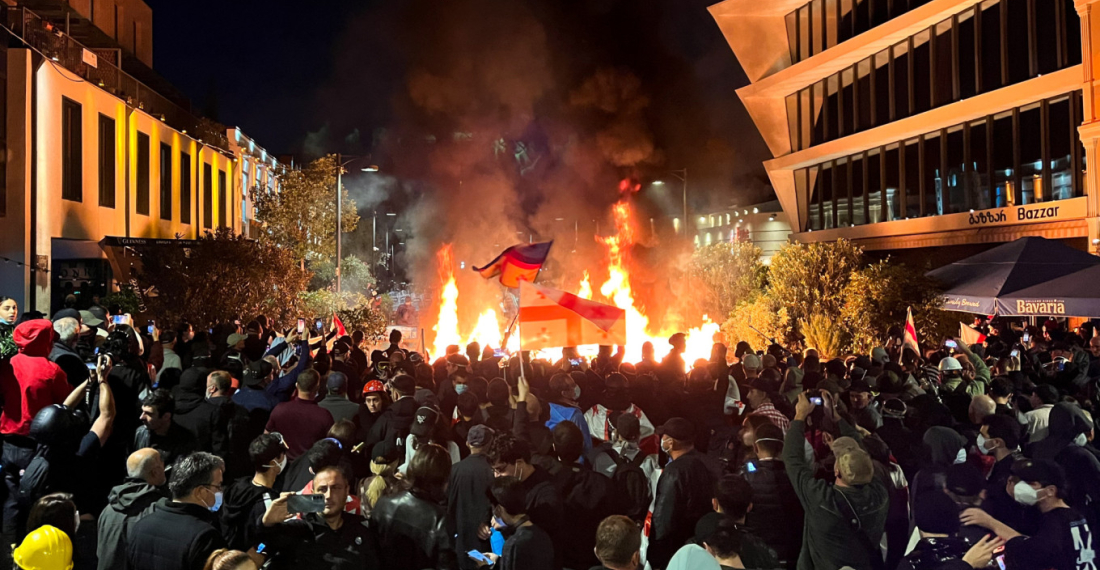
Georgian prosecutors on Monday 6 October charged five opposition leadership figures with attempting to overthrow the government, after protests on Saturday culminated in clashes between police and demonstrators in the country’s capital, Tbilisi. Police repelled and dispersed the crowd, later making a number of arrests vowing to identify and apprehend others. Georgian Dream officials described the events as an attempt at a foreign-orchestrated coup and pledged to respond decisively.

During a late-night interview with Rustavi 2 channel on October 6, Georgian Dream Prime Minister Irakli Kobakhidze said that police were arresting protesters “who stormed the presidential palace.” Deputy Interior Minister Aleksandre Darakhvelidze also said during a briefing that police had arrested two more individuals, identified as R.Sh. and S.P., on October 4 for the illegal purchase and possession of firearms and ammunition.

According to the BBC, those arrested included opera singer Paata Burchuladze, one of the protest organisers. Earlier, he read out a declaration urging the employees of the ministry of internal affairs to obey the will of the people and to immediately arrest six senior figures from the Georgian Dream party. The government said 21 police officers and six protesters were taken to hospital with injuries. Waving Georgian and EU flags, tens of thousands of protesters marched in central Tbilisi on Saturday.

Georgia has been in crisis since the ruling Georgian Dream party claimed victory in last year's election, which the pro-European Union opposition says was stolen.  Since then the government has paused talks on joining the EU.

According to the Central Election Commission, the incumbent mayor Kakha Kaladze of Tbilisi secured re-election with 71.58% of the vote (214,872 ballots). In Rustavi, Georgian Dream candidate Nino Latsabidze achieved a landslide victory, receiving 91.93% (30,962 votes). Kutaisi voters elected Davit Eremishvili, who gained 85.65% (37,635 votes). In Batumi, Giorgi Tsintsadze won the mayoral race with 80.62% (42,815 votes). In Poti, Georgian Dream candidate Beka Vacharadze was the sole contender and received 100% of the vote (14,431 ballots).

In their joint statement, High Representative/Vice President Kaja Kallas and Commissioner for Enlargement Marta Kos expressed concern over the political climate and treatment of opposition voices and said that a significant part of the opposition boycotted the vote, which also saw relatively low turnout.

The EU also criticised the Georgian government’s refusal to invite international monitors in time, particularly the OSCE/ODIHR, which undermined transparency and prevented credible international observation. Domestic organizations refrained from monitoring as well, citing a repressive environment. Kallas and Kos noted that large numbers of Georgians have continuously protested against the government’s repressive policies and reiterated the EU’s call for the release of all those arbitrarily detained.

The statement further urged calm and restraint in the post-election period, calling on the authorities to respect citizens’ rights to freedom of assembly and expression. It emphasised the need for constructive, inclusive dialogue involving all political actors and civil society, with all sides refraining from violence. Finally, the EU firmly rejected “disinformation regarding the EU’s role in Georgia” and condemned the personal attacks directed against the EU Ambassador to Georgia.

Source: commonspace.eu with the BBC, Georgia Today, Civil Georgia and agencies. Photo: Demonstrators in Tbilisi on 4 October 2025. Mikhail Yegikov/TASS
 

Related articles

Editor's choice
News
Borrell tells the European Parliament that the situation in Afghanistan was critical, but the EU will remain engaged

Borrell tells the European Parliament that the situation in Afghanistan was critical, but the EU will remain engaged

Borrell underlined that the European Union will make every effort to support the peace process and to remain a committed partner to the Afghan people. "Of course, we will have to take into account the evolving situation, but disengagement is not an option.  We are clear on that: there is no alternative to a negotiated political settlement, through inclusive peace talks.
Editor's choice
News
Mystery surrounds the crash of a Turkish airline in Georgia which resulted in the death of 20 Turkish Airforce personnel

Mystery surrounds the crash of a Turkish airline in Georgia which resulted in the death of 20 Turkish Airforce personnel

​ Twenty Turkish Airforce personnel died when a military plane crushed on the Georgian side of the Azerbaijan - Georgia border on Tuesday (11 November). The C130 took off from Ganja and was heading to Merzifon, transporting service members that had participated in Azerbaijan's Victory Day celebrations. Half an hour after takeoff, the aircraft lost altitude and broke apart in mid-air over a mountainous area on the Georgian border. Lockheed C130 Hercules have been in service with Turkey since the 1960s and are considered among the most reliable in their class. However, some of these aircraft are 50–60 years old. In October, the Turkish Ministry of Defense announced plans to replace them with new C130J Super Hercules models, with deliveries expected to begin in the coming years. All aircraft fragments have already been collected for technical examination. The cause of the crash has not yet been officially determined. A Turkish expert and retired military officer Coşkun Başbuğ noted on CNN Türk, a technical malfunction "should be ruled out" as the cause of the crash. "Various possibilities should be considered, but the first thing to consider is that the C-130 is a time-tested military transport aircraft, the last known incident involving which occurred in 1982." "A technical malfunction should be ruled out as the cause of the crash. The same applies to weather conditions, as the relevant authorities would have reported bad weather. The remaining theories include a mid-air collision, sabotage, or an attack," he emphasized. Former Turkish Armed Forces Logistics Commander and retired Army General Erdoğan Karakuş stated in an interview with Turkish television that although the C-130 aircraft are old, they have undergone a complete modernization in Turkey, and their technical condition is thoroughly inspected before each flight. The Turkish Air Force is expected to operate the C-130 aircraft until 2040. ​

Popular

Editor's choice
News
Mystery surrounds the crash of a Turkish airline in Georgia which resulted in the death of 20 Turkish Airforce personnel

Mystery surrounds the crash of a Turkish airline in Georgia which resulted in the death of 20 Turkish Airforce personnel

​ Twenty Turkish Airforce personnel died when a military plane crushed on the Georgian side of the Azerbaijan - Georgia border on Tuesday (11 November). The C130 took off from Ganja and was heading to Merzifon, transporting service members that had participated in Azerbaijan's Victory Day celebrations. Half an hour after takeoff, the aircraft lost altitude and broke apart in mid-air over a mountainous area on the Georgian border. Lockheed C130 Hercules have been in service with Turkey since the 1960s and are considered among the most reliable in their class. However, some of these aircraft are 50–60 years old. In October, the Turkish Ministry of Defense announced plans to replace them with new C130J Super Hercules models, with deliveries expected to begin in the coming years. All aircraft fragments have already been collected for technical examination. The cause of the crash has not yet been officially determined. A Turkish expert and retired military officer Coşkun Başbuğ noted on CNN Türk, a technical malfunction "should be ruled out" as the cause of the crash. "Various possibilities should be considered, but the first thing to consider is that the C-130 is a time-tested military transport aircraft, the last known incident involving which occurred in 1982." "A technical malfunction should be ruled out as the cause of the crash. The same applies to weather conditions, as the relevant authorities would have reported bad weather. The remaining theories include a mid-air collision, sabotage, or an attack," he emphasized. Former Turkish Armed Forces Logistics Commander and retired Army General Erdoğan Karakuş stated in an interview with Turkish television that although the C-130 aircraft are old, they have undergone a complete modernization in Turkey, and their technical condition is thoroughly inspected before each flight. The Turkish Air Force is expected to operate the C-130 aircraft until 2040. ​