


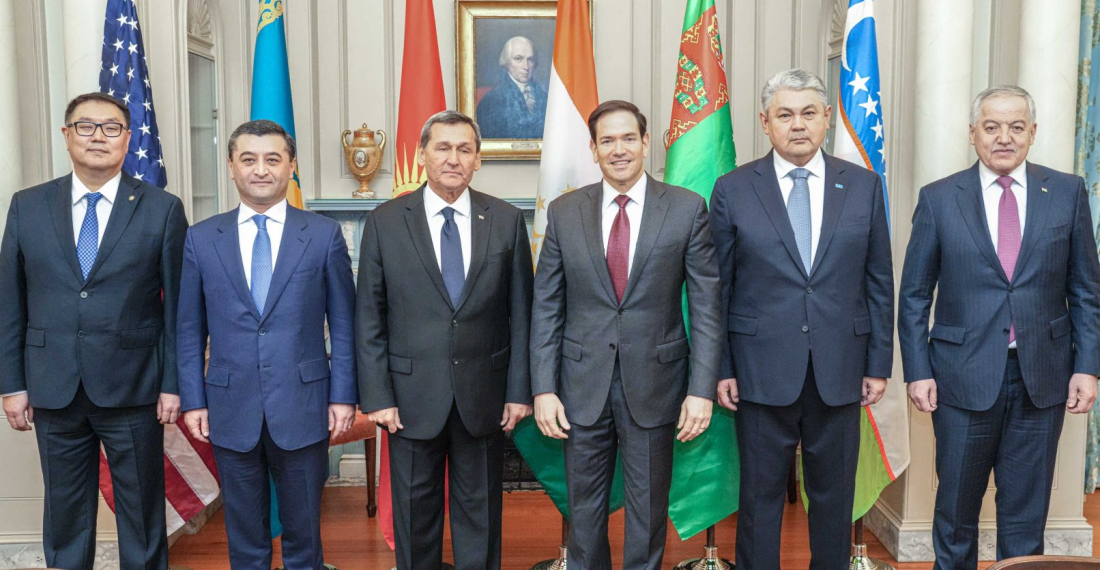
Rubio plans to visit all five Central Asian countries as Trump hosts their leaders in Washington

US Secretary of State Marco Rubio said on Wednesday 5th November that he planned to visit the five Central Asian countries in the coming year, as he met their foreign ministers as part of a Trump administration charm offensive aimed at the resource-rich region. The presidents of Kazakhstan, Kyrgyzstan, Tajikistan, Turkmenistan and Uzbekistan are set to meet US President Donald Trump in Washington on 6th November for talks that are likely to include discussions of rare earths minerals and other resources in the Central Asian nations.

According to Reuters, Mr Rubio told a reception at the State Department that US interests and those of the Central Asian states were aligned when it comes to working together to develop the countries' natural resources. "You are looking to take the resources ... that God has blessed your nations with, and turn them into responsible development that allow you to diversify your economies," Mr Rubio said.

“I personally intend to visit in the coming year," he added. "All five (countries)," he said, "so I know it would probably be a week-long trip. So we’ve got to work on that and make that happen together.”

Rich in minerals and energy, the five overwhelmingly Muslim countries of Central Asia remain closely tied economically to Russia, which ruled the region as part of the Soviet Union until 1991. Neighbouring China also enjoys significant commercial influence.

Deputy Secretary of State Christopher Landau, who spoke before Mr Rubio, said Mr Trump had invited the five leaders to Washington as part of a personal push by the president to engage more actively with the region.

Mr Landau and Mr Sergio Gor, the US ambassador to India and Mr Trump's special envoy to Central Asia, visited Kazakhstan and Uzbekistan last week to prepare agreements to be announced during the leaders' visit, Reuters reported. "The opportunities are amazing - business opportunities. Many ways to partner there," Mr Landau said.

Senator James Risch, a Republican, who also spoke at the reception, announced he would introduce a bill to Congress this week aimed at repealing the Jackson–Vanik trade rules introduced during the Cold War era that restrict US trade with non-market economies. 

The meeting in Washington between President Trump and the five Central Asian republics known as the C5 marks the tenth anniversary of the C5+1 format. Established in 2015, the C5+1 is the main platform through which the United States engages collectively with the five countries of Central Asia.
Source: commonspace.eu with Reuters and agencies. Photo: US Secretary of State Marco Rubio meeting Foreign Ministers of CA nations on Wednesday 5th November/Secretary Marco Rubio/X

Related articles

Editor's choice
News
Key European countries back Denmark in the face of Trump's continuing insistence on taking over Greenland

Key European countries back Denmark in the face of Trump's continuing insistence on taking over Greenland

 Six major European countries have declared their support to Denmark following renewed insistence by the US that it must have control over Greenland. "Greenland belongs to its people, and only Denmark and Greenland can decide on matters concerning their relations," said the leaders of the UK, France, Germany, Italy, Poland, and Spain, in a joint statement, issued on Tuesday (6 January), together with Denmark. On Sunday, Donald Trump said the US "needed" Greenland - a semi-autonomous region of fellow Nato member Denmark - for security reasons. He has refused to rule out the use of force to take control of the territory, and Danish Prime Minister Mette Frederiksen warned on Monday that an attack by the US would spell the end of Nato. The issue of Greenland's future resurfaced in the wake of the US military intervention in Venezuela, during which elite troops went in to seize the country's President Nicolás Maduro and take him to face drugs and weapons charges in New York. Following the raid, Trump said the US would "run" Venezuela for an unspecified period of time. He also said the US was returning to an 1823 policy of US supremacy in its sphere of influence in the Western hemisphere - and he warned a number of countries the US could turn its attention to them. The US military raid in Venezuela has reignited fears that the US may consider using force to secure control of Greenland. A day after the raid, Katie Miller - the wife of one of Trump's senior aides - posted on social media a map of Greenland in the colours of the American flag, alongside the word "SOON". On Monday, her husband Stephen Miller said it was "the formal position of the US government that Greenland should be part of the US". In an interview with CNN, he also said the US "is the power of Nato. For the US to secure the Arctic region, to protect and defend Nato and Nato interests, obviously Greenland should be part of the US." Asked repeatedly whether the US would rule out using force to annex it, Miller responded: "Nobody's going to fight the US over the future of Greenland." Stressing they were as keen as the US in Arctic security, the seven European signatories of Tuesday's joint statement said this must be achieved by Nato allies, including the US "collectively" - whilst "upholding the principles of the UN Charter, including sovereignty, territorial integrity and the inviolability of borders". Greenland's Prime Minister Jens-Frederik Nielsen welcomed the statement and called for "respectful dialogue". "The dialogue must take place with respect for the fact that Greenland's status is rooted in international law and the principle of territorial integrity," Nielsen said. Trump has claimed that making Greenland part of the US would serve American security interests due to its strategic location and its abundance of minerals critical to high-tech sectors. Greenland, which has a population of 57,000 people, has had extensive self-government since 1979, though defence and foreign policy remain in Danish hands. While most Greenlanders favour eventual independence from Denmark, opinion polls show overwhelming opposition to becoming part of the US.
Editor's choice
News
Donald Tusk: "One for all, and all for one! Otherwise we are finished."

Donald Tusk: "One for all, and all for one! Otherwise we are finished."

Europe is rattled by events in Venezuela, and there are serious concerns that US disregard for international law may have consequences close to home.  The BBC diplomatic correspondent, James Landale, said, the question is how Europe may respond in the longer term to America's military operation in Venezuela. Will it provide a catalyst for the continent to take greater responsibility for its own security in the face of so much instability from what many see as an unreliable ally? Polish prime minister, Donald Tusk, appears to have answered the question, saying on social media: "No-one will take seriously a weak and divided Europe: neither enemy nor ally. It is already clear now. "We must finally believe in our own strength, we must continue to arm ourselves, we must stay united like never before. One for all, and all for one. Otherwise, we are finished." The US seizing of Venezuela's leader has faced strong criticism from both America's friends and foes at an emergency meeting of the United Nations Security Council, held on Monday, 5 January. Many member states agreed with the US that Nicolás Maduro had been an illegitimate and repressive leader. But many also condemned the US military action as a breach of international law and the UN Charter, and they demanded a democratic transition that reflected the will of the Venezuelan people. (click the image to read the full article).

Popular

Editor's choice
News
Key European countries back Denmark in the face of Trump's continuing insistence on taking over Greenland

Key European countries back Denmark in the face of Trump's continuing insistence on taking over Greenland

 Six major European countries have declared their support to Denmark following renewed insistence by the US that it must have control over Greenland. "Greenland belongs to its people, and only Denmark and Greenland can decide on matters concerning their relations," said the leaders of the UK, France, Germany, Italy, Poland, and Spain, in a joint statement, issued on Tuesday (6 January), together with Denmark. On Sunday, Donald Trump said the US "needed" Greenland - a semi-autonomous region of fellow Nato member Denmark - for security reasons. He has refused to rule out the use of force to take control of the territory, and Danish Prime Minister Mette Frederiksen warned on Monday that an attack by the US would spell the end of Nato. The issue of Greenland's future resurfaced in the wake of the US military intervention in Venezuela, during which elite troops went in to seize the country's President Nicolás Maduro and take him to face drugs and weapons charges in New York. Following the raid, Trump said the US would "run" Venezuela for an unspecified period of time. He also said the US was returning to an 1823 policy of US supremacy in its sphere of influence in the Western hemisphere - and he warned a number of countries the US could turn its attention to them. The US military raid in Venezuela has reignited fears that the US may consider using force to secure control of Greenland. A day after the raid, Katie Miller - the wife of one of Trump's senior aides - posted on social media a map of Greenland in the colours of the American flag, alongside the word "SOON". On Monday, her husband Stephen Miller said it was "the formal position of the US government that Greenland should be part of the US". In an interview with CNN, he also said the US "is the power of Nato. For the US to secure the Arctic region, to protect and defend Nato and Nato interests, obviously Greenland should be part of the US." Asked repeatedly whether the US would rule out using force to annex it, Miller responded: "Nobody's going to fight the US over the future of Greenland." Stressing they were as keen as the US in Arctic security, the seven European signatories of Tuesday's joint statement said this must be achieved by Nato allies, including the US "collectively" - whilst "upholding the principles of the UN Charter, including sovereignty, territorial integrity and the inviolability of borders". Greenland's Prime Minister Jens-Frederik Nielsen welcomed the statement and called for "respectful dialogue". "The dialogue must take place with respect for the fact that Greenland's status is rooted in international law and the principle of territorial integrity," Nielsen said. Trump has claimed that making Greenland part of the US would serve American security interests due to its strategic location and its abundance of minerals critical to high-tech sectors. Greenland, which has a population of 57,000 people, has had extensive self-government since 1979, though defence and foreign policy remain in Danish hands. While most Greenlanders favour eventual independence from Denmark, opinion polls show overwhelming opposition to becoming part of the US.

